
Every warehouse manager believes their team follows the same process. The pick slip goes here, the scan happens there, the pallet moves to this location. It's all documented. It's all trained. Everyone knows what to do.
Then you actually watch the footage.
Body cameras and wearable cameras have been standard equipment in logistics and distribution for years — mostly for safety compliance and liability. But a growing number of supply chain operations teams are pointing them at something different: the work itself. Not to surveil workers, but to finally answer a question that paper-based SOPs never could. What is actually happening on the floor, right now, at scale?
The gap between documented and real
There's a version of your process that lives in a binder or a SharePoint folder. It was written two years ago by someone who observed the process once, or maybe just asked a supervisor how it worked. It has numbered steps and a revision date and an approver signature.
Then there's the version your workers actually run.
These two versions are almost never identical. Over time, workers develop shortcuts. They adapt to equipment quirks. They compensate for upstream errors in ways that never make it into documentation. A skilled operator who's been picking product for six years has optimized their own personal workflow in dozens of small ways — none of which are captured anywhere.
This isn't negligence. It's how human expertise works. The problem is that when that person leaves, or when you need to scale a process across 50 new hires, or when a regulator asks you to prove consistency — the gap between the documented process and the real process becomes expensive.
What body cam footage actually captures
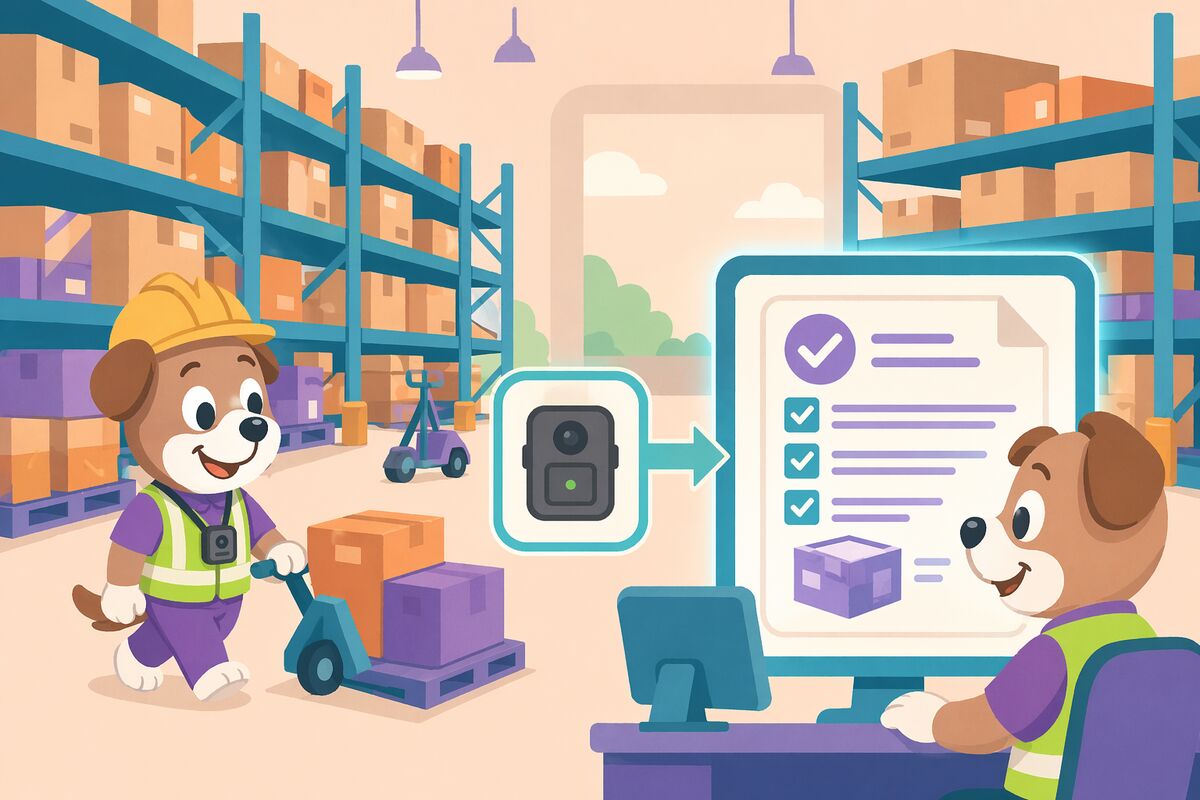
A wearable camera attached to a worker's chest or hard hat captures the process as it is lived, not as it was imagined. It records the sequence of physical actions, the decisions made at each step, the tools used, the paperwork touched, the scan performed, the exception handled.
Modern AI video analysis doesn't require narration. It reads frames, detects motion and object interaction, follows visual sequences, and constructs a step-by-step account of what happened. A 20-minute picking run becomes a structured document. A 45-minute receiving sequence becomes a numbered SOP with decision points flagged.
The real power comes when you do this for more than one worker.
Running ten videos at once
One video gives you one version of the process. Ten videos give you the truth.
When you process body cam footage from ten different workers performing the same task and run a structured comparison across all of them, patterns emerge immediately. Worker A skips a verification step that Worker B performs every time. Workers C, D, and E all handle a specific exception the same way — a way that isn't documented anywhere. Worker F takes a detour that adds four minutes to every cycle, and no one has noticed because it's buried in the middle of a shift.
This is not anecdotal. It's systematic. And it's only possible when you can compare structured documentation across multiple instances of the same process simultaneously.
From variation to standardization
Once you can see where your processes diverge, you can make real decisions. Which variation is actually better? Which shortcut introduces risk? Which undocumented workaround should become the official procedure?
AI can help answer these questions too. By analyzing the full set of documented variations and asking the system to recommend a unified best-practice process, operations teams get a starting point for standardization that reflects how work actually happens — not how someone assumed it did three years ago.
The output is a living, accurate SOP. One that was derived from real footage of real workers doing real work — and that can be updated the same way the next time the process changes.
Docsie turns body cam and wearable camera footage into structured, comparable SOPs — with on-premise deployment for regulated supply chain operations. Book a demo.