

Confluence vs Guru: Which Enterprise Knowledge Platform Fits Your Team in 2026?
Choosing between Confluence and Guru feels like comparing apples and oranges—both are fruit, but they serve completely different purposes on your documentation table. One is the heavyweight enterprise wiki champion deeply embedded in development workflows, while the other specializes in keeping knowledge accurate through verification workflows and surfacing it exactly when teams need it.
If you're evaluating these platforms, you're likely facing one of two scenarios: either you're already invested in the Atlassian ecosystem and wondering if Confluence is the obvious choice, or your sales and support teams are drowning in outdated knowledge and someone mentioned Guru's verification workflows. Let's cut through the marketing noise and examine what each platform actually delivers in 2026.
What Is Confluence?
Confluence is Atlassian's enterprise wiki and team workspace platform—the documentation backbone for organizations using Jira, Bitbucket, and other Atlassian products. Think of it as the default choice for engineering and product teams who need to document architecture decisions, maintain runbooks, and connect documentation directly to development tickets.
With Rovo AI now included across all paid plans (not as an add-on), Confluence has evolved beyond static wiki pages into an AI-assisted knowledge platform featuring 20+ pre-built agents and 80+ app connectors. The platform scales to 150,000 users and offers a free tier supporting up to 10 users—making it accessible for small teams while providing enterprise-grade infrastructure for massive organizations. The deep Jira integration remains Confluence's killer feature: link documentation directly to epics, stories, and bugs, creating a unified view of what you're building and why.

What Is Guru?
Guru takes a fundamentally different approach to enterprise knowledge management. Instead of building comprehensive wiki pages, Guru focuses on card-based knowledge verification—bite-sized, expert-verified answers delivered contextually through browser extensions, Slack integrations, and direct app embeddings.
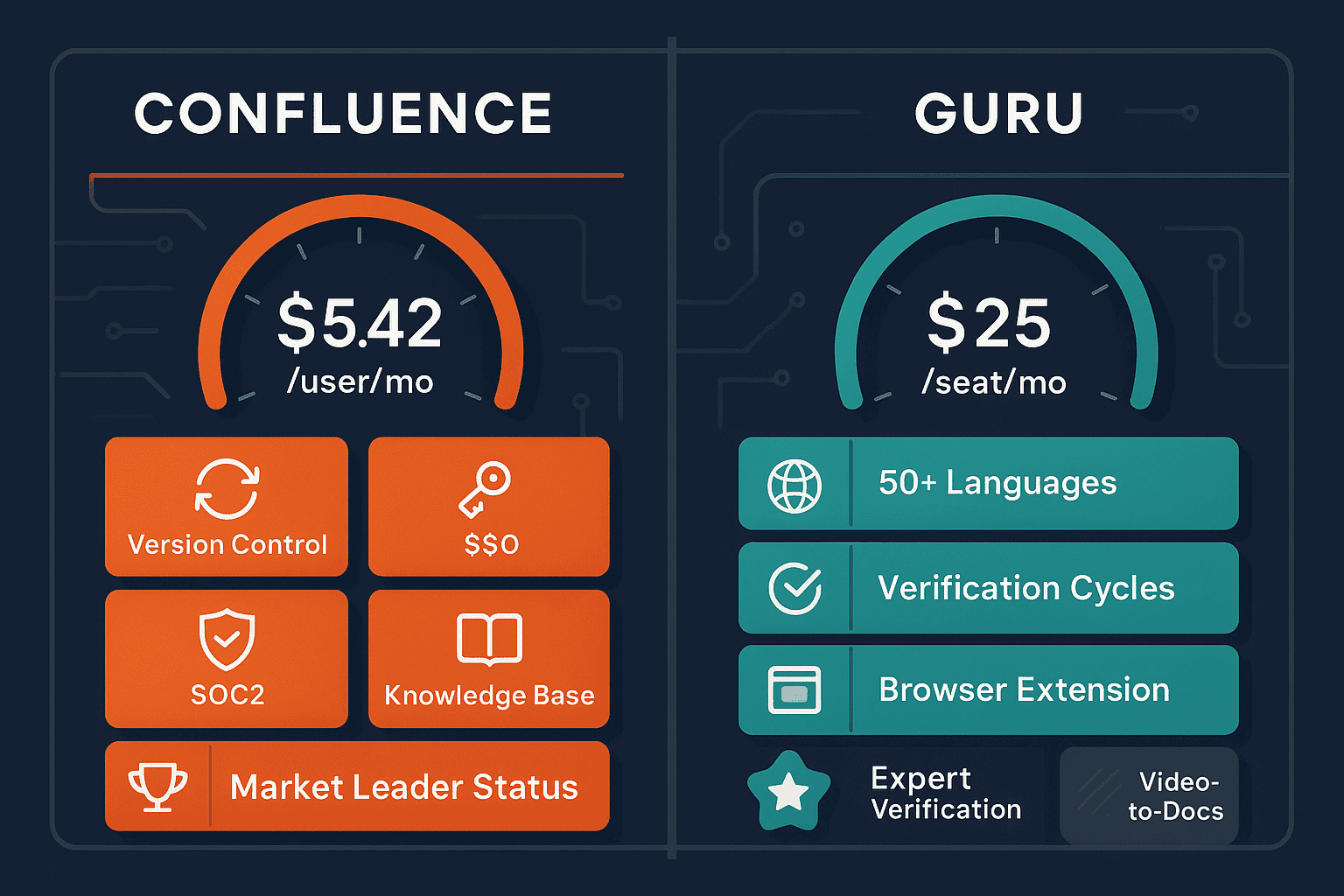
Launched in 2015 and significantly enhanced with Knowledge Agents (Chat, Research, and MCP Server) in 2025, Guru addresses a specific pain point: knowledge decay. Subject-matter experts verify cards on scheduled cycles, ensuring information stays current rather than becoming documentation debt. The browser extension surfaces relevant knowledge while you work in Salesforce, Zendesk, or any web application, eliminating the need to context-switch to a separate documentation portal. However, Guru's per-seat pricing model with a 10-seat minimum creates a $250/month floor—a significant consideration for smaller teams.
Feature Comparison: Where They Differ
Integration Philosophy: Ecosystem Lock-In vs. Contextual Delivery
Confluence's value proposition accelerates dramatically the deeper you go into the Atlassian ecosystem. The Jira integration isn't just API-level connectivity—it's bidirectional linking, smart fields, and automatic relationship mapping between documentation and development work. Rovo AI's 80+ connectors span Atlassian products first, with third-party integrations secondary.
Guru optimizes for knowledge surfacing rather than creation. The browser extension and Slack integration deliver verified answers directly in your workflow—no need to open another tab or search through wiki hierarchies. While Confluence requires users to visit the platform, Guru brings knowledge to wherever work happens. This contextual delivery makes Guru particularly powerful for sales teams needing competitive intelligence mid-call or support agents requiring accurate troubleshooting steps without leaving their ticketing system.
The trade-off? Confluence centralizes knowledge in one comprehensive location with robust page hierarchies and unlimited version history. Guru decentralizes delivery but sacrifices the deep structural organization of traditional wikis.
AI Capabilities: Pre-Built Agents vs. Knowledge Verification
Both platforms embraced AI in 2025, but with different priorities.
Confluence's Rovo AI includes 20+ pre-built agents handling common documentation tasks: generating meeting summaries, creating page templates, answering questions across your knowledge base, and connecting insights across Atlassian products. The "virtual teammate" framing positions Rovo as an assistant that automates repetitive documentation work. Importantly, Rovo AI comes bundled with all paid plans—no separate add-on costs.
Guru's Knowledge Agents (Chat, Research, and MCP Server) focus on intelligent retrieval and contextual Q&A rather than content generation. The MCP (Model Context Protocol) Server support connects Guru to broader AI agent ecosystems, enabling advanced automation workflows. Guru also offers 50+ language translation, making verified knowledge accessible globally.
Neither platform offers video-to-docs conversion—a growing need as organizations recognize their training video libraries as untapped documentation goldmines.
Pricing Structure: Free Tier vs. Minimum Commitment
Confluence offers a free tier supporting up to 10 users with 2GB storage—generous enough for small teams to build substantial internal documentation before hitting paid plans. The Standard plan ($6.05/user/month) and Premium plan ($11.55/user/month) scale linearly with team size, though pricing becomes negotiable at enterprise scale.
Guru requires a 10-seat minimum commitment even for small teams, creating a $250/month entry point ($25/user/month × 10 seats). This pricing structure makes Guru prohibitively expensive for startups or small departments testing knowledge management platforms. Once you exceed the minimum, per-seat costs accumulate quickly as teams grow.
Neither platform offers workspace-based pricing—an important consideration for agencies, consultancies, or MSPs serving multiple clients who want predictable costs independent of seat count.
External Documentation Delivery: The Missing Piece
Here's where both platforms share a critical limitation: neither supports external documentation delivery through branded, multi-tenant client portals.
Confluence and Guru are architected exclusively for internal knowledge management. You cannot create separate branded documentation portals with custom domains for external clients, partners, or customers. While Confluence offers "external user" access, it's fundamentally different from true multi-tenant architecture where each client receives an isolated, branded experience from the same underlying knowledge base.
For organizations needing to deliver documentation externally—SaaS companies building help centers, consultancies providing client documentation, or implementation partners maintaining customer knowledge bases—both platforms require workarounds or supplementary tools.
Who Should Choose What?
Choose Confluence if you need...
Deep Jira integration for engineering teams. If your development workflows live in Jira, Confluence becomes the natural documentation layer. Link requirements docs to epics, attach technical specifications to stories, and maintain architectural decision records connected to implementation tickets.
Enterprise wiki scaling. Supporting 150,000 users with comprehensive page hierarchies, unlimited version history, and 99.9% uptime SLA makes Confluence suitable for the largest organizations. The free tier also makes it accessible for small teams just starting internal documentation.
Rovo AI without add-on costs. All paid plans include Rovo AI's 20+ pre-built agents and 80+ app connectors—no separate subscription required. For Atlassian-heavy teams, this bundled AI capability provides immediate value.
Choose Guru if you need...
Expert verification workflows. If knowledge accuracy matters more than comprehensive coverage, Guru's subject-matter expert review cycles ensure information stays current. The card-based structure encourages focused, verified answers rather than sprawling wiki pages that become documentation debt.
Contextual knowledge delivery. The browser extension and Slack integration surface verified answers directly in your workflow—critical for sales teams needing competitive intelligence or support teams requiring troubleshooting steps without leaving their ticketing system.
MCP Server support. Organizations building advanced AI agent ecosystems benefit from Guru's Model Context Protocol server, enabling integration with broader automation workflows beyond native platform capabilities.
The Better Alternative: Why Docsie Outperforms Both
For detailed feature-by-feature comparison, see our complete Confluence vs Guru comparison.
The fundamental issue? Both Confluence and Guru are designed exclusively for internal knowledge management. Neither addresses three critical needs modern organizations face:
Converting existing content into documentation. Your organization already has hours of training videos, product demos, recorded webinars, PDFs, and legacy websites representing valuable knowledge. Both Confluence and Guru require manual transcription and documentation creation. Docsie's multimodal AI converts videos, PDFs, and websites directly into structured documentation—unlocking knowledge trapped in non-searchable formats.
Multi-tenant external delivery. Consultancies, agencies, MSPs, and implementation partners serving multiple clients need branded documentation portals with custom domains for each client—delivered from a single knowledge base. Neither Confluence nor Guru supports this architecture. Docsie's multi-tenant portals enable one team to manage documentation while delivering isolated, branded experiences to dozens or hundreds of external clients.
Complete knowledge orchestration workflow. Docsie addresses the full CONVERT → MANAGE → DELIVER cycle. Convert video training into docs, collaborate with internal teams on revisions, then deliver through branded client portals with agentic AI chatbots providing accurate answers (using tool calls, not RAG). Both Confluence and Guru stop at internal management—they lack the external delivery infrastructure required for customer-facing documentation.
Additional advantages include 100+ language auto-translation for global documentation delivery, workspace-based pricing (not per-seat models that inflate costs as teams grow), and SOC 2 Type II, GDPR, HIPAA-ready compliance with audit logs and EU data residency.
Make the Right Choice for Your Documentation Needs
Confluence excels as an enterprise wiki for Atlassian-invested engineering teams. Guru differentiates with verification workflows and contextual delivery for sales and support organizations. Both are strong platforms for internal knowledge management within their respective niches.
But if you need to convert existing video content into searchable documentation, deliver branded knowledge portals to external clients, or support the complete knowledge lifecycle from creation through external delivery, neither platform addresses these fundamental requirements.
Docsie bridges these gaps with video-to-docs AI, multi-tenant architecture, and comprehensive knowledge orchestration—making it the superior choice for organizations serving external audiences while maintaining internal collaboration capabilities.
Ready to see the difference? Start your free Docsie trial and convert your first training video into structured documentation in minutes. No credit card required.