
Clueso vs Tango: Which Documentation Tool Is Actually Enterprise-Ready in 2026?
Choosing documentation software feels straightforward until you start asking enterprise questions. Can it serve multiple clients from one system? Does it convert your 2,000 hours of existing training videos? Will it pass your security audit? Suddenly, tools that looked impressive in demos reveal significant gaps.
Clueso and Tango represent two popular approaches to modern documentation—AI-edited video production versus browser workflow capture. Both have vocal advocates and legitimate strengths. But when enterprise teams dig into compliance certifications, multi-tenant architecture, version control depth, and content migration capabilities, the picture becomes more complex.
This comparison examines what Clueso and Tango actually deliver for enterprise knowledge management in 2026, where they fall short, and what a truly enterprise-ready alternative looks like.
What Is Clueso?
Clueso transforms screen recordings into polished product videos using AI. Record your software walkthrough, and Clueso's AI automatically adds professional touches: cursor smoothing, auto-zoom on key actions, pan effects, and AI-generated voiceovers. The output looks like it came from a video production team, not a hastily recorded screen capture.
Beyond video, Clueso generates step-by-step written articles from the same recording—dual output from a single capture session. The platform targets SaaS companies building customer education libraries, particularly those needing branded, professional-looking tutorials without hiring videographers. Clueso has invested heavily in compliance, achieving SOC 2 Type II and ISO 27001 certifications—uncommon for tools in this space.
The trade-off: Clueso only processes screen recordings. You cannot upload existing training videos, webinar recordings, or real-world footage. It's a creation tool, not a conversion or management platform.
What Is Tango?
Tango started as a Chrome extension for capturing browser workflows as screenshot-based guides. Click through a process in your web app, and Tango automatically generates a visual step-by-step guide with annotated screenshots. The capture experience is genuinely frictionless—install the extension, hit record, and go.
Tango has expanded into in-app guided walkthroughs called "Nuggets" that overlay instructions directly on web applications, useful for onboarding users within your software. The platform offers SAML SSO and SCIM provisioning, addressing enterprise identity management requirements.
Notably, Tango has pivoted heavily toward CRM automation and sales workflow tooling (Salesforce, HubSpot integrations). Documentation increasingly feels like a secondary product line. The platform processes zero video—everything is screenshot-based. If your knowledge exists as recorded webinars, training sessions, or demonstration videos, Tango cannot help you convert or manage that content.
Enterprise Readiness: Four Critical Dimensions
1. Security and Compliance Posture
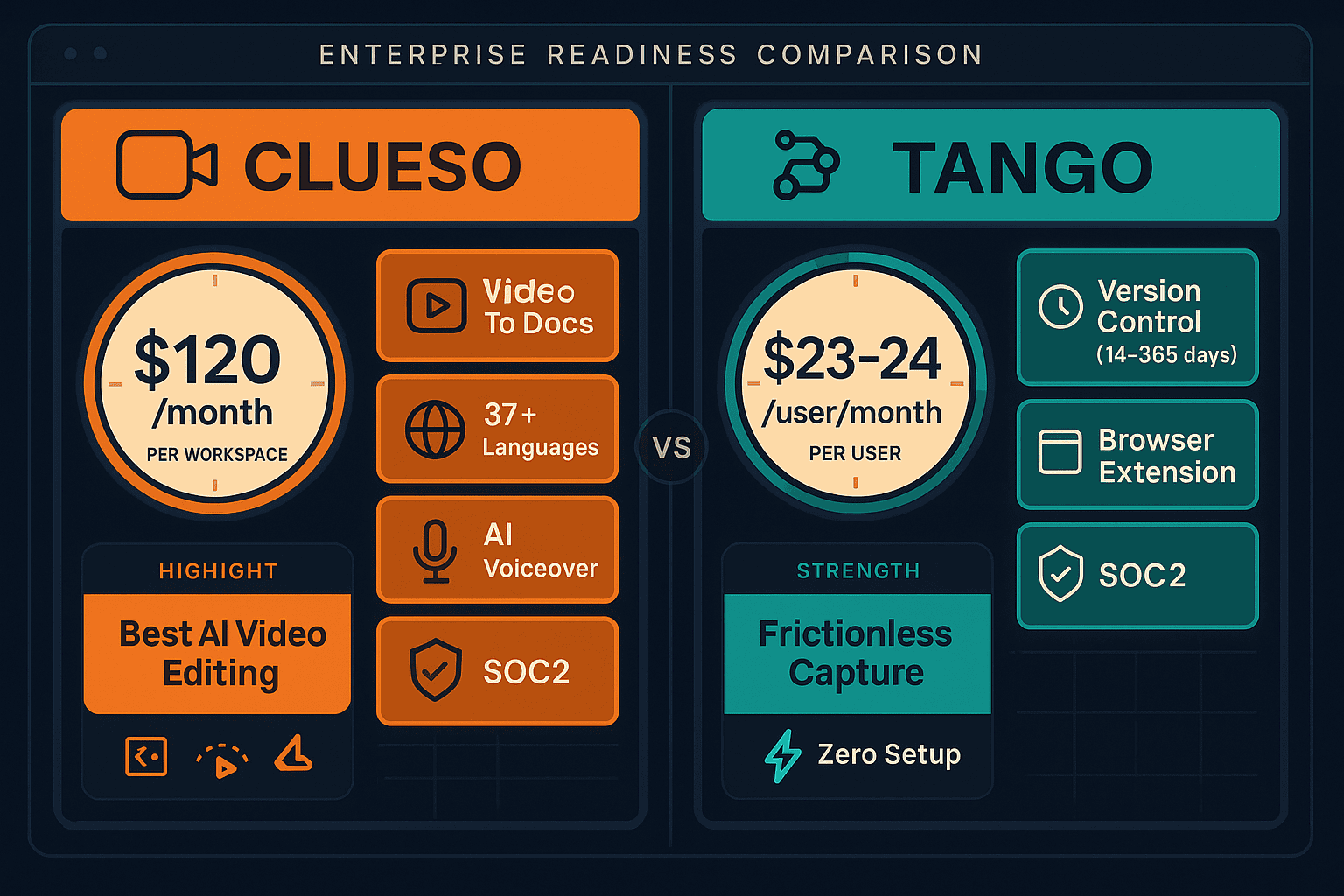
Clueso takes the lead here. SOC 2 Type II and ISO 27001 certifications demonstrate significant investment in information security controls, audit processes, and risk management. For regulated industries—healthcare, financial services, government contractors—these certifications often appear as hard requirements in procurement checklists.
Tango offers SAML SSO and SCIM provisioning for enterprise identity management, allowing centralized user access control through platforms like Okta or Azure AD. However, documentation on broader compliance certifications is limited. The platform publishes security practices but lacks the formal audit attestations enterprise security teams increasingly demand.
The gap both tools share: Neither provides EU data residency options, HIPAA-ready configurations, or comprehensive audit logging for content changes. Enterprise compliance often requires proving who changed what content when—granular audit trails that go beyond user authentication.
2. Multi-Tenant Architecture and Client Delivery
This is where both tools reveal a fundamental architectural limitation.
Neither Clueso nor Tango offers true multi-tenant customer portals. You cannot create separate branded knowledge bases for different clients, each with custom domains, independent SSO configurations, and isolated content management. Both platforms operate as single-tenant systems—you maintain one documentation environment, not dozens.
For consultancies, agencies, or software companies serving multiple enterprise clients, this is disqualifying. You need to provision distinct portals for Client A and Client B, each believing they're accessing a dedicated system, while you manage content centrally and reuse documentation across clients where appropriate.
Clueso and Tango lack: - Custom domain mapping per client portal - Client-specific SSO configurations - Isolated content libraries with selective sharing - White-label portal infrastructure at scale
This isn't a feature gap—it's an architectural reality. Building multi-tenant systems requires fundamentally different platform design from the ground up.
3. Version Control and Content Lifecycle Management
Clueso provides no version control. Edit a video or article, and the previous version disappears. No rollback capability, no change history, no ability to compare versions or maintain staging/production environments. For enterprise documentation, this creates risk: incorrect edits become permanent, and regulatory documentation loses its audit trail.
Tango offers basic version history—you can restore previous versions of guides—but lacks comprehensive content lifecycle features. No approval workflows, no content reuse across multiple documents, no branching for maintaining multiple product versions simultaneously.
What's missing from both: - Git-style version control with branching and merging - Content blocks reusable across documents (update once, reflect everywhere) - Approval workflows with role-based review stages - Parallel documentation for multiple product versions - Scheduled publishing and content expiration
Enterprise documentation teams manage complex release cycles. Documentation for v2.1 needs to exist alongside v2.0 content while v2.2 documentation develops in draft. Neither Clueso nor Tango supports this reality.
4. Existing Content Migration and Video Conversion
Clueso cannot process existing videos. If you have 500 hours of training webinars, product demonstrations, or conference presentations, Clueso cannot convert them into structured documentation. The platform only processes new screen recordings created within its capture tool.
Tango has zero video capability. It captures screenshots, period. Your video library might as well not exist—Tango cannot ingest, process, or extract knowledge from video content in any form.
This represents the most significant enterprise limitation. Mature organizations don't start with blank slates. They have accumulated years of institutional knowledge in recorded training sessions, customer webinars, internal presentations, and product demonstrations. Enterprise-ready platforms must handle this migration reality, converting unstructured video into searchable, structured documentation.
Both tools assume you're starting fresh, creating new documentation from scratch. For enterprises with existing knowledge repositories, this assumption fails immediately.
Who Should Choose What?
Choose Clueso if you: - Need polished, professional video tutorials for customer-facing education - Operate in regulated industries requiring SOC 2 or ISO 27001 certification - Want dual output (video + written guide) from screen recordings - Primarily create new documentation rather than converting existing content - Don't require SSO, multi-tenant portals, or serving multiple client organizations
Choose Tango if you: - Document browser-based software workflows extensively - Need SAML SSO and SCIM provisioning for enterprise identity management - Want in-app guided walkthroughs embedded in your web application - Create primarily internal SOPs and training for browser-based tools - Work exclusively with screenshot-based guides (no video requirements)
Choose neither if you: - Serve multiple clients requiring isolated branded portals - Need to convert existing video libraries into structured knowledge - Require comprehensive version control with branching and approval workflows - Want API access for integrating documentation into other enterprise systems - Need HIPAA-ready configurations, EU data residency, or advanced compliance features
The Docsie Alternative: Enterprise Knowledge Management Beyond Creation Tools
Clueso and Tango comparison reveals a pattern: both are creation tools, not management platforms. They help you make new documentation but don't address the full enterprise knowledge lifecycle: CONVERT → MANAGE → DELIVER.
Docsie was architected specifically for enterprise knowledge orchestration:
Multi-tenant at the core: Create unlimited branded customer portals from centralized content. Each client gets custom domains, independent SSO configurations (SAML, OAuth, OIDC, Azure AD, Okta), and role-based access—while you manage and reuse content across clients from one system.
Video conversion at scale: Upload existing training video libraries (200-3,000 hours) and Docsie's multimodal AI extracts structured documentation, searchable transcripts, and key concepts. Your institutional knowledge trapped in video becomes accessible, searchable content.
Comprehensive compliance: SOC 2 Type II, GDPR compliance, HIPAA-ready configurations, EU data residency options, granular audit logs, and 99.9% uptime SLA. Enterprise security teams get the attestations and controls they require.
Full version control and content lifecycle: Git-style versioning, content block reuse, approval workflows, scheduled publishing, and parallel documentation for multiple product versions. Manage complex release cycles without breaking existing documentation.
Enterprise administration: API access for integrations, advanced analytics, granular role-based permissions, team collaboration features, and 100+ language auto-translation for global operations.
Docsie doesn't just create documentation—it manages your entire enterprise knowledge infrastructure at scale, with the security, compliance, and multi-tenant architecture both Clueso and Tango fundamentally lack.
Make Your Documentation Infrastructure Enterprise-Ready
If you're evaluating Clueso or Tango, you've likely already recognized that basic documentation tools won't scale with enterprise requirements. The question isn't whether you need professional documentation—it's whether your platform can handle multi-client delivery, existing content migration, comprehensive compliance, and sophisticated version control.
Docsie addresses the gaps both platforms leave open: true multi-tenant architecture, video conversion capabilities, enterprise-grade security, and complete content lifecycle management from creation through delivery.
Start your Docsie trial today and see how enterprise knowledge management should work—with the scalability, security, and sophistication your organization actually needs.