
Clueso vs ReadMe: Enterprise Readiness Comparison 2026
Choosing enterprise documentation tools feels like shopping for a Swiss Army knife when what you really need is a full workshop. You'll find platforms that excel at video creation but can't handle API docs. Others dominate developer portals but treat video content like it doesn't exist. And almost none deliver multi-tenant client portals with the security, version control, and AI capabilities that modern enterprises actually need.
This comparison examines Clueso and ReadMe—two specialized platforms serving fundamentally different documentation needs—and reveals why enterprises managing diverse content types and multiple client deployments need a more comprehensive solution.
What is Clueso?
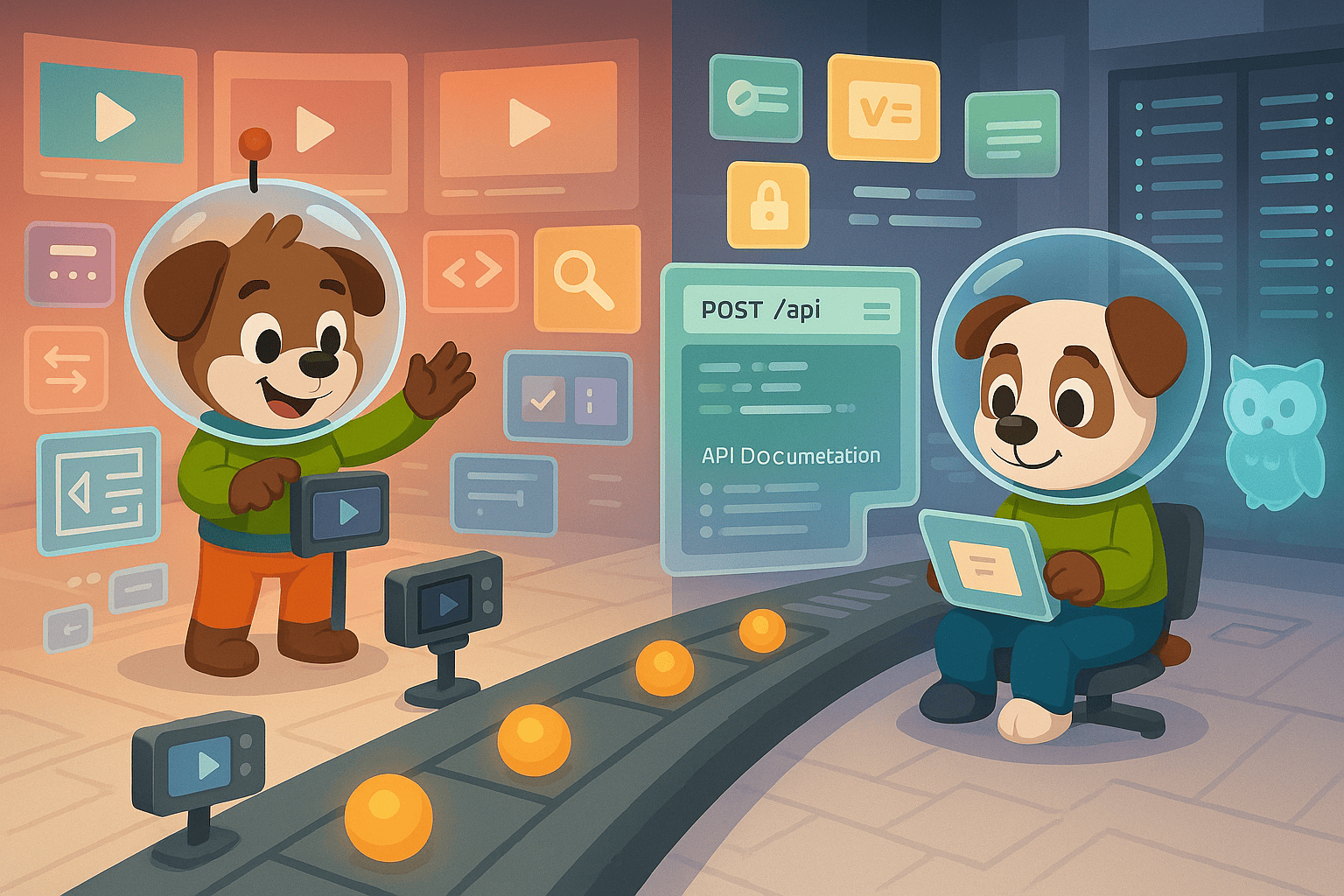
Clueso transforms screen recordings into professionally edited product videos with AI-powered auto-zoom, cursor smoothing, and branded styling. The platform targets SaaS companies creating customer education content, delivering dual outputs: a polished tutorial video plus a step-by-step text article from a single recording.
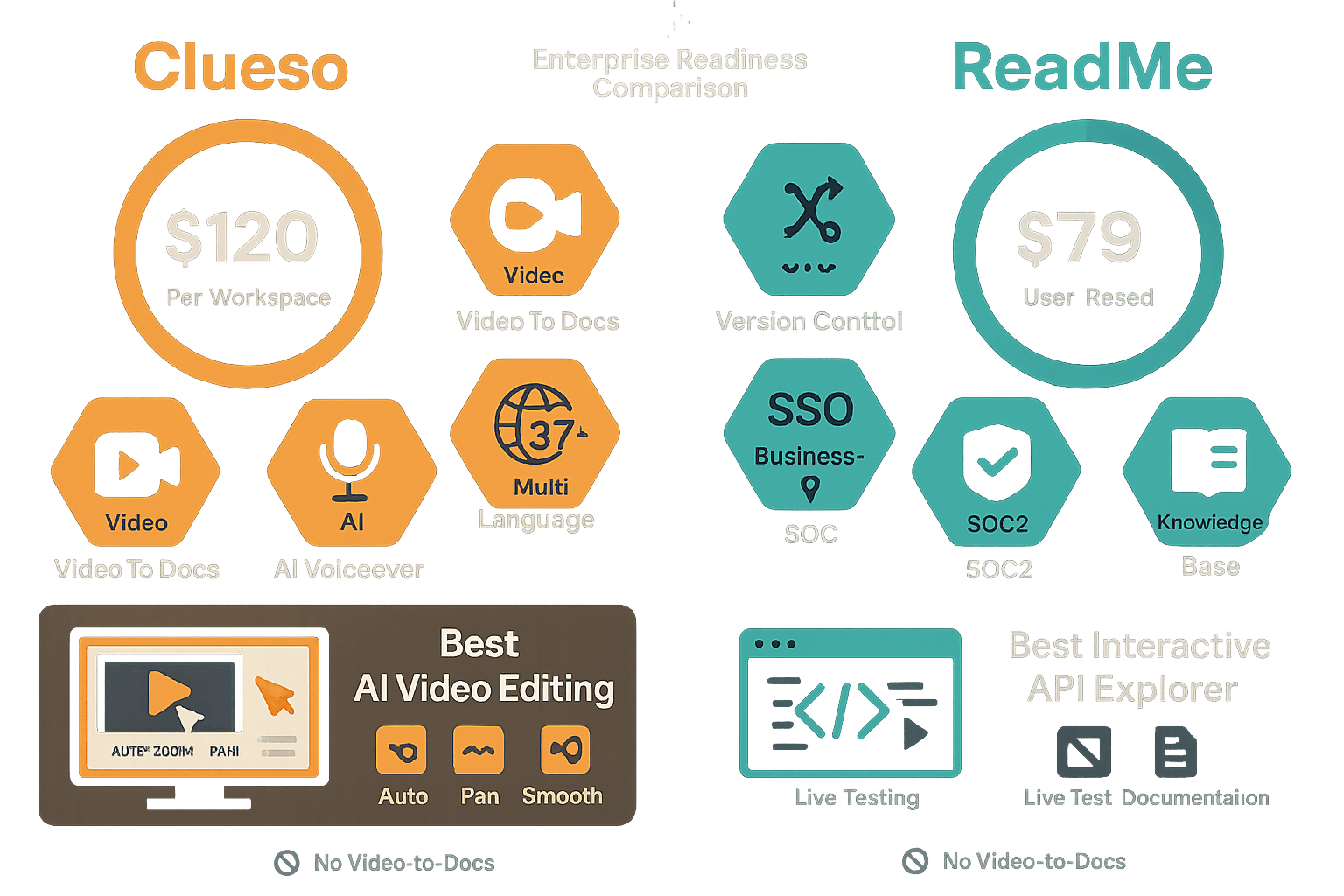
With SOC 2 Type II and ISO 27001 certifications, Clueso addresses compliance requirements that matter to security-conscious organizations. The platform supports 37 languages for multilingual tutorial creation and offers professional editing features that would typically require video production expertise. However, its screen recording focus means it cannot process real-world footage, existing training videos, or arbitrary video content—a significant limitation for enterprises with established video libraries.
What is ReadMe?
ReadMe dominates the interactive API documentation space, providing developer-focused portals with live API testing capabilities directly within documentation pages. The platform's Agent Owlbert AI suite, launched in October 2025, includes documentation linting, style consistency enforcement, and Ask AI search functionality for developer Q&A.
ReadMe excels at managing multiple API versions with branching capabilities and version-specific developer portals. GitHub integration, changelog management, and technical documentation workflows make it the go-to choice for companies building public or partner-facing developer experiences. However, at $3,000+ per month for Enterprise tier access, ReadMe represents a substantial investment—and it offers zero capabilities for video content processing or multi-tenant client portal delivery.
Enterprise Readiness: Key Comparison Dimensions
Security & Compliance Posture
Clueso brings dual compliance certifications (SOC 2 Type II and ISO 27001) that demonstrate serious commitment to enterprise security standards. For organizations in regulated industries or those requiring formal security attestations from vendors, Clueso meets baseline compliance expectations.
ReadMe's security posture isn't publicly detailed at the same level, though their Enterprise tier includes security features appropriate for developer documentation. Neither platform offers HIPAA-ready compliance options or the comprehensive audit logging that healthcare, financial services, and government sectors require.
The gap: Both platforms lack the granular security controls enterprises need for client-facing deployments—no per-client SSO configuration, no custom compliance frameworks, and limited audit trail capabilities for tracking who accessed what content when.
Content Creation & Management Capabilities
Clueso's strength lies in creating new video content from screen recordings. The AI editing quality—automatic zoom, pan, and cursor smoothing—produces professional results without manual editing expertise. The dual output (video plus text article) adds value for teams creating structured tutorial content.
But here's the constraint: Clueso only works with screen recordings you create within their platform. Got 500 hours of training videos already recorded? An existing Loom library? Customer success recordings from Zoom calls? Clueso can't process them. You're starting from scratch.
ReadMe takes a completely different approach, focusing exclusively on text-based technical documentation. The interactive API explorer allows developers to test API calls directly in the docs—a killer feature for API-first companies. Agent Owlbert AI helps maintain documentation quality through linting and style consistency checks.
The gap: Neither platform offers video-to-documentation conversion capabilities. ReadMe can't touch video content at all. Clueso creates videos but cannot transform existing video libraries into structured knowledge bases. For enterprises sitting on hundreds or thousands of hours of training recordings, product demos, and customer success content, neither tool provides extraction or conversion capabilities.
Version Control & Content Delivery
ReadMe shines in version control, offering robust branching for managing multiple API versions simultaneously. You can maintain separate documentation sets for v1, v2, and v3 of your API, allowing developers to access version-specific information. This capability is essential for API-first companies managing backward compatibility and deprecation timelines.
Clueso lacks version control entirely. Once you've created a video, updating it means creating a new recording and starting over. No branching, no version comparison, no ability to maintain multiple versions of the same tutorial for different product releases.
The gap: Neither platform offers multi-tenant portal delivery. You cannot create one knowledge base and deliver it to unlimited branded client portals with custom domains, per-client SSO, and granular access control. This architectural limitation makes both platforms unsuitable for SaaS companies, consulting firms, or any organization that needs to deliver customized documentation experiences to multiple client organizations.
Enterprise Integration & Scalability
ReadMe provides solid developer-focused integrations—GitHub, version control systems, and API management tools. The platform scales well for companies with complex API documentation needs, though Enterprise pricing at $3,000+ per month becomes expensive as you add projects and API keys.
Clueso's scalability constraints appear in their export and usage limits. The platform restricts video creation hours per month and imposes export limitations, forcing growing teams into higher pricing tiers based on consumption rather than organizational size.
The gap: Neither platform offers comprehensive API access for programmatic content management, webhook support for workflow automation, or the embedding capabilities enterprises need to integrate documentation across multiple systems. ReadMe provides some API access but primarily for reading documentation, not orchestrating enterprise knowledge workflows.
Who Should Choose What?
Choose Clueso If You Need...
Clueso makes sense for organizations with specific, narrowly defined requirements:
- High-quality tutorial video creation from screen recordings with minimal editing effort
- Compliance certifications (SOC 2 Type II and ISO 27001) for vendor security assessments
- Dual format output (video and text) for customer onboarding and education
- Multilingual tutorial content across 37 languages without manual translation
- Small-scale production (under 10 hours per month) focused exclusively on SaaS product tutorials
Clueso works best for small teams creating net-new tutorial content with strong branding requirements and compliance needs. It's not appropriate for organizations with existing video libraries, teams needing version control, or enterprises requiring multi-tenant delivery.
Choose ReadMe If You Need...
ReadMe excels in specific developer documentation scenarios:
- Interactive API documentation with best-in-class live API testing capabilities
- Agent Owlbert AI for documentation quality control and Ask AI developer search
- Robust version control for managing multiple API versions with branching
- Developer-focused workflows with GitHub integration and changelog management
- Established brand recognition in the API documentation space for developer community adoption
ReadMe is purpose-built for API-first companies creating public or partner-facing developer portals. It's not suitable for organizations needing video content processing, multi-tenant client delivery, or comprehensive knowledge management beyond API documentation.
Choose Docsie If You Need...
For enterprises with comprehensive documentation requirements, Docsie addresses the critical gaps both competitors share:
Convert any content type: Docsie's multimodal AI processes existing video libraries (training recordings, screen captures, Loom links, real-world footage), PDFs, and websites using computer vision, OCR, and transcription. Unlike Clueso's screen-recording-only approach and ReadMe's zero video capabilities, Docsie transforms your entire content archive into structured knowledge bases.
Multi-tenant enterprise architecture: Deliver one knowledge base to unlimited branded client portals with custom domains, per-client SSO configuration, and granular access control. Neither Clueso nor ReadMe offers client portal architecture—a fundamental requirement for SaaS companies, consulting firms, and enterprises serving multiple client organizations.
Complete knowledge orchestration workflow:
- CONVERT: Video/PDF/website ingestion with AI extraction
- MANAGE: Version-controlled knowledge bases with branching, collaboration, and audit trails
- DELIVER: Branded portals, AI chatbots trained on your content, embeddable widgets, and API access
Both competitors lack this end-to-end workflow. Clueso creates videos but doesn't manage or deliver knowledge. ReadMe manages and delivers technical docs but can't process diverse content types or serve multi-tenant architectures.
Enterprise-grade capabilities at transparent pricing: 100+ language auto-translation, agentic AI chatbot, comprehensive API access, audit logs, HIPAA-ready compliance options, and 99.9% uptime SLA. Workspace-based pricing ($199-$750/month for teams of 15-90 users) provides predictable costs without consumption limits or forced Enterprise tier upgrades—addressing both Clueso's restrictive export limits and ReadMe's expensive per-project model.
The Verdict: Why Most Enterprises Need More Than Either Platform Offers
Clueso and ReadMe excel in their specific niches but reveal fundamental gaps when evaluated against comprehensive enterprise documentation requirements. Clueso creates beautiful tutorial videos but cannot process existing content, lacks version control, and offers no multi-tenant delivery. ReadMe dominates API documentation but treats video content as non-existent and provides no client portal architecture.
The real enterprise challenge isn't choosing between video creation and API docs—it's orchestrating diverse content types (video, text, PDFs, websites) into version-controlled knowledge bases delivered through secure, branded, multi-tenant portals with AI assistance, comprehensive APIs, and enterprise compliance.
For organizations with existing video libraries, multiple client deployments, version control requirements, and comprehensive content types beyond screen recordings or API docs, neither Clueso nor ReadMe provides the complete knowledge orchestration platform modern enterprises need.
Try a Complete Enterprise Documentation Platform
Stop cobbling together specialized tools that each solve 20% of your documentation challenges. Start your free Docsie trial and experience a platform built for complete knowledge orchestration—from converting any content type to delivering branded multi-tenant portals with enterprise security, version control, and AI capabilities that neither Clueso nor ReadMe can match.
Transform your existing video libraries, manage versions with git-like branching, deliver unlimited client portals with custom SSO, and deploy AI chatbots trained on your content—all from a single platform with transparent pricing and no consumption restrictions. See the full Clueso vs ReadMe enterprise comparison for detailed feature analysis and pricing breakdowns.