
Archbee vs Notion: Which Documentation Platform is Truly Enterprise-Ready in 2026?
Choosing documentation software is deceptively difficult for enterprise teams. On the surface, dozens of platforms promise collaboration, AI assistance, and scalability. But scratch beneath the marketing copy, and you'll find critical gaps: hidden add-on costs, missing compliance certifications, no multi-tenant delivery, or AI features that only work for internal docs. For enterprise decision-makers, the wrong choice means months of migration headaches and compliance risks that could derail customer commitments.
Two platforms frequently appear on enterprise shortlists: Archbee, which markets itself to developer teams with API documentation capabilities, and Notion, the beloved all-in-one workspace that's captured startup culture. Both offer modern interfaces and baseline security credentials. But when you're evaluating enterprise readiness—not just feature lists—the comparison gets complicated quickly.
Let's examine how Archbee and Notion stack up across the dimensions that actually matter for enterprise documentation: security and compliance, pricing transparency, external delivery capabilities, and administrative control.
Archbee: Developer Documentation with Add-On Complexity
Archbee positions itself as a "Product and API Documentation for Dev Teams" platform. It targets technical teams building developer portals, API references, and product documentation with OpenAPI/Swagger integration and a clean, modern UI that developers appreciate.
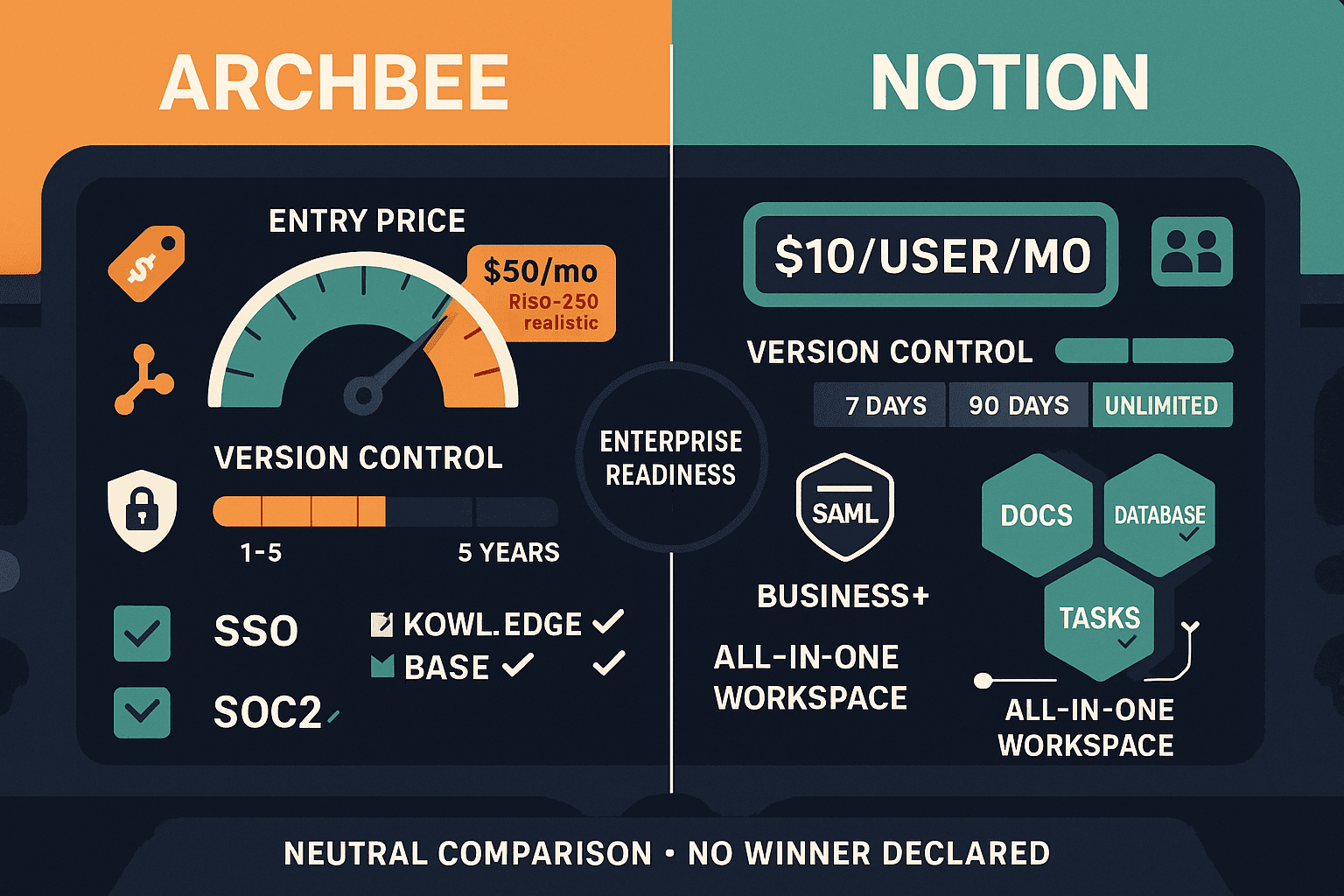
The platform's advertised entry price of $50/month catches attention in budget discussions. It supports custom domains for branded external documentation, offers review and approval workflows for content governance, and provides up to 5 years of version history retention—features that appeal to enterprise compliance requirements. For teams focused exclusively on technical documentation delivered through developer portals, Archbee's feature set checks several boxes.
But there's a significant catch: the base price is highly misleading. AI Write Assist costs an additional $20/month. Analytics—table stakes for understanding documentation effectiveness—adds another $80/month. The App Widget and API Access are separate paid add-ons too. By the time you've assembled the features enterprises actually need, you're looking at $150-230/month, not the advertised $50. This add-on pricing structure makes accurate budgeting difficult and creates uncomfortable conversations when initial estimates prove inaccurate.

Notion: The Flexible Workspace with Internal Focus
Notion has achieved remarkable brand recognition as an "All-in-One Workspace for Notes, Docs, and Databases." It combines documentation with databases, task management, and wikis in a uniquely flexible interface that's become synonymous with modern knowledge work, especially among startups and creative teams.
Following their May 2025 restructuring, Notion bundled AI capabilities exclusively in their Business tier at $20/user/month. This AI implementation is notably sophisticated, powered by both GPT-4 and Claude 3.7, with AI Agents that can autonomously complete tasks across connected applications. For internal collaboration, Notion's strength is undeniable—cross-functional teams can build custom workflows, link databases to documentation, and create interconnected knowledge systems that adapt to their specific needs.
The challenge emerges when enterprises need to deliver documentation externally. Notion lacks custom domain support for external delivery, offers no multi-tenant client portals, and provides no video-to-docs conversion capability. It's built brilliantly for internal team collaboration, but it wasn't designed for customer-facing documentation delivery at scale. For enterprises that need to maintain one knowledge base while delivering branded portals to hundreds of different clients, Notion simply can't fulfill that requirement.
Enterprise Readiness: The Critical Comparison
For a detailed feature-by-feature breakdown, see our complete Archbee vs Notion enterprise comparison. Here, we'll focus on the decision-critical dimensions.
Security and Compliance Depth
Both platforms offer SOC 2 Type II certification and GDPR compliance—the baseline requirements for enterprise consideration. But baseline isn't comprehensive.
Neither Archbee nor Notion provides HIPAA readiness, which eliminates them immediately for healthcare organizations or any enterprise handling protected health information. Neither offers data residency controls, which creates challenges for organizations with European customers subject to strict data localization requirements. While both platforms provide audit logs, neither matches the comprehensive audit trail depth required for regulated industries where every access, edit, and export must be tracked and retrievable.
Archbee offers longer version history retention (up to 5 years versus Notion's 90-day page history), which matters for compliance documentation that must demonstrate historical accuracy. But version history alone doesn't constitute enterprise-grade security when fundamental compliance capabilities are missing.
Pricing Transparency and Total Cost of Ownership
Archbee's add-on pricing model creates budgeting uncertainty. The advertised $50/month base price excludes AI ($20/month), Analytics ($80/month), and other functionality that enterprises reasonably expect in a documentation platform. This isn't transparent pricing—it's the software equivalent of hotel resort fees.
Notion's pricing is more straightforward: $20/user/month for the Business tier that includes AI capabilities. However, per-user pricing becomes expensive quickly for documentation use cases. If you're provisioning licenses for 50 contributors across product, engineering, and support teams, you're spending $1,000/month before you've published a single doc to customers.
Neither platform offers truly transparent enterprise pricing where all necessary features are included without surprises or complex calculations.
External Documentation Delivery
This is where the fundamental architectural differences matter most.
Archbee supports custom domains for external documentation, allowing enterprises to publish technical docs at docs.yourcompany.com with full branding control. This works well for single-portal scenarios—one company, one documentation site, one brand. But it offers no multi-tenant capabilities. If you need to deliver the same core content to 100 different customers with each customer seeing their own branded portal, custom navigation, and personalized content, Archbee can't scale to that architecture.
Notion lacks even the single custom domain capability. You can share Notion pages externally, but they'll always appear on notion.site domains with Notion branding. For enterprise customer-facing documentation, this isn't viable. Your customers expect documentation at your domain, with your branding, not a third-party workspace tool.
Neither platform solves the multi-tenant documentation challenge that's increasingly critical for SaaS companies, enterprise software vendors, and any organization delivering knowledge bases to multiple clients simultaneously.
Administrative Control and Governance
Archbee provides review and approval workflows, which enables content governance for regulated documentation. This matters when subject matter experts must approve content before publication, or when compliance requires documented approval chains.
Notion offers sophisticated permission controls for internal collaboration, including page-level permissions and team spaces. But these permissions are designed for internal team boundaries, not external client portals with isolated tenant data.
Neither platform offers the granular administrative control required for true enterprise knowledge management: role-based access control with custom roles, SSO/SAML integration with attribute mapping, detailed audit logs with export capabilities, or the ability to manage thousands of users across multiple tenant boundaries.
Who Should Choose What?
Choose Archbee if you need developer and API documentation with OpenAPI/Swagger integration, custom domain support for a single branded documentation portal, review and approval workflows for content governance, and longer version history retention (up to 5 years). Archbee works for technical teams focused on developer portals where pricing predictability isn't critical and external delivery needs are straightforward.
Choose Notion if you need a flexible internal workspace that combines documentation with databases and project management, advanced AI capabilities powered by GPT-4 and Claude 3.7 with autonomous AI Agents, strong collaboration features for cross-functional teams, and extensive integration ecosystem for connected workflows. Notion excels at internal knowledge management where the documentation never leaves your organization and collaboration flexibility matters more than external delivery.
Choose neither if you need true multi-tenant documentation delivery, HIPAA compliance, comprehensive audit logs, video-to-docs conversion, or transparent enterprise pricing where all features are included without add-on traps.
The Superior Enterprise Alternative: Docsie
For enterprises requiring capabilities that neither Archbee nor Notion provides, Docsie offers a fundamentally different approach to documentation management.
Docsie delivers true multi-tenant portals, enabling organizations to maintain one knowledge base while delivering unlimited branded customer portals with custom domains, isolated content, and personalized navigation. This architecture solves the scalability challenge that eliminates both Archbee and Notion from consideration for SaaS platforms and enterprise software vendors.
Docsie provides full HIPAA readiness, SOC 2 Type II certification, EU data residency options, and comprehensive audit logs that track every access, edit, and export. This compliance depth meets the requirements of regulated industries that can't compromise on security certifications.
The platform includes video-to-docs conversion from any source—training videos, screen recordings, product demonstrations, real-world footage—transforming visual content into searchable, translatable documentation. This capability accelerates documentation creation and makes existing video assets accessible through documentation search.
Docsie's 100+ language auto-translation enables global documentation delivery without managing separate language versions. Combined with enterprise-grade version control with inheritance and end-of-life management, this creates a complete documentation lifecycle from creation through translation to archival.
The agentic AI chatbot, semantic search, and embeddable widgets deliver customer-facing documentation experiences that reduce support ticket volume and improve customer self-service. Unlike platforms where AI only works for internal docs, Docsie's AI capabilities are designed for external customer documentation delivery.
Perhaps most importantly, Docsie offers transparent pricing with all enterprise features included—no add-on traps, no surprises, no complex calculations to determine actual costs.
When enterprise decision-makers need documentation software that handles the complete CONVERT → MANAGE → DELIVER workflow with true enterprise security, multi-tenant architecture, and pricing transparency, Docsie provides capabilities that neither Archbee nor Notion can match.
Make the Right Choice for Your Enterprise
The documentation platform you choose shapes how your teams collaborate, how your customers learn, and whether you can meet compliance commitments. Archbee and Notion both serve specific use cases well—Archbee for straightforward API documentation, Notion for internal team collaboration—but neither delivers the comprehensive enterprise capabilities that modern organizations require.
For a detailed comparison including specific feature matrices, see our complete Archbee vs Notion enterprise readiness analysis.
Ready to experience documentation software built specifically for enterprise requirements? Start your free Docsie trial today and discover how true multi-tenant delivery, comprehensive compliance, video-to-docs conversion, and transparent pricing transform documentation management.