

Archbee vs Guru: Which Enterprise Documentation Platform Is Really Ready for 2026?
Choosing enterprise documentation software feels straightforward until you start comparing pricing models. One platform advertises $50/month but charges separately for AI, analytics, and API access. Another requires a 10-seat minimum regardless of team size. Both claim "enterprise-ready" status, but what does that actually mean when you're managing documentation for developers, customers, or multiple clients?
Archbee and Guru represent two distinct approaches to enterprise knowledge management. Archbee targets developer teams with API documentation tools and a misleadingly low entry price. Guru focuses on internal knowledge management with AI-powered verification workflows and a high minimum spend. Neither solution addresses multi-tenant client delivery or video-to-docs conversion—two capabilities increasingly critical for implementation partners, consultancies, and agencies.
Let's examine what "enterprise readiness" actually means when comparing these platforms in 2026.
What Is Archbee?
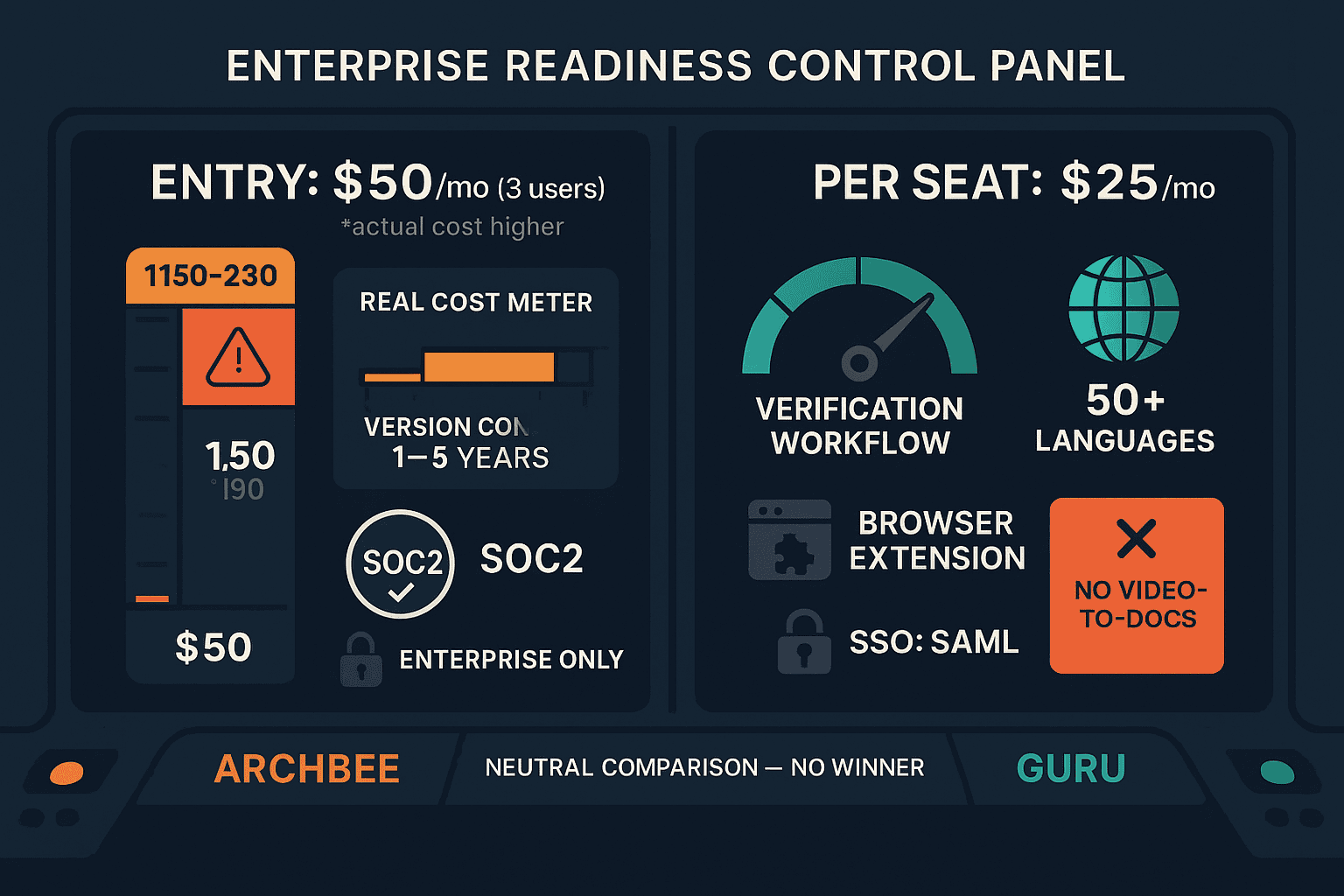
Archbee positions itself as a "Product and API Documentation for Dev Teams" platform with a clean, modern interface optimized for technical documentation. The advertised base price of $50/month initially appears competitive, but that's before adding AI Write Assist ($20/month), Analytics ($80/month), API Access, or the App Widget. Real-world costs for teams needing standard documentation capabilities typically land between $150-230/month once necessary add-ons are included.
The platform excels at developer-focused use cases: OpenAPI/Swagger integration, code block syntax highlighting, and version history retention up to 5 years for compliance needs. Custom domain support enables branded documentation sites, and the UI prioritizes simplicity over feature density. For teams exclusively focused on API reference documentation without AI requirements, Archbee delivers a focused toolset.

What Is Guru?
Guru bills itself as "AI-Powered Enterprise Knowledge Management" with a fundamentally different focus than Archbee. Rather than external documentation delivery, Guru concentrates on internal knowledge management with expert verification workflows that keep information accurate and current. The 2025 launch of Knowledge Agents (Chat, Research, and MCP Server support) brought AI-powered Q&A capabilities into the platform's core offering.
Pricing starts at $25 per seat monthly but requires a 10-seat minimum, creating a $250/month floor regardless of actual team size. This structure favors larger enterprises with established teams but penalizes smaller organizations testing the platform. Strong Slack integration and a browser extension that surfaces knowledge across web applications make Guru particularly effective for workflow-based knowledge delivery to internal teams. The platform supports 50+ language translation for global workforces.
Enterprise Readiness: Comparing Core Capabilities
Pricing Transparency and Total Cost of Ownership
Archbee's add-on pricing model creates significant confusion around total cost. The $50/month base price excludes features most teams consider standard: AI writing assistance, usage analytics, API access for integrations, and the app widget. Add these essentials and monthly costs more than triple. This pricing structure resembles budget airline tactics—advertise a low fare, then charge separately for seats, baggage, and boarding priority.
Guru's per-seat model with a 10-seat minimum is expensive for small teams but at least transparent. A 5-person team pays for 10 seats ($250/month) whether they use them or not. A 15-person team pays $375/month. There are no hidden feature gates or surprise add-ons during expansion. However, neither platform offers workspace-based pricing that scales with documentation volume rather than seat count—a limitation when contractors, freelancers, or rotating team members need occasional access.
For context, enterprise-focused platforms increasingly bundle core capabilities (AI, analytics, integrations) into transparent tier pricing rather than nickel-and-diming teams with add-ons.
Use Case Alignment: Internal vs External Documentation
Archbee targets developer documentation and API references—inherently external-facing use cases. Technical teams publish documentation for customers, partners, or open-source communities. The platform supports custom domains and branding for public-facing sites, making it suitable for single-product documentation portals.
Guru optimizes for internal knowledge management: employee onboarding, process documentation, policy libraries, and tribal knowledge capture. The browser extension and Slack integration deliver knowledge within existing workflows rather than requiring users to visit separate documentation sites. Expert verification workflows assign content ownership and track freshness—critical for internal compliance but less relevant for external API documentation.
Neither platform addresses multi-tenant client delivery—the ability to maintain one knowledge base while delivering customized, branded versions to multiple clients with separate access controls and domains. Implementation consultancies, agencies, and software companies serving multiple customers need multi-tenant architecture, which remains absent from both platforms.
AI Capabilities and Content Generation
Archbee offers AI Write Assist as a $20/month add-on. It helps draft documentation content but isn't included in the base price—a significant oversight in 2026 when AI writing assistance has become table stakes for documentation platforms.
Guru's Knowledge Agents (launched 2025) provide AI-powered Chat and Research capabilities that answer questions using verified internal knowledge. MCP Server support connects Guru to the broader AI agent ecosystem, enabling integration with Claude and other AI assistants. These capabilities make Guru stronger for AI-powered Q&A workflows compared to Archbee's basic AI writing assistance.
Neither platform offers video-to-docs conversion—the ability to upload training videos, screen recordings, or real-world footage and automatically generate structured documentation with screenshots, step-by-step instructions, and searchable text. As video becomes the primary format for software training and product demonstrations, the inability to convert video assets into text documentation represents a significant gap.
Enterprise Security and Compliance
Both platforms meet baseline enterprise security requirements with SSO/SAML support and role-based access controls. Archbee provides up to 5 years of version history retention, supporting compliance needs in regulated industries. Guru emphasizes SOC 2 Type II compliance and offers enterprise security features expected by IT procurement teams.
Neither platform mentions HIPAA-ready capabilities, GDPR-specific features beyond basic compliance, or detailed data residency options—features increasingly required by healthcare, financial services, and European enterprises. For organizations with advanced compliance requirements, third-party security assessments and vendor questionnaires become necessary evaluation steps.
Who Should Choose What?
Choose Archbee If You Need...
Developer and API documentation with OpenAPI/Swagger integration remains Archbee's core strength. If your primary use case involves publishing technical reference documentation with code examples and interactive API explorers, Archbee delivers a focused toolset without unnecessary complexity.
Long version history retention (up to 5 years) supports compliance needs in regulated industries requiring detailed audit trails. Financial services, healthcare, and government contractors may find this capability valuable.
Lower entry price if you can avoid add-ons—teams that genuinely don't need AI assistance, analytics, or API access can start at $50/month. However, most teams quickly discover these "add-ons" are actually core capabilities, pushing costs to $150-230/month.
Choose Guru If You Need...
Internal knowledge management with expert verification workflows ensures knowledge stays accurate across large organizations. Assigning content owners and tracking freshness prevents documentation decay that plagues most internal wikis.
Strong Slack integration delivers knowledge within communication workflows rather than requiring context switching to separate documentation tools. For Slack-centric organizations, this workflow integration significantly improves knowledge accessibility.
Browser extension surfacing knowledge across web applications helps employees find relevant information regardless of which tool they're using. This cross-application knowledge delivery reduces time spent searching and improves employee productivity.
50+ language translation supports global internal teams requiring multilingual documentation without manual translation workflows.
The Enterprise Readiness Gap: What Both Tools Miss
For all their strengths, both Archbee and Guru share critical limitations that restrict their enterprise readiness:
No multi-tenant client portals—organizations serving multiple clients need to deliver one knowledge base to unlimited customers with separate branding, domains, and access controls. Implementation partners, consultancies, and agencies require multi-tenant architecture, which neither platform provides.
No video-to-docs conversion—as training and product demonstrations shift to video formats, the inability to automatically convert video content into structured, searchable documentation creates significant manual overhead. Teams waste hours manually transcribing and documenting processes already captured on video.
Limited external client documentation delivery—while Archbee supports public documentation, neither platform offers the complete CONVERT → MANAGE → DELIVER workflow required for comprehensive external client documentation programs.
The Superior Alternative: Docsie for Enterprise Documentation
For organizations needing true enterprise readiness beyond basic security checkboxes, Docsie provides capabilities both Archbee and Guru lack:
Multi-tenant enterprise portals deliver one knowledge base to unlimited clients with separate branding, domains, and access controls. Implementation consultancies manage documentation for 50+ clients from a single workspace without duplicating content or compromising security boundaries.
Video-to-docs conversion uses multimodal AI to transform training videos, screen recordings, and real-world footage into structured documentation with screenshots, step-by-step instructions, and searchable text. Upload a 10-minute software demo and receive complete documentation within minutes.
Complete CONVERT → MANAGE → DELIVER workflow supports external client documentation delivery from content creation through multi-tenant distribution, eliminating tool fragmentation and workflow gaps.
100+ language auto-translation with SOC 2 Type II, GDPR, and HIPAA-ready compliance ensures global reach without compromising security standards.
Transparent pricing without hidden add-ons—all enterprise features included in workspace-based plans that scale with documentation volume rather than arbitrary seat counts.
Making the Right Choice for Your Enterprise
Archbee serves developer teams focused exclusively on API documentation with minimal AI requirements. Guru fits internal knowledge management for Slack-centric enterprises willing to pay the $250/month minimum. Both platforms meet baseline enterprise security requirements but lack multi-tenant architecture, video conversion, and external delivery capabilities.
For organizations managing documentation across multiple clients, converting video content into structured documentation, or requiring transparent pricing without add-on surprises, neither Archbee nor Guru delivers complete enterprise readiness.
Start your free Docsie trial to experience multi-tenant portals, video-to-docs conversion, and transparent enterprise pricing designed for organizations serious about scalable documentation delivery. No hidden add-ons. No minimum seat requirements. Just comprehensive documentation capabilities that actually scale with your enterprise needs.