

Archbee vs Guru: Which Documentation Tool Fits Your Needs in 2026?
Shopping for documentation tools feels like navigating a maze of overlapping features, confusing pricing models, and platforms that claim to do everything but excel at nothing. You're comparing Archbee and Guru because someone on your team flagged them as options—but here's the challenge: these tools serve fundamentally different purposes, and neither may actually solve your complete documentation problem.
Let's cut through the marketing speak and examine what each platform actually delivers, where they excel, and—critically—what gaps both leave unfilled.
What Is Archbee?
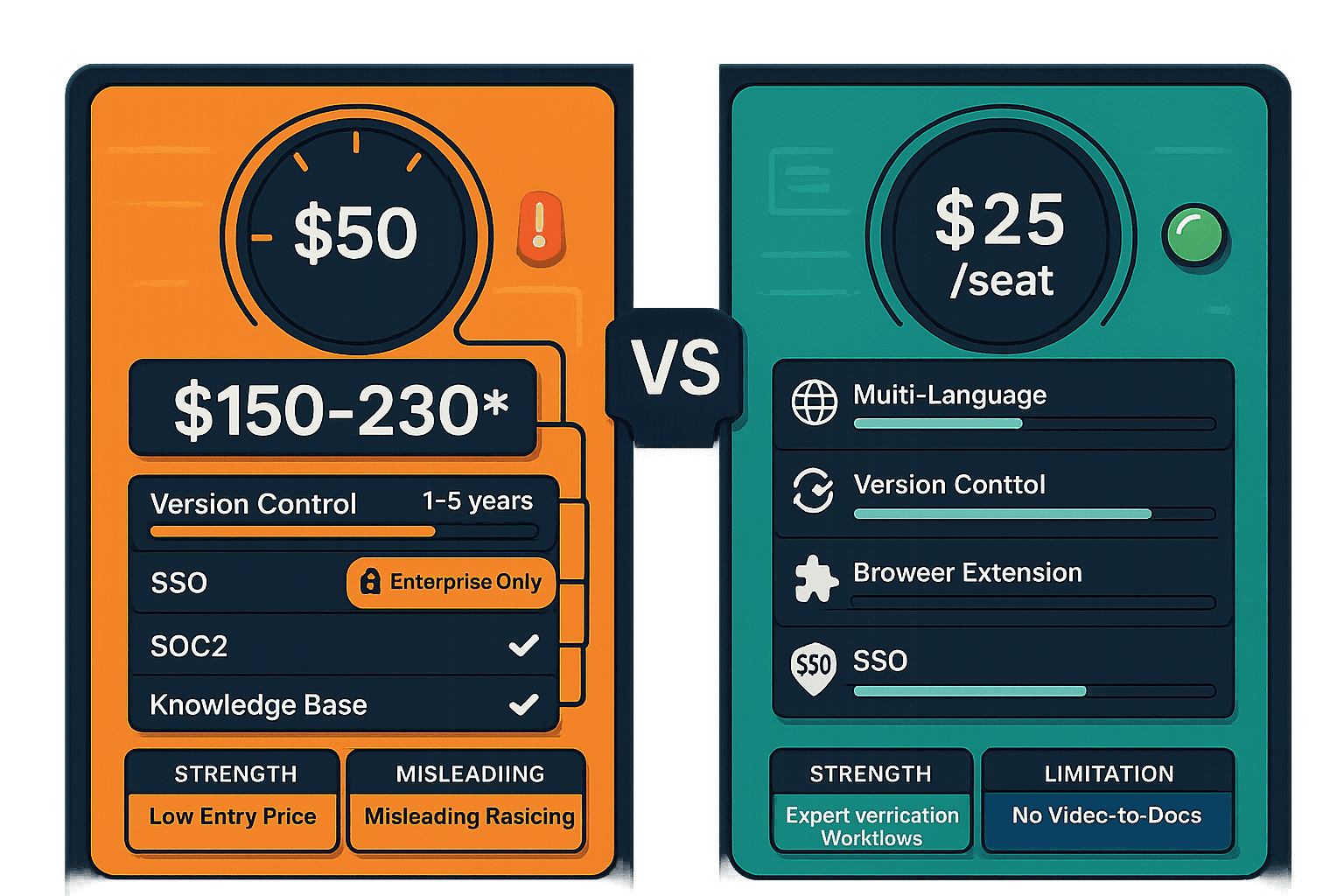
Archbee positions itself as a product and API documentation platform purpose-built for developer teams. With a clean, modern interface and strong OpenAPI/Swagger support, it's designed to help technical teams publish and maintain API references and developer portals. The platform advertises an attractive $50/month starting price that initially looks competitive—until you realize that AI writing assistance, analytics, API access, and even the app widget are all paid add-ons. By the time you've enabled the features most teams actually need, you're looking at $150-230/month in real costs. It's developer documentation with a pricing model that requires careful scrutiny of the fine print.

What Is Guru?
Guru takes a completely different approach as an AI-powered enterprise knowledge management platform. Rather than focusing on external documentation or developer portals, Guru specializes in capturing, verifying, and surfacing internal tribal knowledge across large organizations. The platform's signature feature is its expert verification workflows, which ensure knowledge stays current and accurate. In 2025, Guru launched Knowledge Agents—including Chat, Research capabilities, and MCP Server support—that surface answers directly in Slack, browsers, and AI agent ecosystems. With per-seat pricing and a 10-seat minimum creating a $250/month floor, Guru clearly targets mid-to-large enterprises with distributed teams managing complex internal knowledge.
Feature Comparison: Where They Diverge
Documentation Focus and Use Case
The most fundamental difference between Archbee and Guru is who they serve and what documentation problems they solve.
Archbee is laser-focused on external-facing technical documentation. It's built for engineering teams that need to publish API references, developer guides, and product documentation for external developers or technical users. The platform's OpenAPI/Swagger integration allows you to automatically generate and maintain API documentation from your spec files, while code block syntax highlighting and interactive API explorers create a polished developer experience. If your primary need is creating beautiful, searchable documentation for people outside your organization to consume technical information, Archbee's toolset aligns well.
Guru, conversely, is designed for internal knowledge management at scale. It's not about publishing documentation for external consumption—it's about capturing the collective knowledge scattered across your organization's Slack messages, email threads, and individual team members' heads. Expert verification workflows assign knowledge owners who are responsible for keeping specific content accurate, while browser extensions and Slack integrations surface relevant knowledge right where employees work. The 2025 launch of Knowledge Agents takes this further, using AI to answer questions by searching across your verified knowledge base.
Neither platform excels outside its core domain. Archbee doesn't offer the verification workflows or internal knowledge surfacing tools that make Guru valuable for internal use. Guru lacks the developer-focused features, API documentation generators, and external portal capabilities that Archbee provides.
Pricing Models and Real Costs
Both platforms have pricing structures that deserve careful examination—though for different reasons.
Archbee's $50/month advertised price is genuinely misleading. That base tier gets you basic documentation editing and publishing, but most teams will immediately need add-ons: AI Write Assist costs an additional $20/month, Analytics runs $80/month extra, and API access is another paid add-on. For a realistic deployment with the features most teams expect as standard (AI assistance, usage analytics, API integration), budget $150-230/month. This isn't necessarily expensive compared to competitors—but the advertised pricing creates a bait-and-switch experience that erodes trust.
Guru's per-seat pricing with a 10-seat minimum creates a hard $250/month floor regardless of your actual team size. If you're a 5-person startup, you're paying for seats you don't use. For the target market—enterprises with 50+ employees managing knowledge across sales, support, product, and engineering—this pricing makes sense and scales predictably. The transparency is refreshing compared to Archbee's add-on model, but the minimum spend locks out smaller teams entirely.
AI Capabilities and Automation
Both platforms incorporate AI, but they apply it to vastly different problems.
Archbee's AI Write Assist—when you pay the extra $20/month—helps draft and improve documentation content. It's a writing assistant that can generate initial documentation drafts, improve clarity, or suggest content structure. Useful for teams creating documentation from scratch, but it's fundamentally a content creation tool, not an intelligence layer.
Guru's Knowledge Agents represent a more ambitious AI implementation. The Chat agent answers questions by searching across your verified knowledge base, while the Research agent synthesizes information from multiple sources. The MCP (Model Context Protocol) Server support allows Guru to function as a knowledge source for emerging AI agent ecosystems. Rather than just helping you write documentation, Guru's AI actively surfaces existing knowledge and answers questions—reducing the need for people to search manually or recreate information that already exists somewhere in your organization.
The catch? Neither platform offers video-to-documentation conversion—an increasingly critical capability as organizations sit on massive libraries of training videos, screen recordings, and Zoom calls that contain valuable knowledge locked in video format.
Multi-Tenant and Client Delivery
Here's where both platforms share a significant limitation: neither supports multi-tenant client portals or comprehensive external client delivery.
Archbee can publish documentation portals, but you're creating documentation for your product or API—not managing separate branded documentation portals for multiple clients. If you're a consultancy, implementation partner, or SaaS platform that needs to deliver customized documentation to dozens or hundreds of different clients, Archbee's architecture doesn't support that use case.
Guru doesn't even pretend to address external documentation delivery—it's purely an internal knowledge management system. The concept of delivering branded documentation to external clients falls completely outside its design.
For organizations that need to manage documentation for multiple clients, deliver white-labeled portals, or orchestrate both internal and external knowledge bases from one platform, both Archbee and Guru leave critical needs unmet.
Who Should Choose What?
Choose Archbee if you need:
- Developer-focused API documentation with OpenAPI/Swagger integration
- Technical documentation for a single product or platform
- Clean modern UI for developer portals with code block support
- Entry-level pricing for small technical teams (despite add-on costs)
Archbee works well for product companies and SaaS platforms that need one beautiful, searchable developer portal. Just budget for the real cost with necessary add-ons, not the advertised base price.
Choose Guru if you need:
- Internal enterprise knowledge management with expert verification workflows
- AI-powered knowledge agents surfacing answers in Slack and browser
- Large distributed teams (50+ employees) managing tribal knowledge
- Strong integration ecosystem for sales and support teams
- MCP Server support for emerging AI agent workflows
Guru shines in large organizations where knowledge is scattered, out-of-date information creates costly mistakes, and you need AI to surface answers without requiring people to search manually.
The Real Recommendation: A Complete Documentation Solution
The detailed comparison of Archbee vs Guru reveals a pattern: both platforms excel at specific, narrow use cases while leaving significant documentation needs unaddressed.
Neither platform can: - Convert existing video content (training videos, screen recordings, Zoom calls) into structured documentation - Manage multi-tenant portals delivering branded documentation to multiple clients - Provide a complete CONVERT → MANAGE → DELIVER workflow in one platform - Serve both internal knowledge management AND external client delivery needs
This is where Docsie fundamentally differs.
Docsie addresses the complete documentation lifecycle that modern organizations actually face. The platform's video-to-documentation conversion transforms your existing video libraries—whether training recordings, product demos, or customer calls—into searchable, structured documentation. Instead of forcing teams to recreate knowledge that already exists in video format, Docsie extracts and structures it automatically.
For consultancies, implementation partners, and SaaS platforms managing documentation for multiple clients, Docsie's multi-tenant portal capabilities allow you to deliver unlimited branded documentation portals from a single system. Each client gets their own customized portal with their branding, specific content, and access controls—while you manage everything centrally.
The platform includes 100+ language auto-translation, ensuring documentation reaches global audiences without manual translation work or expensive localization agencies. Version control, collaborative editing, and comprehensive analytics come standard—not as expensive add-ons with misleading pricing.
For enterprises needing both internal knowledge management and external documentation delivery, Docsie provides unified knowledge orchestration that neither Archbee nor Guru can match. You're not choosing between internal tribal knowledge capture and external developer documentation—you're addressing both from one platform with transparent, scalable pricing.
SOC 2, GDPR, and HIPAA-ready compliance features ensure Docsie meets enterprise security requirements without compromise, while the platform's architecture supports the scale and governance needs of large organizations.
Make the Right Choice for Your Documentation Needs
Archbee serves developer documentation teams willing to pay add-on costs for basic features. Guru serves large enterprises managing internal knowledge with verification workflows. Both leave critical gaps that force organizations to cobble together multiple tools or leave documentation needs unmet.
If you need comprehensive documentation capabilities—converting existing video content, managing versions and translations, delivering through branded multi-tenant portals, and orchestrating both internal and external knowledge—Docsie provides the complete solution both competitors lack.
Ready to see the difference? Start your free Docsie trial today and experience documentation tools that address your complete workflow, not just one narrow use case.