
Docsie vs GitBook: Which Documentation Platform is Truly Enterprise-Ready in 2026?
Enterprise buyers evaluating documentation platforms face a deceptive choice: tools that look similar on feature checklists often serve completely different use cases. A platform optimized for developer API documentation won't scale for implementation partners managing hundreds of client portals. Conversely, a multi-tenant knowledge orchestration system will feel over-engineered for a single technical team documenting REST endpoints.
This comparison cuts through the noise to help enterprise decision-makers understand which platform—Docsie or GitBook—actually meets their specific enterprise requirements. We'll examine architecture, compliance capabilities, scalability economics, and real-world deployment scenarios to clarify which tool fits which buyer.
What is Docsie?
Docsie positions itself as an Agentic Knowledge Orchestration Platform that converts training videos, PDFs, and existing websites into structured knowledge bases using multimodal AI. The platform then delivers this content as branded portals, AI chatbots, and embedded widgets across 100+ languages—simultaneously serving multiple clients from a single system.
The core workflow follows a CONVERT → MANAGE → DELIVER model: ingest unstructured content (including real-world training videos, screen recordings, and Loom videos—not just screen captures), organize it within a centralized knowledge base, and deploy it across unlimited client-branded portals. Docsie's multi-tenant architecture makes it purpose-built for implementation partners, consulting firms, and SaaS companies delivering documentation to multiple customers at scale.
Key differentiators include agentic AI search using tool calls rather than basic RAG (Retrieval-Augmented Generation), workspace-based pricing that prevents per-seat cost inflation, and HIPAA-ready compliance with EU data residency options.

What is GitBook?
GitBook describes itself as Technical Documentation for Developer Teams—and that focus is intentional. The platform emerged from developer-first principles, offering Git-native version control that integrates seamlessly with GitHub and GitLab workflows. It excels at API documentation and developer portals where code-heavy technical content requires versioning, collaboration, and OpenAPI/Swagger spec support.
GitBook's interface delivers the clean, professional documentation UI that developer audiences expect. Features like Git sync workflows, branch-based editing, and docs-as-code practices make it the natural choice for engineering teams documenting APIs, SDKs, and technical products.
The platform restructured its pricing in 2024-2025 to a site-based model, which creates specific cost implications for enterprises deploying documentation at scale. GitBook holds dual SOC 2 Type II and ISO 27001 certifications, demonstrating serious security posture for technical teams in regulated industries.
Enterprise Readiness: Four Critical Dimensions
1. Multi-Tenant Architecture and Client Scalability
Docsie built its entire architecture around multi-tenancy from day one. A single knowledge base can power unlimited client-branded portals, each with custom domains, white-labeling, and isolated branding. This matters enormously for implementation partners, consulting firms, and SaaS companies serving hundreds or thousands of customers.
Consider a healthcare software vendor delivering HIPAA-compliant documentation to 500 hospital systems: Docsie allows them to maintain one master knowledge base while delivering 500 individually branded, compliant documentation portals. The pricing model supports this use case—workspace-based licensing means adding client portals doesn't multiply costs.
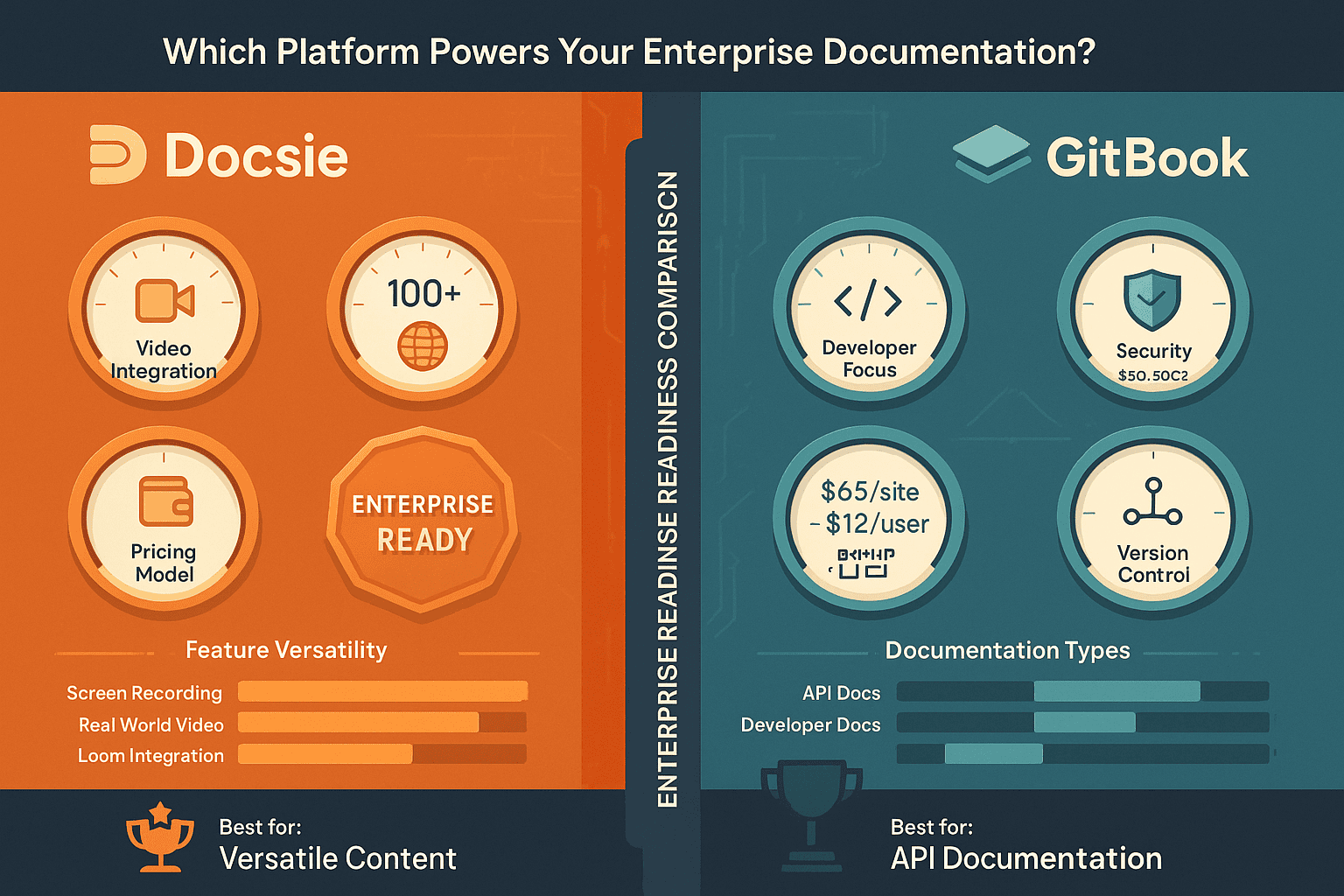
GitBook takes the opposite approach: its site-based pricing model charges per documentation site. Custom domains cost $65 per site, which creates cost inflation when deploying documentation for multiple clients. GitBook's 2024-2025 pricing restructure optimized for single-site or small-scale deployments, not multi-tenant scenarios requiring hundreds of branded portals.
For enterprises needing to deliver documentation to multiple external clients, Docsie's architecture provides clear economic and operational advantages. For internal technical teams documenting a single API or developer portal, GitBook's model aligns perfectly with that use case.
2. Compliance, Security, and Audit Capabilities
Both platforms offer enterprise security, but with different certification profiles and compliance capabilities:
GitBook holds dual SOC 2 Type II and ISO 27001 certification—arguably the gold standard for developer-focused security. These certifications signal rigorous security controls that satisfy security teams at enterprise technology companies. However, GitBook does not advertise HIPAA-ready configurations or comprehensive audit logging in its standard documentation.
Docsie positions itself as HIPAA-ready with EU data residency options, comprehensive audit logs, and security controls specifically designed for regulated industries like healthcare, finance, and government. While Docsie's certifications are still maturing compared to GitBook's dual-certification status, its compliance features target different regulatory requirements.
For healthcare implementation partners needing HIPAA compliance and audit trails, or European enterprises requiring EU data residency, Docsie provides purpose-built capabilities. For technology companies prioritizing SOC 2 and ISO 27001 certifications for developer-focused documentation, GitBook's dual certification offers immediate credibility.
The verdict here depends entirely on your regulatory environment and the industries you serve.
3. Content Ingestion and Knowledge Conversion
Docsie's standout enterprise capability is multimodal AI conversion from videos, PDFs, and existing websites. Implementation teams frequently inherit unstructured training materials—recorded Zoom sessions from subject matter experts, legacy PDF manuals, scattered internal wikis. Docsie converts these sources into structured, searchable knowledge bases.
Critically, Docsie handles real-world training videos and screen recordings (including Loom), not just polished screen captures. This matters for enterprises where knowledge exists in informal formats: sales engineers explaining product configurations on Zoom, implementation consultants walking through setup processes, customer success teams demonstrating workflows.
GitBook provides no video-to-docs capability and no comparable content conversion features. Its strength lies in Git-native version control for documentation written and maintained as code. GitBook expects documentation to be authored in Markdown or imported from Git repositories—it's optimized for creating documentation from scratch within developer workflows, not converting existing unstructured content.
For enterprises sitting on years of training videos, PDF documentation, and scattered knowledge sources, Docsie's conversion capabilities unlock immediate value. For developer teams maintaining API documentation through docs-as-code practices, GitBook's Git-native approach provides superior workflow integration.
4. Scalability Economics and Total Cost of Ownership
Pricing models reveal each platform's intended enterprise buyer:
GitBook's site-based model charges per documentation site, with custom domains at $65/site. For a single developer portal, this remains manageable. For implementation partners deploying documentation across 1,000 clients, costs escalate dramatically. GitBook optimized for depth (sophisticated features for one site), not breadth (many sites at scale).
Docsie's workspace-based pricing supports scaling to 10,000+ documentation sites without per-site cost inflation. The platform prevents per-seat cost escalation as teams grow, recognizing that enterprise documentation efforts often involve cross-functional contributors who need occasional access, not daily usage.
For enterprises projecting documentation deployments across hundreds or thousands of clients, customers, or product lines, Docsie's economics support that growth trajectory. For focused technical teams documenting a single product or API, GitBook's pricing aligns with that scope.
Who Should Choose What?
Choose Docsie if You Need...
Multi-tenant client delivery where you're serving documentation to multiple external customers, implementation clients, or partners from a single platform. Implementation partners, consulting firms, SaaS companies with white-label offerings, and agencies delivering documentation as a service all fit this profile.
HIPAA-ready compliance with EU data residency for regulated industries. Healthcare software vendors, medical device companies, financial services firms, and government contractors often face these requirements.
Video and PDF conversion capabilities to unlock knowledge from existing unstructured content. Enterprises with extensive training video libraries, legacy PDF documentation, or scattered knowledge sources gain immediate ROI from Docsie's conversion features.
Scalability to thousands of documentation sites without cost inflation. If your roadmap includes delivering documentation across many products, clients, or markets, Docsie's architecture and pricing support that trajectory.
100+ language support with auto-translation for global enterprise deployments. Multinational corporations and companies serving international markets need this capability baked into the platform.
Custom SLAs and dedicated success managers for mission-critical documentation where downtime or support delays carry business consequences.
Choose GitBook if You Need...
Developer-focused API documentation with Git-native version control. Engineering teams documenting REST APIs, GraphQL schemas, SDKs, or technical products benefit from GitBook's docs-as-code approach.
Dual SOC 2 Type II and ISO 27001 certification for security-conscious technical teams where these specific certifications satisfy compliance requirements.
Git workflow integration with GitHub or GitLab where documentation lives alongside code repositories and follows software development lifecycle practices.
OpenAPI/Swagger spec support for auto-generating API reference documentation from specification files.
Single-site or small-scale deployments where you're documenting one product, API, or developer portal rather than deploying documentation across many clients.
For a detailed feature-by-feature breakdown, see our complete Docsie vs GitBook enterprise comparison.
The Bottom Line: Different Tools for Different Enterprise Buyers
Both platforms offer legitimate enterprise capabilities, but they optimize for fundamentally different scenarios.
GitBook excels when the enterprise buyer is a developer team documenting technical products through Git-native workflows. Its dual SOC 2 and ISO 27001 certifications, OpenAPI support, and docs-as-code integrations make it purpose-built for this use case. If you're an engineering-led organization documenting APIs and developer tools, GitBook delivers exactly what you need.
Docsie wins when the enterprise buyer is an implementation partner, consulting firm, or SaaS company deploying documentation to multiple clients at scale. Its multi-tenant architecture, HIPAA-ready compliance with EU data residency, audit logs, unlimited client portal delivery, and video conversion capabilities solve problems GitBook doesn't address. If you're serving documentation to hundreds or thousands of external customers, clients, or partners—especially in regulated industries—Docsie's platform architecture supports that business model.
The determining factor isn't which platform has more features, but which one aligns with your specific enterprise documentation requirements and buyer profile.
For organizations needing comprehensive enterprise readiness with multi-tenant client delivery, HIPAA-ready compliance, scalability to thousands of sites, and content conversion from videos and PDFs, Docsie provides purpose-built capabilities that GitBook simply doesn't offer.
Ready to see how Docsie handles enterprise-scale documentation? Start your free trial and test multi-tenant portals, content conversion, and enterprise compliance features with your own documentation requirements.