
Docsie vs GitBook: Feature Comparison 2026
Choosing the right documentation tool isn't about finding "the best platform"—it's about matching capabilities to your actual workflow. Are you building API references for developers who live in Git? Or are you converting training videos into branded knowledge bases for dozens of enterprise clients? The answer determines whether GitBook or Docsie belongs in your stack.
These platforms serve fundamentally different buyers with minimal overlap. GitBook has refined itself into a developer-first API documentation platform with Git-native workflows. Docsie positions itself as an agentic knowledge orchestration platform that converts multimodal content (videos, PDFs, websites) into multi-tenant portals. The feature comparison isn't just about capabilities—it's about identifying which architectural philosophy matches your content creation and delivery model.
What is GitBook?
GitBook is a technical documentation platform purpose-built for developer teams maintaining API docs, SDK references, and technical knowledge bases. Its core strength is Git-native version control—documentation lives alongside code repositories, changes flow through pull requests, and updates deploy via branch-based workflows. GitBook excels at rendering OpenAPI/Swagger specifications, code blocks, and API endpoint references with a clean, professional UI developers expect.
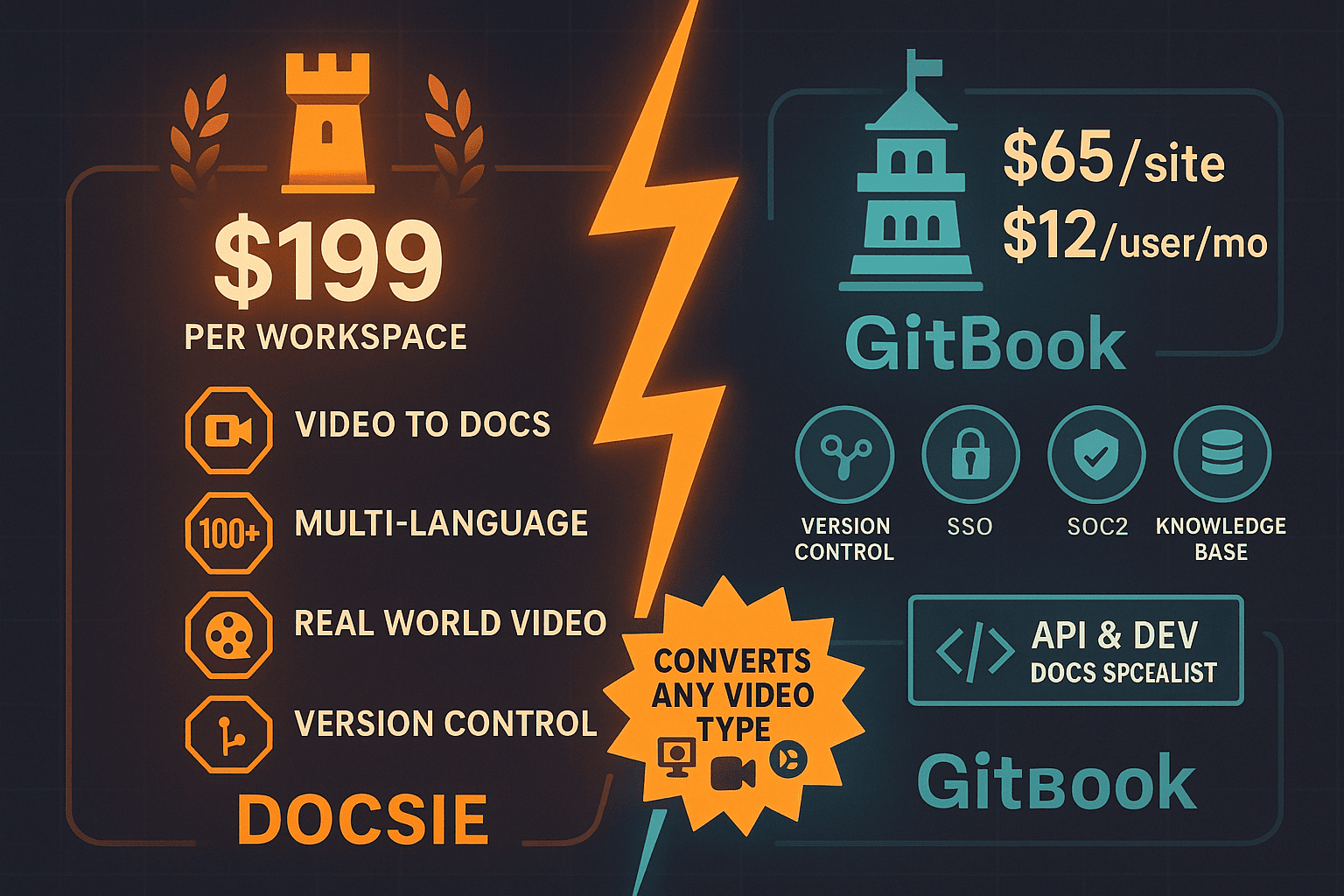
The platform restructured its pricing in 2024-2025 to a site-based model, where custom domains now cost $65 per site. This makes GitBook excellent for focused API documentation projects but potentially expensive for teams managing documentation across multiple products or client-facing portals. GitBook is the gold standard when your primary content is code-heavy technical documentation maintained by engineering teams.
What is Docsie?
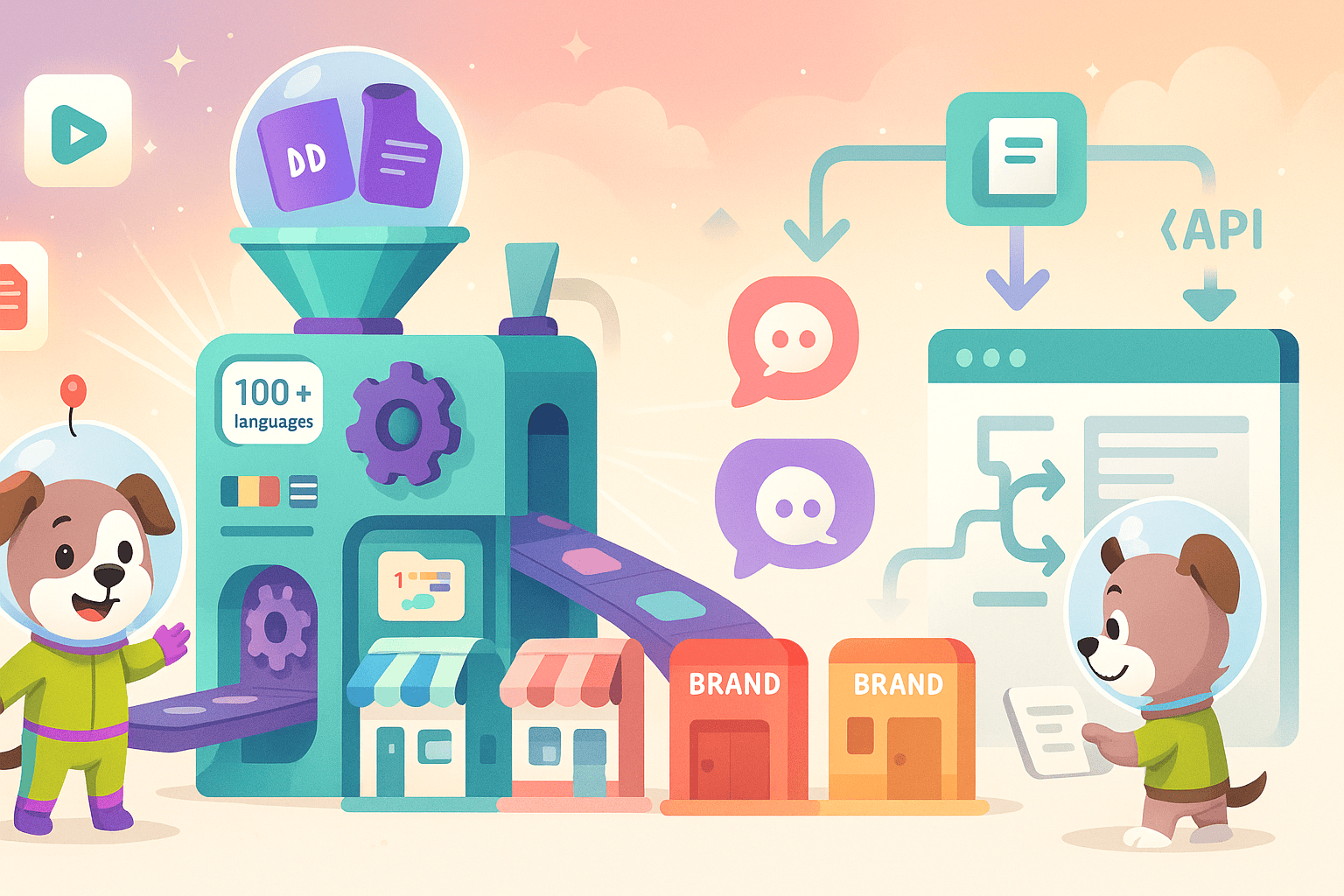
Docsie is an agentic knowledge orchestration platform designed around a complete CONVERT → MANAGE → DELIVER workflow. Its differentiator is multimodal AI that converts training videos (real-world recordings, screen captures, Loom videos), PDFs, and websites into structured knowledge bases—then delivers them as branded portals, AI chatbots, and embeddable widgets across 100+ languages.
The platform targets implementation partners, consultancies, and enterprise teams who need multi-tenant documentation. One knowledge base powers unlimited client-branded portals, each with custom domains, white-label branding, and independent access controls. Docsie uses workspace-based pricing (not per-seat or per-site), making it economically viable for teams scaling documentation across dozens or hundreds of client relationships. The platform includes SOC 2, GDPR, and HIPAA-ready compliance features, positioning it for regulated industries requiring audit logs and EU data residency.
Feature Comparison: Where They Diverge
Content Creation and Import Workflows
GitBook operates on a docs-as-code model. You write content in Markdown, commit changes to Git repositories, and sync documentation with source code version control. The platform imports OpenAPI/Swagger specifications and renders them as interactive API references. Content creation assumes technical writers or developers working with text-based formats and code repositories.
Docsie inverts this model by starting with multimodal content conversion. Upload training videos (any format—not just screen recordings), PDFs, or point to existing websites, and the platform's AI extracts structure, generates documentation, and creates searchable knowledge bases. This addresses a common enterprise pain point: subject matter experts record training sessions, but converting that institutional knowledge into searchable documentation requires manual transcription and structuring. Docsie automates this extraction using multimodal AI, then allows teams to refine and publish the structured output.
The differentiation: GitBook assumes you're creating documentation from scratch or maintaining existing Markdown files. Docsie assumes you have unstructured knowledge artifacts (videos, PDFs, legacy content) that need transformation into structured knowledge bases. If your workflow involves converting existing training materials, Docsie provides the toolchain. If you're writing API docs alongside code, GitBook's Git integration is purpose-built for that workflow.
Multi-Tenant and Client Portal Capabilities
GitBook's architecture centers on individual documentation sites. Each site represents a distinct documentation project, typically tied to a product, API version, or repository. Custom domains cost $65 per site under the current pricing model. For teams managing documentation for multiple clients or products, costs scale linearly with the number of branded sites required.
Docsie architected its platform around multi-tenancy from the ground up. One knowledge base powers unlimited client-branded portals, each with independent custom domains, white-label branding, user access controls, and usage analytics. Implementation partners and consultancies can maintain a single source of truth while delivering branded experiences to dozens of clients without per-site fees. Each client sees only their portal, but content updates propagate from the central knowledge base to all portals simultaneously.
The differentiation: GitBook's site-based model works well for teams managing a handful of documentation projects. Docsie's multi-tenant architecture is designed for businesses that need to deliver the same knowledge base to many clients with different branding—a requirement common among SaaS implementation partners, managed service providers, and consultancies with multiple enterprise customers.
Localization and Language Support
GitBook supports multiple languages through separate content versions. Teams create distinct Markdown files for each language, maintaining parallel documentation sets. This approach works for developer documentation where content volume is moderate and translation is infrequent.
Docsie includes auto-translation across 100+ languages as a core platform feature, not an add-on. Content authored in one language automatically generates translated versions without per-language fees or separate content trees. The platform maintains semantic search and AI chatbot functionality across all languages, ensuring non-English users get the same experience as English readers. For global enterprises, this eliminates the cost and operational complexity of maintaining parallel documentation sets.
The differentiation: If your documentation primarily serves English-speaking developers, GitBook's approach is sufficient. If you're delivering knowledge bases to global clients, partners, or customers across regulatory regions, Docsie's built-in multi-language support eliminates significant operational overhead.
AI-Powered Search and Knowledge Delivery
GitBook provides traditional text search with keyword matching and filtering. The documentation UI is clean and navigation is intuitive, but search functionality operates on string matching rather than semantic understanding.
Docsie implements agentic AI search using tool calls rather than RAG (retrieval-augmented generation). This architectural difference produces more accurate chatbot responses because the AI can execute specific queries against structured knowledge rather than returning probabilistically similar text chunks. The platform delivers this AI-powered search through multiple interfaces: in-portal chatbots, embeddable widgets for external websites, and help desk integrations for customer success workflows.
The differentiation: GitBook's search is excellent for developers who know what they're looking for in API documentation. Docsie's agentic AI is designed for end-users who need conversational access to knowledge—particularly useful for customer-facing portals where non-technical users ask questions in natural language rather than searching documentation structure.
Who Should Choose What?
Choose GitBook if your primary use case is:
- API documentation with OpenAPI/Swagger specification rendering
- Developer portals where documentation lives alongside source code
- Teams already using Git workflows who want docs-as-code architecture
- Technical documentation maintained by engineering teams
- Open-source project documentation requiring version control
- Single-product documentation with modest localization needs
GitBook is unmatched for developer-focused technical documentation. If your content is code-heavy, your team works in Git, and you're documenting APIs or SDKs, GitBook delivers the exact toolchain engineers expect.
Choose Docsie if your primary use case is:
- Converting training videos, PDFs, or websites into structured documentation
- Multi-tenant portals delivering branded knowledge bases to multiple clients
- Global documentation requiring 100+ language support without per-language costs
- Customer-facing knowledge delivery through AI chatbots and embeddable widgets
- Implementation partners and consultancies serving enterprise clients
- Non-technical teams who need content conversion, not docs-as-code workflows
- Help desk integration for customer success and support ticket workflows
- Enterprise compliance (SOC 2, GDPR, HIPAA) with audit logs and data residency
Docsie addresses the complete knowledge orchestration workflow from content conversion through multi-client delivery. If your challenge is transforming unstructured knowledge into scalable client portals, Docsie provides capabilities GitBook was never designed to offer.
The Clear Recommendation
For the broader enterprise documentation market—particularly implementation partners, consultancies, and companies delivering knowledge to multiple clients—Docsie vs GitBook isn't a close comparison. Docsie wins decisively because it solves a different problem.
GitBook excels in its lane: developer-first API documentation with Git workflows. But most enterprise documentation challenges don't fit that narrow use case. Organizations struggle with converting institutional knowledge trapped in training videos, managing documentation for multiple clients, delivering content in dozens of languages, and providing AI-powered search for non-technical users. These are knowledge orchestration problems, not code documentation problems.
Docsie's multimodal AI conversion, multi-tenant portal architecture, 100+ language support, and agentic AI search address the actual pain points enterprise teams face when scaling documentation across complex client relationships. The workspace-based pricing eliminates the per-site cost inflation that makes traditional documentation tools prohibitively expensive at scale.
The verdict: Choose Docsie if you're converting training content into multi-client knowledge bases, need true multi-tenancy, or operate in global markets requiring extensive localization. Choose GitBook if you're a developer team documenting APIs with Git-native workflows—but recognize that's a fundamentally different buyer with different requirements.
See the Difference Yourself
The fastest way to evaluate whether Docsie's knowledge orchestration capabilities match your workflow is hands-on experience. Upload a training video, import a PDF, or point to an existing website and watch the multimodal AI convert it into structured documentation. Set up a multi-tenant portal and see how one knowledge base powers multiple branded client experiences.
Start your free Docsie trial and test the complete CONVERT → MANAGE → DELIVER workflow with your actual content. No credit card required, no artificial feature limitations—just full platform access to see if Docsie solves your specific documentation challenges.
For a detailed side-by-side feature breakdown, review the complete Docsie vs GitBook comparison with pricing analysis and use case recommendations.