
Docsie vs Document360: Pricing Comparison 2026
Choosing documentation software shouldn't feel like navigating a maze blindfolded. Yet for many teams evaluating knowledge base platforms, understanding what you'll actually pay remains frustratingly opaque. When Document360 discontinued its free tier in November 2024 and moved all pricing behind sales contacts, the contrast with transparent competitors became impossible to ignore.
If you're comparing Docsie and Document360 in 2026, pricing structure matters as much as features. One platform publishes every price point and lets you buy online in minutes. The other requires sales calls, custom quotes, and negotiation before you see a single number. For procurement teams, finance departments, and self-serve buyers, this difference fundamentally changes the evaluation process.
What Is Docsie?
Docsie positions itself as an Agentic Knowledge Orchestration Platform that transforms training videos, PDFs, and websites into structured knowledge bases using multimodal AI. Unlike traditional documentation tools that start with manual writing, Docsie converts existing content—screen recordings, real-world training videos, even Loom presentations—into searchable knowledge bases.
The platform handles the full workflow: convert source materials into documentation, manage that content with version control and collaboration tools, then deliver it as branded portals, AI chatbots, and embedded widgets. Docsie's multi-tenant architecture stands out particularly for agencies and SaaS companies serving multiple clients, letting one knowledge base power unlimited client-branded portals across 100+ languages.

What Is Document360?
Document360 describes itself as AI-Powered Knowledge Base Software purpose-built for external documentation. The platform has earned recognition for strong AI writing capabilities through its Eddy AI suite, which handles translation across 50+ languages and converts video and audio into written content.
As part of the Kovai.co family, Document360 recently acquired Floik to add screen-recording-to-demo capabilities. The platform emphasizes content governance with approval workflows and deep integrations with help desk tools like Zendesk, Intercom, and Freshdesk. However, Document360's November 2024 decision to eliminate its free tier and move entirely to quote-based pricing represents a significant shift toward enterprise-only, sales-assisted purchasing.
Pricing Transparency: Published vs. Hidden
The most striking difference between these platforms appears before you evaluate a single feature: can you actually see what things cost?
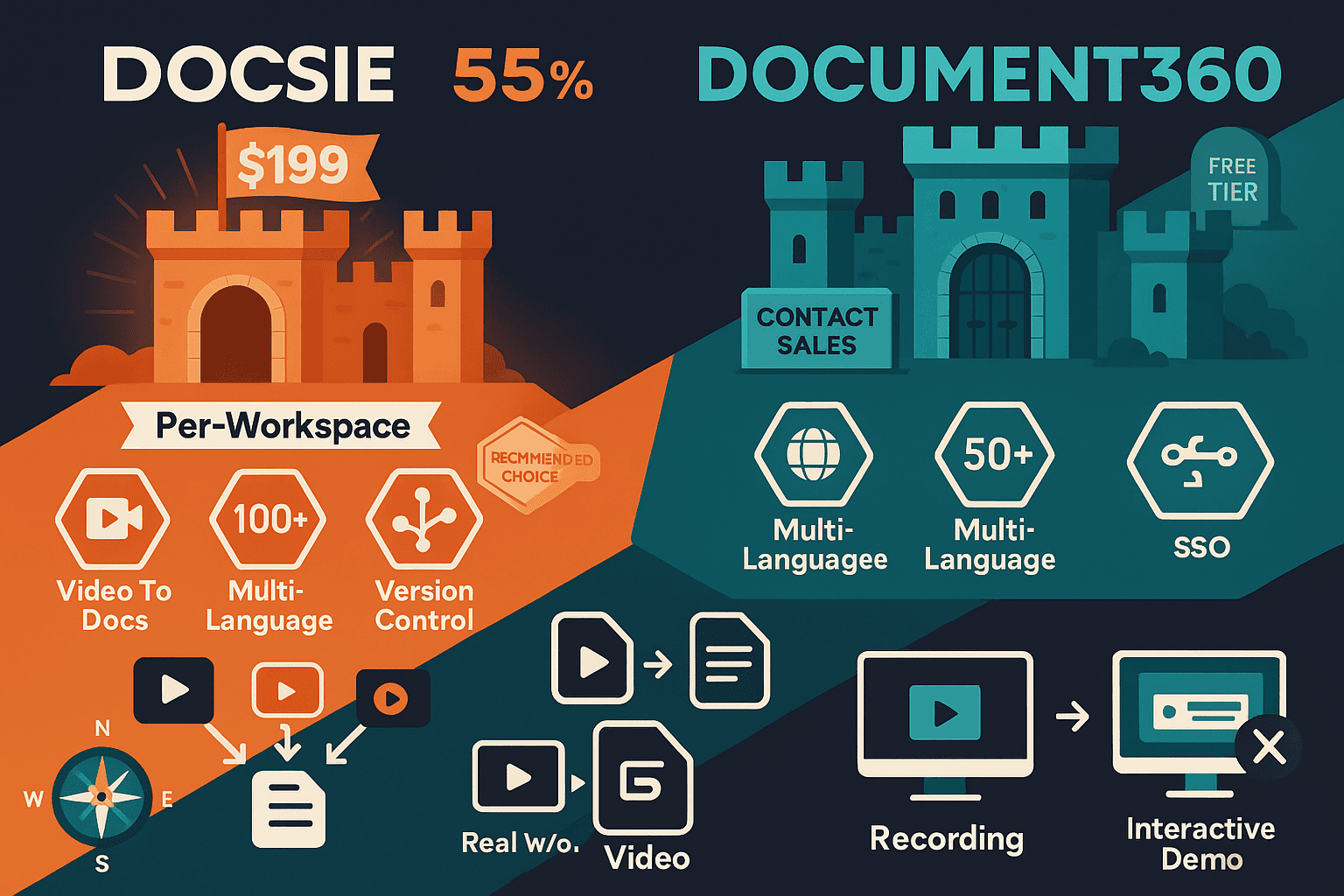
Docsie publishes complete pricing information on its website with clear monthly and annual rates. Plans start at $199/month for the Standard tier, $499/month for Professional, and $750/month for Business, with all feature breakdowns visible without contacting sales. A free Startup plan provides genuine testing capability with included AI credits—not a time-limited demo, but a real working environment.
Docsie also offers a 30-day free trial for paid tiers, giving you twice the evaluation period of competitors. When you're ready to purchase, you can complete the transaction online through self-serve checkout. No calendar scheduling, no discovery calls, no waiting for custom quotes.
Document360 requires sales contact for all pricing. Since discontinuing its free tier, the company provides zero pricing visibility on its website. Want to know if Document360 fits your $500/month budget or requires $5,000/month? You'll need to fill out a form, wait for sales outreach, schedule a call, and sit through a demonstration before receiving a quote.
For self-serve buyers accustomed to evaluating SaaS tools independently, this creates immediate friction. For procurement teams requiring budget estimates across multiple vendors, Document360's opaque pricing makes comparative analysis nearly impossible. And for startups or growing companies that need cost certainty for financial planning, quote-based pricing introduces unpredictability that transparent competitors simply don't impose.
Pricing Structure: Per-Workspace vs. Per-Seat
How platforms structure pricing determines your total cost of ownership as your team and customer base grow. Docsie and Document360 take fundamentally different approaches.
Docsie uses workspace-based pricing rather than charging per seat. A workspace includes unlimited team members at each tier, eliminating the per-user inflation that makes some platforms exponentially more expensive as teams grow. Whether you have 5 collaborators or 50, your monthly cost remains predictable.
This structure particularly benefits: - Growing teams that don't want documentation costs to balloon with each new hire - Agencies managing documentation for multiple clients without per-client licensing fees - Cross-functional companies where documentation involves product, support, marketing, and engineering teams
Docsie's multi-tenant architecture reinforces this value proposition—one knowledge base can power unlimited client-branded portals without additional per-portal charges. For agencies or B2B SaaS companies serving dozens or hundreds of clients, this represents substantial savings compared to platforms that charge per client portal.
Document360's pricing structure remains unclear without sales engagement, but the platform's single-tenant architecture means each knowledge base represents a separate licensing concern. The lack of multi-tenant capability creates potential cost multiplication for companies serving multiple clients with branded documentation.
Without published pricing, you can't model future costs as your team grows. What happens when you add 10 more team members? Launch documentation in 5 additional languages? Serve 20 new enterprise clients who need branded portals? With quote-based pricing, these questions require renegotiation rather than transparent calculation.
AI Credits and Content Conversion Costs
Both platforms emphasize AI-powered content creation, but their approaches to AI credits and conversion limits differ significantly.
Docsie includes AI credits in every plan, including the free tier. The Startup plan provides real conversion credits for testing video-to-docs and PDF-to-knowledge-base transformation—not a neutered demo, but functional AI capability. Paid plans include substantial monthly AI credits, with flexible add-on packages available when you need burst conversion capacity for large content migrations.
This transparent AI credit system lets you: - Test conversion quality on your actual content before paying - Budget AI costs based on predictable credit consumption - Add capacity flexibly without renegotiating your entire contract
Document360's Eddy AI capabilities include translation and content conversion, but without published pricing, understanding AI credit costs, limits, or top-up fees requires sales discussion. This opacity makes it difficult to budget for AI-intensive use cases like converting large video libraries or maintaining documentation in dozens of languages.
For teams evaluating AI-powered documentation tools specifically for content conversion workflows, Docsie's transparent AI credit pricing and generous free-tier inclusion provide decisive advantages in both testing and budgeting.
Feature Availability and Trial Access
Documentation platforms vary dramatically in what features they make available for evaluation and at which pricing tiers.
Docsie publishes detailed feature breakdowns for each tier on its pricing page. You know exactly what capabilities come with the $199 Standard plan versus the $750 Business plan. Multi-tenant portals? Included across paid plans. Advanced AI search with tool calls? Available at Professional tier and above. Custom domains, SSO, white-labeling—all clearly assigned to specific pricing tiers.
The 30-day free trial for paid plans gives you a full month to test advanced features with your real content and team workflows. For the free Startup plan, there's no time limit—you can use Docsie indefinitely for smaller projects while evaluating whether to upgrade.
Document360's feature availability remains tied to undisclosed pricing tiers. Without public pricing, you can't determine which features fall within specific budget ranges. Does AI translation require the mid-tier plan or only enterprise pricing? Are approval workflows included in base pricing or add-on modules? These questions necessitate sales engagement before you can even qualify the platform as viable for your budget.
Document360 does offer a 14-day free trial—half the duration of Docsie's 30-day trial and significantly shorter for thoroughly evaluating documentation tools with real team workflows and content migration.
Who Should Choose What
Choose Docsie if you need:
- Transparent, predictable pricing you can evaluate without sales calls
- Self-serve purchasing for fast procurement without vendor negotiation
- Free plan to test AI conversion with your actual videos and PDFs
- Per-workspace pricing that doesn't inflate as your team grows
- Multi-tenant portals to serve multiple clients without per-client fees
- Video-to-documentation conversion from real-world training videos, not just screen recordings
- Budget certainty for finance teams and procurement departments
- Longer trial periods (30 days vs. 14) for thorough evaluation
Consider Document360 if you:
- Prefer sales-assisted buying with relationship-based negotiation
- Need single-tenant external knowledge bases exclusively
- Have existing Document360 integrations or team familiarity
- Qualify for startup programs and can navigate their restrictions
- Don't require pricing transparency for internal approval processes
- Value purpose-built knowledge base focus over broader orchestration capabilities
The Clear Winner for Pricing Value
For transparent pricing, predictable costs, and superior value—especially for growing teams and multi-client scenarios—Docsie wins decisively.
Published pricing from $199-$750/month with clear feature breakdowns gives you immediate budget certainty. The free Startup plan with real AI credits lets you test video conversion, PDF transformation, and knowledge base delivery without credit card commitment. Self-serve purchase eliminates sales friction and procurement delays. Workspace-based pricing prevents per-seat cost inflation as teams grow. And multi-tenant architecture means serving 10 clients or 100 doesn't multiply licensing costs.
Document360's discontinuation of its free tier and complete move to quote-based pricing creates barriers that transparent competitors simply don't impose. For self-serve buyers, finance teams requiring budget predictability, and procurement departments comparing multiple vendors, opaque pricing represents an immediate disqualifier—not because Document360 necessarily costs more, but because you can't know what it costs without significant time investment in sales engagement.
The pricing transparency gap has widened in 2026. For companies that value self-serve evaluation, clear feature-to-price mapping, and predictable total cost of ownership, Docsie delivers what modern software buyers expect: straightforward pricing you can evaluate, compare, and purchase without friction.
Ready to See Transparent Pricing in Action?
Experience the difference that published pricing and genuine free-tier access make. Start your free Docsie account with included AI credits and test video-to-docs conversion on your actual content—no sales call required, no credit card needed, no time pressure.
For detailed feature and pricing breakdowns between these platforms, check out our comprehensive Docsie vs Document360 pricing comparison.