
Docsie vs Confluence: Which Documentation Platform Is Truly Enterprise-Ready in 2026?
Choosing an enterprise documentation platform isn't just about features—it's about architectural fit. Your technical team might lobby for Confluence because "everyone uses it," while your customer success leader is drowning in requests for branded portals they can't deliver. Your training department has hundreds of hours of video content gathering dust because no one has time to convert it into searchable documentation. Meanwhile, your compliance officer wants to know how either platform handles HIPAA data and EU residency requirements.
The truth is, Confluence and Docsie are both enterprise-ready platforms—but they solve fundamentally different problems. One dominates internal wikis for Atlassian-heavy organizations. The other delivers external multi-tenant documentation portals with AI-powered video conversion. If you're evaluating them side-by-side, you're likely facing a decision about whether your primary use case is internal knowledge management or external client-facing documentation delivery.
Let's cut through the marketing noise and examine what "enterprise ready" actually means for each platform in 2026.
Understanding the Platforms: Different DNA, Different Purposes
Confluence is Atlassian's enterprise wiki and collaboration platform, serving as the market-leading internal knowledge base for organizations already invested in Jira, Trello, and the broader Atlassian ecosystem. With proven scalability to 150,000 users per site and deep integration into engineering and product workflows, Confluence has earned its position as the default internal wiki for large enterprises. The recent addition of Rovo AI—included in all paid plans, not as an add-on—brings 80+ app connectors and 20+ pre-built documentation agents to automate common wiki tasks.
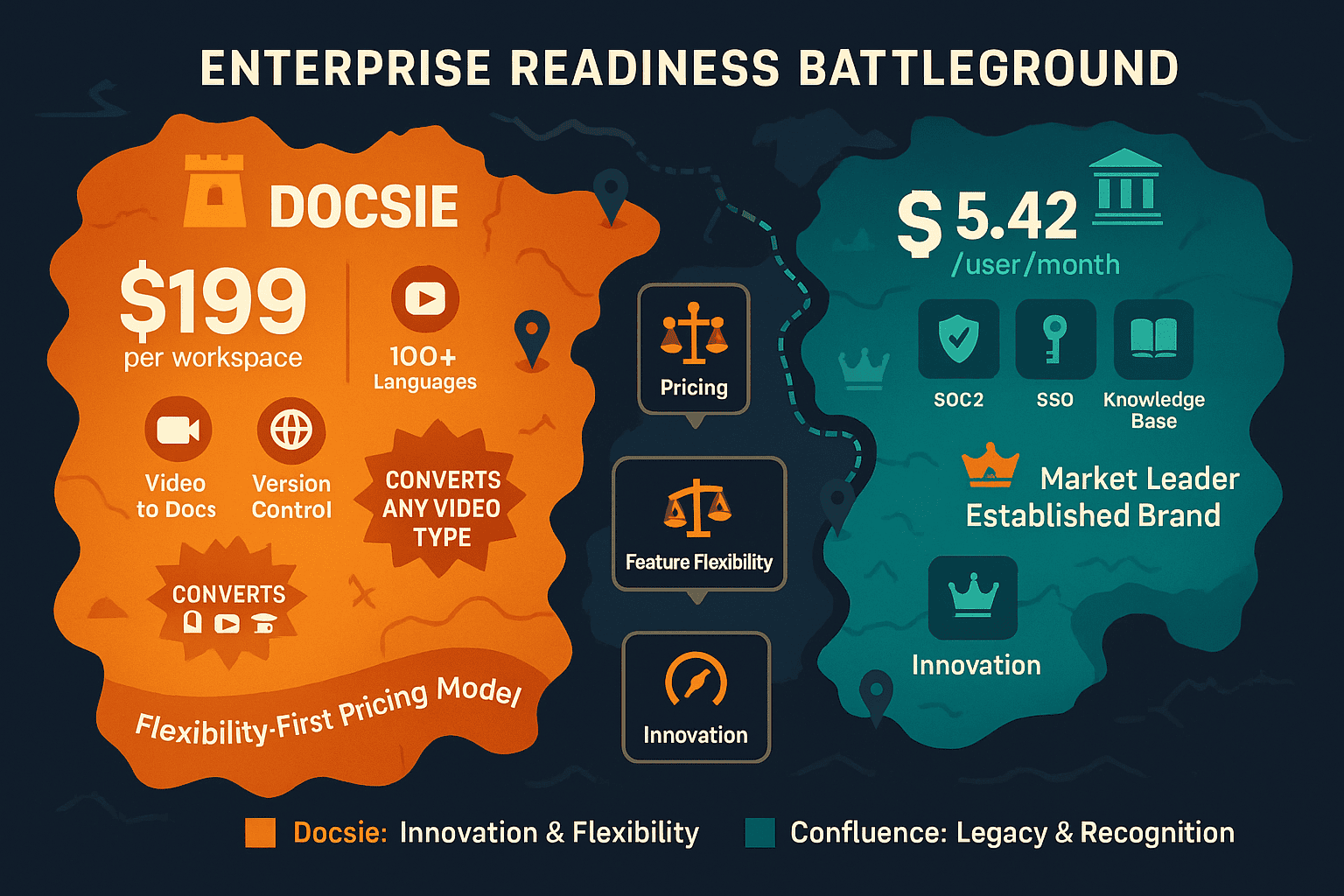
Docsie positions itself as an Agentic Knowledge Orchestration Platform, converting training videos, PDFs, and websites into structured knowledge bases using multimodal AI, then delivering them as branded portals, AI chatbots, and embedded widgets across 100+ languages. Unlike Confluence's internal wiki model, Docsie's architecture centers on multi-tenant external delivery: one knowledge base can power unlimited client-branded portals, each with custom domains, white-labeling, and isolated access controls. This makes it the natural choice for consultancies, implementation partners, SaaS companies, and any enterprise that needs to deliver documentation to clients rather than share it among internal teams.
For a detailed feature-by-feature breakdown, see our complete Docsie vs Confluence enterprise comparison.

Enterprise Readiness Dimension 1: Security, Compliance, and Data Residency
Both platforms deliver enterprise-grade security, but with different compliance emphases.
Confluence holds SOC 2 Type II certification, GDPR compliance, and ISO 27001 certification—the full compliance trifecta that satisfies most enterprise procurement requirements. As an Atlassian Cloud product, it inherits Atlassian's mature security infrastructure, including SSO via SAML 2.0, granular permission controls at the page and space level, and comprehensive audit logging. Organizations subject to regulatory requirements will appreciate the extensive compliance documentation and third-party audit reports Atlassian makes available.
Docsie matches the core compliance baseline with SOC 2 Type II and GDPR, but goes further for specific use cases: HIPAA-ready infrastructure for healthcare organizations and EU data residency options for companies that need to guarantee data storage within European borders. For enterprises delivering documentation to clients in regulated industries—healthcare providers, financial services firms, government contractors—these capabilities are critical. Docsie also provides granular audit logging at the portal level, meaning you can track which client users accessed which documents when, essential for compliance reporting.
The key difference: Confluence's compliance story assumes you're managing internal documentation for your own employees. Docsie's compliance architecture accounts for the complexity of managing documentation across multiple external clients with different regulatory requirements.
Enterprise Readiness Dimension 2: Multi-Tenant Architecture vs. Single-Instance Wikis
This is where the platforms diverge most sharply.
Confluence operates as a single-instance wiki (or multiple separate spaces within one instance). You can create different spaces for different departments, projects, or teams, and control permissions granularly. This works beautifully for internal use cases: engineering teams document architecture decisions, product teams maintain roadmaps, support teams build internal runbooks. Real-time collaborative editing allows teams to work simultaneously on the same page. The entire system is optimized for internal knowledge sharing among employees who all work for the same organization.
But what happens when you need to deliver documentation to external clients? You hit architectural limitations. Confluence doesn't support custom domains for external delivery, doesn't provide white-label branding per client, and doesn't offer true multi-tenant isolation. You can technically create separate Confluence sites for different clients, but you're paying per site and managing them separately—an approach that breaks down at scale.
Docsie builds multi-tenancy into its core architecture. You create a master knowledge base once, then deploy it to unlimited client-branded portals. Each portal can have its own custom domain (docs.clientname.com), white-label branding, isolated access controls, and even content variations. This architecture serves enterprises that need to deliver documentation at scale to external audiences: implementation partners supporting multiple clients, SaaS companies serving different customer segments, consultancies delivering custom documentation packages.
If you're a company with one internal team sharing knowledge among themselves, Confluence's single-instance model is simpler and more mature. If you're a company delivering documentation to multiple external clients, Docsie's multi-tenant architecture is purpose-built for your use case.
Enterprise Readiness Dimension 3: AI Capabilities and Video-to-Docs Conversion
AI is the buzzword of 2026, but implementation quality matters more than feature lists.
Confluence includes Rovo AI across all paid plans—a significant advantage over competitors that charge separately for AI features. Rovo provides 20+ pre-built documentation agents that automate common tasks: generating page summaries, suggesting related content, drafting documentation from Jira tickets, and answering questions across your Confluence spaces. The 80+ app connectors mean Rovo can pull information from your broader tool stack to enrich documentation. This is powerful for teams already living in the Atlassian ecosystem, creating genuine productivity gains for internal documentation workflows.
However, Confluence notably lacks video-to-docs capability. If your training team records onboarding videos, your product team creates feature demos, or your support team maintains video troubleshooting guides, Confluence can't help you convert that content into searchable, structured documentation. You can embed videos on Confluence pages, but they remain opaque black boxes that search can't penetrate and AI can't analyze.
Docsie positions video-to-docs AI as a core capability, not an afterthought. The platform ingests real-world training videos, screen recordings, Loom videos, and other video content, then uses multimodal AI to extract structured documentation: step-by-step procedures, screenshots at key moments, searchable transcripts, and even translated versions across 100+ languages. This is transformative for enterprises sitting on libraries of video training content that's currently underutilized because it's not discoverable or searchable.
Docsie's AI also uses agentic search with tool calls rather than pure RAG (Retrieval-Augmented Generation), which the company claims delivers more accurate chatbot responses by having the AI execute specific tools rather than just retrieving text chunks. In practice, this means the AI chatbot can perform actions like "show me the installation procedure for version 2.3" rather than just returning paragraphs that mention installation.
The trade-off: Confluence's AI is more mature for traditional wiki tasks and benefits from Atlassian's massive investment in the Rovo platform. Docsie's AI is more specialized for video conversion and external delivery use cases that Confluence doesn't address at all.
Enterprise Readiness Dimension 4: Scalability, Integration, and Support
Both platforms scale to enterprise volumes, but through different mechanisms.
Confluence has proven scalability to 150,000 users per site, backed by Atlassian's infrastructure and decades of experience serving Fortune 500 companies. The integration story centers on the Atlassian ecosystem: deep Jira integration for linking documentation to issues, seamless connection to Trello and Bitbucket, and now Rovo's 80+ app connectors extending to the broader SaaS landscape. For support, you get Atlassian's mature enterprise support organization, extensive documentation, active community forums, and a massive third-party consulting ecosystem. If you need to hire someone who knows Confluence, you'll find hundreds of candidates.
Docsie scales through its workspace-based pricing model rather than per-seat pricing, which avoids cost inflation as your team grows. The integration approach emphasizes API access and webhooks for custom workflows rather than pre-built integrations—appropriate for a newer platform serving more specialized use cases. SOC 2 Type II compliance and GDPR mean the infrastructure meets enterprise security standards. EU data residency options provide geographic control over data storage.
The support story is less mature than Atlassian's by virtue of company age, and Docsie acknowledges "enterprise sales cycle still maturing" as a current limitation. You won't find the same depth of community resources, third-party consultants, or decade-old forum threads solving edge cases.
Who Should Choose What?
Choose Confluence if your primary use case is internal documentation for teams deeply embedded in the Atlassian ecosystem. If your engineers already live in Jira, your product managers plan in Confluence, and your support team triages in Jira Service Management, Confluence is the obvious choice for internal knowledge management. The platform's maturity, proven scalability to 150,000 users, ISO 27001 certification, and real-time collaborative editing make it the gold standard for internal enterprise wikis.
Choose Docsie if you need to deliver documentation externally to clients, partners, or customers through branded portals. The multi-tenant architecture, video-to-docs AI conversion, 100+ language auto-translation, custom domains, and white-labeling capabilities serve use cases Confluence simply doesn't address. This makes Docsie the clear choice for implementation consultancies supporting multiple clients, SaaS companies delivering customer education, training organizations converting video libraries into searchable knowledge bases, and any enterprise where the primary consumer of documentation is external rather than internal.
The Verdict: Different Tools for Different Architectural Needs
Confluence is enterprise-ready for internal wikis. Docsie is enterprise-ready for external documentation delivery. Both statements can be true simultaneously because they serve fundamentally different use cases.
If you're evaluating them side-by-side, the deciding factor isn't feature count or brand recognition—it's whether your documentation consumers are primarily internal employees collaborating on shared knowledge, or external clients each needing their own branded experience.
For enterprises facing the external documentation challenge—converting video training content, delivering multi-tenant branded portals, supporting customers across 100+ languages, providing white-labeled documentation as part of your service offering—Docsie delivers enterprise readiness for use cases Confluence cannot serve. The architecture is purpose-built for external delivery, the AI converts video into structured documentation rather than just organizing pages, and the multi-tenant model scales to unlimited client portals without per-site fees.
Confluence remains the stronger choice for internal Atlassian-centric wikis where Jira integration and collaborative editing drive daily workflows. But if your challenge is getting documentation out to clients rather than sharing it among teammates, Docsie's enterprise architecture provides capabilities that don't exist in Confluence's internal wiki model.
Ready to See Multi-Tenant Documentation in Action?
If your organization needs to deliver branded documentation portals to multiple clients, convert video training content into searchable knowledge bases, or support global customers across 100+ languages, Docsie's architecture is purpose-built for your use case.
Start your free trial and see how multi-tenant documentation delivery works for enterprises managing external client documentation at scale. No credit card required—just connect your first video or PDF and experience how AI converts it into structured, searchable, translatable documentation you can deploy to branded client portals in minutes.
For a detailed feature comparison including pricing, security specs, and integration capabilities, visit our complete Docsie vs Confluence enterprise comparison page.