
Docsie vs Clueso: Enterprise Readiness 2026
Choosing documentation tools for enterprise deployment isn't just about features anymore—it's about infrastructure. Your CTO wants SSO integration. Legal demands audit logs. Product needs multi-tenant portals for 47 different clients. Meanwhile, your support team is drowning in outdated PDFs and screen recordings that need to become searchable knowledge bases.
The market now offers AI-powered documentation platforms that promise to solve these problems, but their enterprise readiness varies dramatically. Two platforms generating particular interest are Docsie and Clueso—both SOC 2 Type II certified, both processing video into documentation, yet architected for fundamentally different use cases. One is built for enterprise knowledge orchestration at scale. The other excels at polished video creation but lacks critical enterprise infrastructure.
Let's examine what "enterprise readiness" actually means in 2026 and how these platforms compare when your deployment involves regulated environments, multiple stakeholders, and documentation that must scale across divisions, languages, and customer bases.
What Is Docsie?
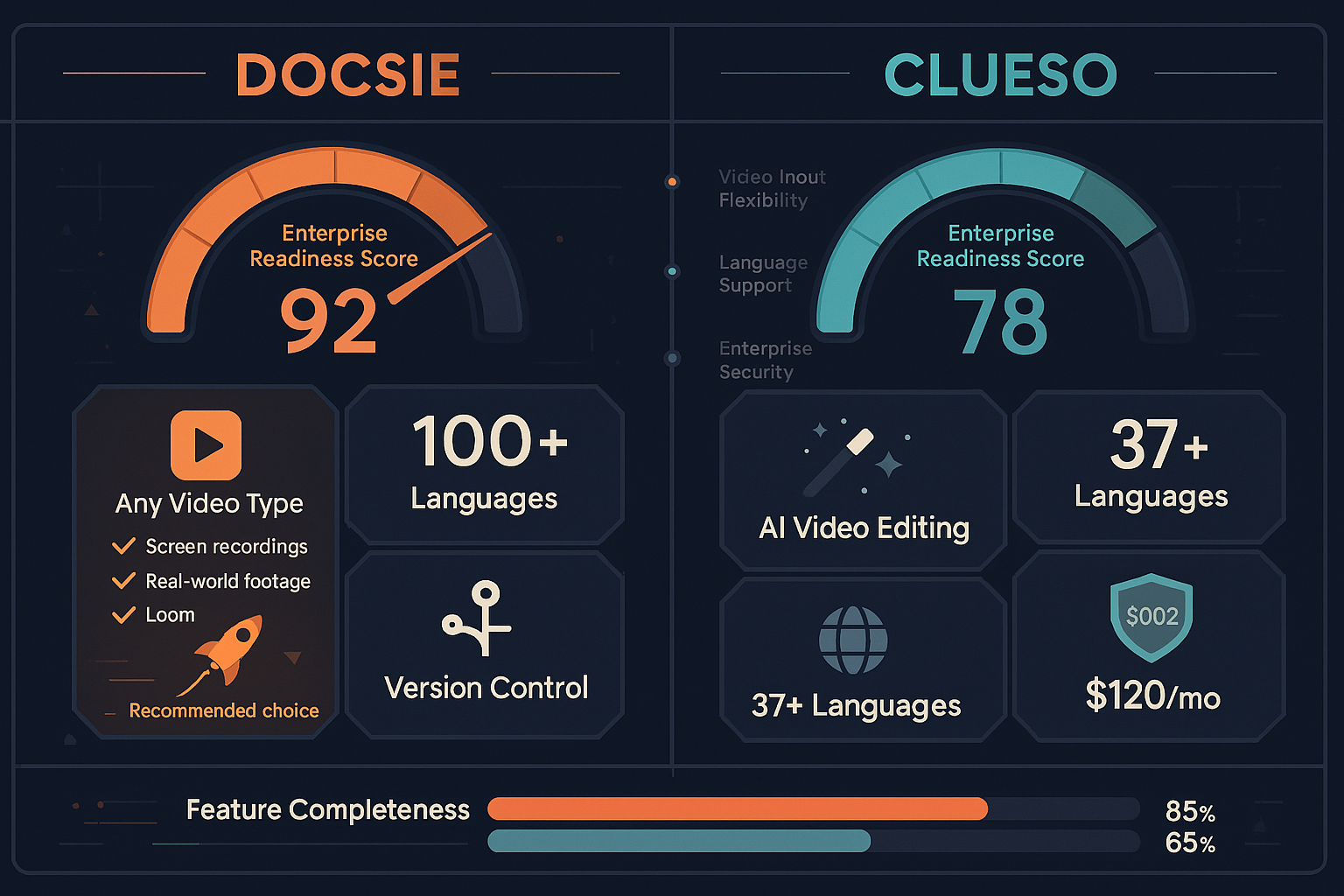
Docsie positions itself as an "Agentic Knowledge Orchestration Platform"—a full-stack solution that converts training videos, PDFs, and websites into structured knowledge bases using multimodal AI, then delivers them as branded portals, AI chatbots, and embedded widgets across 100+ languages.
The platform handles any video type (real-world footage, screen recordings, Loom videos), processes them through multimodal AI, and structures the output into searchable documentation. Crucially, Docsie provides the complete CONVERT → MANAGE → DELIVER workflow in a single platform with multi-tenant architecture—one knowledge base can power unlimited client-branded portals. The search functionality uses agentic AI with tool calls rather than standard RAG approaches, delivering more accurate chatbot responses. This matters for enterprises managing documentation at scale across multiple business units or client organizations.
What Is Clueso?
Clueso takes a different approach: it transforms screen recordings into professionally edited product videos with AI voiceovers, auto-zoom, cursor smoothing, and branded styling—plus step-by-step text articles. The platform targets SaaS customer education teams who need polished video tutorials quickly.
Clueso's strength lies in video editing quality. The AI-powered auto-zoom, pan effects, and cursor smoothing produce professional-looking output that would typically require manual video editing skills. Each recording generates dual output: a polished video and a written article. The platform holds both SOC 2 Type II and ISO 27001 certification, demonstrating strong security compliance. However, Clueso processes only screen recordings—not real-world videos or arbitrary video content—and focuses specifically on video creation rather than comprehensive documentation management.
Enterprise Readiness: Where the Differences Emerge
For a full feature-by-feature breakdown, see our detailed Docsie vs Clueso enterprise comparison. Here we'll focus on the four dimensions that typically determine enterprise deployment success or failure.
Identity & Access Management
SSO Integration is non-negotiable for most enterprise deployments. IT security policies mandate centralized identity management through Azure AD, Okta, or similar providers. When employees leave, their access must terminate instantly across all systems. When contractors join for 90-day projects, access provisioning must be automated.
Docsie provides full SSO integration with major identity providers, enabling centralized authentication and automated user lifecycle management. This alone makes deployment possible in regulated environments where shadow IT is prohibited.
Clueso does not currently offer SSO integration. This architectural gap means enterprises must manage user credentials separately, creating security vulnerabilities and compliance risks. For organizations with strict identity governance requirements, this is typically a deployment blocker regardless of other features.
Role-Based Access Control (RBAC) determines who can create, edit, approve, and publish documentation. Enterprise workflows involve multiple stakeholders—subject matter experts draft content, technical writers edit, legal reviews, managers approve. Docsie's RBAC system supports these complex approval workflows.
Clueso's simpler team structure works for small groups creating video tutorials but lacks the granular permission controls required for enterprise content governance.
Multi-Tenant Architecture & Scalability
Enterprise documentation rarely serves a single audience. Consider a software company delivering documentation to 100+ enterprise clients, each requiring branded portals with their own domains, logos, and customization. Or a multi-national corporation managing knowledge bases for 30 regional divisions in different languages.
Docsie's multi-tenant portals address this exact scenario: one knowledge base powers unlimited client-branded portals. You maintain a single source of truth while delivering customized experiences at scale. Each portal can have custom domains, white-labeling, and tailored content subsets. This architecture dramatically reduces maintenance overhead while enabling personalization.
Clueso does not provide multi-tenant customer portals. The platform creates videos and articles, but lacks the infrastructure for delivering them to multiple audiences through branded, managed environments. Organizations needing client-specific documentation delivery require additional tools in their stack.
Version Control becomes critical when documentation must comply with regulations or support product releases. Regulated industries need to prove which version of documentation was live on specific dates. Product teams need to align documentation releases with software versions.
Docsie includes comprehensive version control and content lifecycle management—track changes, roll back to previous versions, schedule publication dates, and maintain audit trails of content evolution.
Clueso lacks version control infrastructure. For video tutorial creation, this may be acceptable. For enterprise documentation requiring change tracking and regulatory compliance, it's insufficient.
Audit & Compliance Infrastructure
Audit Logs record who accessed what content, when changes were made, and what actions users performed. These logs are mandatory for SOC 2, ISO 27001, HIPAA, and GDPR compliance. During security incidents, audit logs enable forensic investigation. During regulatory audits, they provide required evidence trails.
Docsie provides comprehensive audit logging of user actions, content changes, and system access—essential for compliance and security investigations.
Clueso, despite holding SOC 2 Type II certification for its infrastructure, does not offer audit logs to customers. The platform's security compliance covers Clueso's operations, but enterprises deploying Clueso cannot generate the audit trails their own compliance frameworks require.
Data Residency matters for organizations subject to GDPR, China's data localization laws, or other data sovereignty requirements. Docsie offers EU data residency options, enabling compliant deployments for European customers or companies handling EU citizen data.
Clueso's data residency options are not prominently documented, which may complicate deployments in jurisdictions with strict data localization requirements.
Integration & Extensibility
API Access and Webhooks enable enterprises to integrate documentation platforms into existing workflows—triggering documentation updates when code deploys, synchronizing user permissions from HR systems, embedding documentation in custom applications, or automating translation workflows.
Docsie provides comprehensive API access and webhooks, supporting programmatic content management and custom integrations. For enterprises with unique workflows or legacy systems, this extensibility is often essential.
Clueso's integration capabilities focus on its video creation workflow rather than comprehensive API access for enterprise automation and integration scenarios.
SLA Commitments define accountability. Docsie offers 99.9% uptime SLA with dedicated success management for enterprise customers—creating contractual obligations and escalation paths when issues arise.
Clueso provides enterprise support but without the same SLA commitments and dedicated success infrastructure that large deployments typically require.
Who Should Choose What?
Choose Docsie When You Need...
Comprehensive enterprise infrastructure: If your deployment requires SSO integration, audit logs, multi-tenant portals, API access, or version control, Docsie provides the complete stack. These aren't optional features for most enterprise environments—they're baseline requirements that determine whether deployment is even possible.
Knowledge orchestration at scale: Organizations managing documentation for multiple clients, divisions, or products benefit from Docsie's multi-tenant architecture and full CONVERT → MANAGE → DELIVER workflow. The platform handles any video type (not just screen recordings), processes them into structured knowledge bases, and delivers them through branded portals, chatbots, and widgets across 100+ languages.
Regulated environments: Industries requiring audit trails, version control, data residency options, and comprehensive compliance infrastructure need platforms built for regulatory requirements. Docsie's enterprise stack addresses these needs; Clueso's video creation focus does not.
Choose Clueso When You Need...
Polished video tutorials with minimal effort: If your primary use case is creating professional-looking product videos from screen recordings, Clueso's AI-powered editing (auto-zoom, pan, cursor smoothing) produces exceptional output quality without manual editing skills.
ISO 27001 certification specifically: Organizations with vendor requirements specifically mandating ISO 27001 (beyond SOC 2) will appreciate Clueso's dual certification, though this advantage assumes SSO and audit log requirements don't apply.
Simple team collaboration: Small teams creating video content without complex approval workflows, multi-tenant requirements, or enterprise integration needs may find Clueso's streamlined approach sufficient.
The Enterprise Verdict: Infrastructure Matters
Both platforms hold SOC 2 Type II certification and process video into documentation. The critical difference lies in enterprise infrastructure completeness.
Docsie provides the comprehensive administrative capabilities, integration options, and architectural foundations that enterprise deployments require: SSO for identity management, audit logs for compliance, multi-tenant portals for scalability, API access for automation, version control for governance, and 99.9% SLA for accountability. These aren't luxury features—they're baseline requirements in regulated environments serving multiple stakeholders.
Clueso delivers strong security compliance and excellent video editing quality for its creation-focused use case. However, the absence of SSO integration and audit logs alone disqualifies it for most regulated enterprise environments, while the lack of multi-tenant architecture, version control, and comprehensive API access limits its applicability to simple, small-team video creation scenarios.
For enterprise documentation management requiring security, scalability, compliance, and integration at scale, Docsie's purpose-built knowledge orchestration platform addresses the full spectrum of requirements that video creation tools cannot match.
See It In Action
Enterprise infrastructure requirements are complex, and documentation decisions affect compliance, security, and user experience across your organization.
Evaluate Docsie's enterprise capabilities hands-on: Start your free trial and test SSO integration, multi-tenant portals, audit logging, and API access with your own content and workflows.
For detailed feature comparisons, security specifications, and deployment architectures, visit our complete Docsie vs Clueso enterprise comparison.