
Docsie vs Archbee: Which Documentation Platform Is Truly Enterprise-Ready in 2026?
Enterprise buyers evaluating documentation platforms face a common trap: advertised base prices that look attractive but hide the true cost of enterprise-grade features behind add-ons, upgrades, and service tiers. When security, compliance, and multi-client scalability aren't negotiable, you need to look past marketing pages and compare what's actually included at each pricing level.
This comparison examines Docsie and Archbee through the lens of enterprise readiness: security posture, compliance frameworks, multi-tenant architecture, administrative controls, and transparent pricing. While both platforms serve professional teams, their approaches to enterprise requirements differ substantially—and those differences directly impact deployment timelines, total cost of ownership, and long-term scalability.
Introducing the Platforms
Docsie positions itself as an Agentic Knowledge Orchestration Platform—a system that converts training videos, PDFs, and websites into structured knowledge bases using multimodal AI, then delivers them as branded portals, AI chatbots, and embedded widgets across 100+ languages for multiple clients simultaneously. The platform handles the full workflow from content ingestion through client-facing delivery, with particular strength in multi-tenant architectures where one knowledge base powers unlimited branded portals for different customers, partners, or business units.
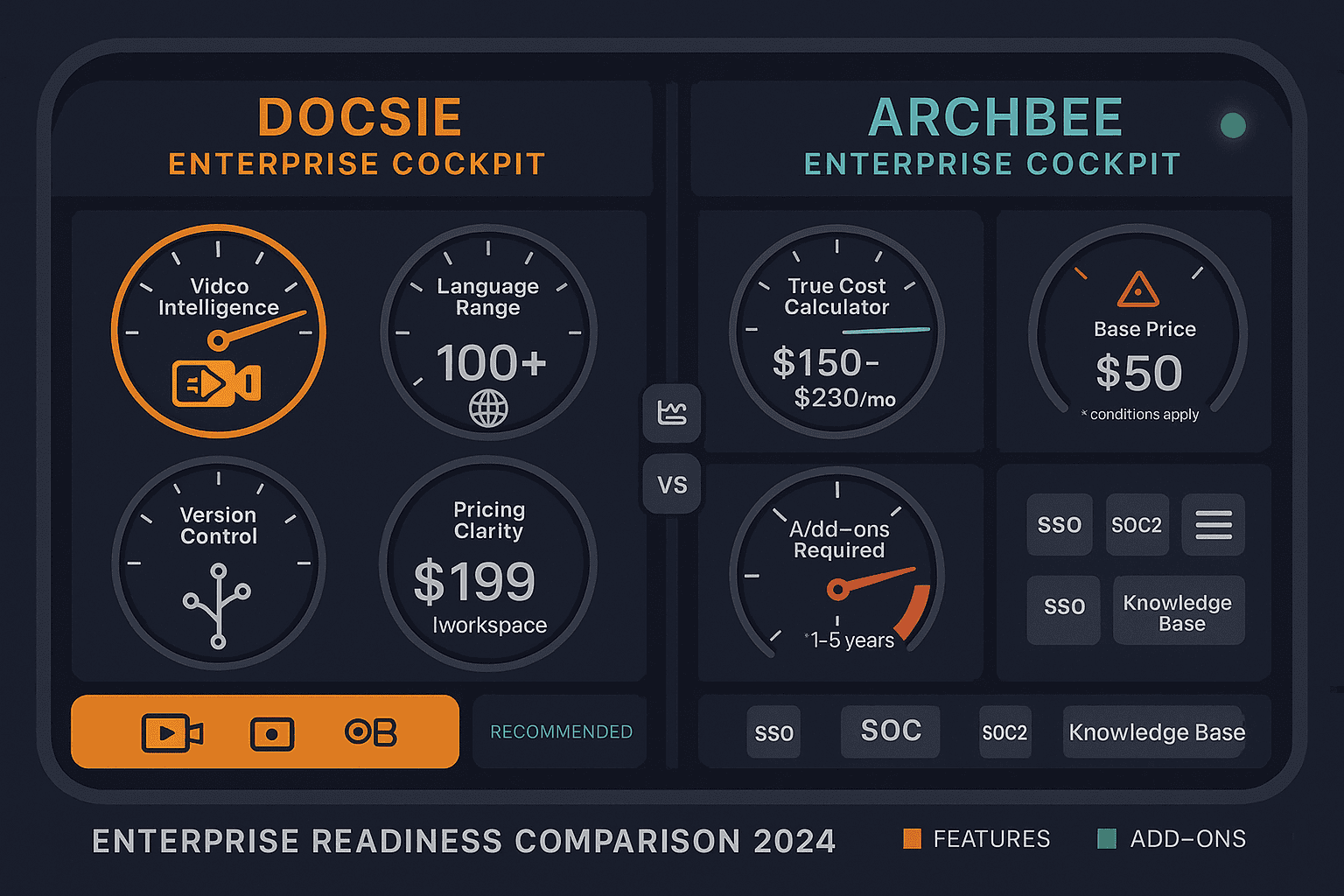
Archbee describes itself as a developer and product documentation platform with a low advertised base price of $50/month. It focuses on API documentation with OpenAPI/Swagger support and clean developer-focused UI. However, that entry price excludes AI Write Assist, App Widget, API Access, and Analytics—all separate paid add-ons that increase the real cost to $150-230/month for teams needing standard documentation capabilities.

Security and Compliance: Built-In vs. Bolted-On
For regulated industries and enterprise procurement teams, security and compliance aren't optional features—they're table stakes. The differences between Docsie and Archbee become immediately apparent when evaluating these requirements.
Docsie's Compliance Framework
Docsie provides SOC 2 Type II certification, GDPR compliance, and HIPAA-ready infrastructure out of the box. This isn't theoretical compliance—it includes comprehensive audit logging that tracks every user action, content change, and access event. For organizations in healthcare, finance, or government sectors, this audit trail isn't just helpful; it's mandatory.
EU data residency options allow enterprises to ensure documentation and customer data remain within specific geographic boundaries, addressing data sovereignty requirements common in European markets. Multiple SSO options—SAML, OAuth, OIDC, Azure AD, and Okta—are included at the Organization tier without requiring an Enterprise upgrade. This means security teams can integrate Docsie into existing identity management infrastructure without negotiating custom contracts or paying premium add-on fees.
Archbee's Security Posture
Archbee offers basic security features appropriate for internal developer documentation teams but lacks the depth required for multi-client enterprise deployments. Audit logging—essential for compliance frameworks like SOC 2, HIPAA, and GDPR—is not prominently featured. Data residency options aren't advertised, which poses challenges for European enterprises with strict data localization requirements.
While SSO is available, the platform's focus on small development teams means administrative controls, permission granularity, and compliance reporting are less developed than what enterprise security teams typically require during vendor assessments.
For enterprises: If your procurement process includes security questionnaires, compliance certifications, or regulatory requirements, Docsie's built-in compliance framework accelerates approval cycles. Archbee's lighter security posture may suffice for internal developer docs but creates friction when serving external clients or operating in regulated industries.
Multi-Tenant Architecture: Client Delivery at Scale
The architectural difference between single-organization tools and multi-tenant platforms fundamentally shapes what's possible at enterprise scale.
Docsie's Multi-Tenant Model
Docsie's core architecture supports multi-tenant portals: one knowledge base can power unlimited client-branded portals, each with custom domains, branding, and access controls. For SaaS companies, agencies, or enterprises with multiple business units, this means maintaining a single source of truth while delivering customized documentation experiences to different audiences.
This architecture scales to 10,000+ sites with a 99.9% uptime SLA. Version inheritance and approval workflows allow central teams to manage content updates while controlling what each tenant sees and when. Granular permissions ensure partners see partner documentation, customers see product guides, and internal teams access administrative resources—all from one system.
Archbee's Single-Organization Design
Archbee is designed for single-organization use cases: internal developer documentation, API references, and product guides for one company's team. It doesn't advertise multi-tenant capabilities, custom portal delivery, or the infrastructure to serve multiple external clients from one knowledge base.
For agencies serving dozens of clients, or enterprises delivering documentation to hundreds of partners, this architectural limitation requires either manual duplication (creating separate Archbee instances for each client) or cobbling together external tools to achieve white-label delivery.
For enterprises: If your documentation serves multiple clients, partners, departments, or regional offices—each requiring branded portals with separate access controls—Docsie's multi-tenant architecture is purpose-built for this use case. Archbee's single-organization model works well for internal teams but doesn't scale to multi-client delivery without significant workarounds.
Pricing Transparency: What's Actually Included?
Enterprise buyers are familiar with "land and expand" pricing strategies where base prices look attractive but necessary features require expensive add-ons. The difference between advertised and actual costs matters when planning budgets and comparing total cost of ownership.
Docsie's Transparent Pricing
Docsie includes analytics, API access, AI capabilities, and widgets in its standard pricing tiers without separate add-on fees. The Organization tier ($150/month for 10 users) includes multiple SSO options, GDPR compliance tools, and multi-tenant capabilities. Enterprise tier adds SOC 2 certification, dedicated success management, and custom SLAs.
This transparent structure means procurement teams can budget accurately. The features required for enterprise deployment—SSO, analytics, API access, compliance reporting—are included, not upsold as premium add-ons after initial commitment.
Archbee's Add-On Model
Archbee advertises a $50/month base price, but that tier excludes features most teams need:
- AI Write Assist: $20/month extra
- Analytics: $80/month extra
- App Widget: Additional fee
- API Access: Separate add-on
For a team needing AI assistance, analytics to track documentation usage, and API access for integrations, the real cost is $150-230/month—triple the advertised base price. This pricing structure isn't unusual in SaaS, but it does mean the headline price isn't representative of actual deployment costs.
For enterprises: When comparing platforms, calculate total cost with all necessary features enabled. Docsie's transparent pricing provides predictability; Archbee's base price requires careful analysis of which add-ons your team actually needs to function effectively.
Global Delivery and AI Capabilities
Enterprise documentation increasingly serves global audiences, requiring translation, localization, and intelligent search capabilities.
Docsie's Global Reach
Docsie provides automatic translation into 100+ languages, enabling global enterprises to maintain one knowledge base while delivering localized documentation to regional offices, international customers, and global partners. The platform's agentic AI search uses tool calls rather than simple RAG (Retrieval-Augmented Generation), resulting in more accurate chatbot responses that can execute actions, not just retrieve information.
Content ingestion handles any video type—including real-world training videos, screen recordings, and Loom videos—plus PDFs and websites, converting them into structured knowledge bases. This multimodal approach means existing training content becomes searchable documentation without manual rewriting.
Archbee's Developer Focus
Archbee's AI Write Assist (available as a paid add-on) helps developers draft technical documentation more quickly. The platform doesn't advertise multi-language translation capabilities or agentic AI search. Its strength lies in OpenAPI/Swagger integration for API documentation, making it well-suited for technical teams documenting REST APIs and SDKs.
For enterprises: If your documentation serves global markets or requires translation at scale, Docsie's 100+ language support is purpose-built for international delivery. If your primary need is internal API documentation in English, Archbee's developer-focused tools may be sufficient.
Who Should Choose What?
The right platform depends on your specific enterprise requirements, organizational structure, and documentation delivery model.
Choose Docsie If You Need...
- SOC 2, GDPR, and HIPAA compliance with EU data residency and comprehensive audit logs for regulated industries
- Multiple SSO options (SAML, OAuth, OIDC, Azure AD, Okta) included without Enterprise-tier upgrades
- Multi-tenant portals delivering branded documentation to multiple clients, departments, or partners from one system
- Transparent pricing with analytics, API access, AI capabilities, and widgets included without add-on fees
- Scalability to 10,000+ sites with 99.9% uptime SLA and dedicated success management
- Granular permissions, version inheritance, and approval workflows for complex organizational structures
- 100+ language auto-translation for global documentation delivery across international markets
Choose Archbee If Your Needs Are Limited To...
- Small internal developer documentation team (3-10 people) with basic compliance needs
- API/OpenAPI documentation as primary focus without multi-client delivery requirements
- Budget constraints and willingness to accept limited features at base price tier
- Single-organization use case without need for multi-tenant portals or data residency
- No requirement for audit logging, advanced analytics, or extensive API integrations
The Verdict: Docsie Delivers Enterprise-Grade Infrastructure
For enterprises evaluating documentation platforms based on security, compliance, scalability, and total cost of ownership, Docsie provides significantly more robust capabilities at transparent pricing.
Multi-tenant architecture, HIPAA readiness, audit logs, EU data residency, included SSO options, and comprehensive API access make Docsie genuinely enterprise-ready for organizations serving multiple clients, operating in regulated industries, or requiring predictable infrastructure at scale.
Archbee's $50 base price quickly becomes $150-230/month with necessary add-ons, yet still lacks multi-tenant delivery, audit logs, data residency options, or translation capabilities. It's a solid choice for small internal developer documentation teams, but doesn't provide the enterprise-grade infrastructure required for multi-client operations or regulated environments.
For enterprise buyers, the decision comes down to whether you need a developer documentation tool or a comprehensive knowledge orchestration platform that handles complex organizational requirements out of the box.
See the Full Comparison
We've created a detailed side-by-side comparison covering security, compliance, scalability, administration, and pricing for both platforms. View the complete Docsie vs Archbee Enterprise Comparison to see feature matrices, pricing breakdowns, and real-world use cases.
Ready to Experience Enterprise-Ready Documentation?
See how Docsie's multi-tenant architecture, compliance framework, and transparent pricing support enterprise documentation at scale. Start your free trial and explore SOC 2 compliance, multi-language delivery, and agentic AI search without credit card requirements or sales calls.