
Confluence vs Slab: Which Enterprise Wiki Wins in 2026?
Every growing organization hits the same wall: tribal knowledge scattered across Slack threads, Google Docs buried in folders, and onboarding that takes weeks instead of days. The solution seems obvious—implement an enterprise wiki. But choosing between Confluence's comprehensive feature set and Slab's radical simplicity isn't straightforward, especially when enterprise requirements like compliance, scalability, and AI capabilities enter the picture.
This comparison examines Confluence and Slab through the lens of enterprise readiness in 2026, evaluating real-world deployment scenarios, security requirements, and the hidden costs of each platform.
What is Confluence?
Confluence is Atlassian's enterprise wiki and collaboration platform, serving as the market leader in internal documentation for large organizations. Used by engineering and product teams globally, it functions as a central knowledge hub deeply integrated with Jira, Trello, and Bitbucket.
As of 2026, Confluence includes Rovo AI across all paid plans—not as an add-on, but as a core feature. This positions Confluence as an AI-native documentation platform with 20+ pre-built agents for common documentation tasks and connectors to 80+ apps. For organizations already invested in the Atlassian ecosystem, Confluence provides the natural documentation layer that ties project management, code repositories, and knowledge management together.
However, Confluence remains exclusively an internal tool. It lacks multi-tenant portal capabilities, custom domain support for external delivery, and video-to-documentation conversion—limitations that matter when organizations need to serve customers, not just internal teams.

What is Slab?
Slab takes the opposite approach: extreme simplicity. Positioned as a clean, minimal internal wiki, Slab focuses on fast search and frictionless collaboration without the feature complexity that makes other platforms intimidating to new users.
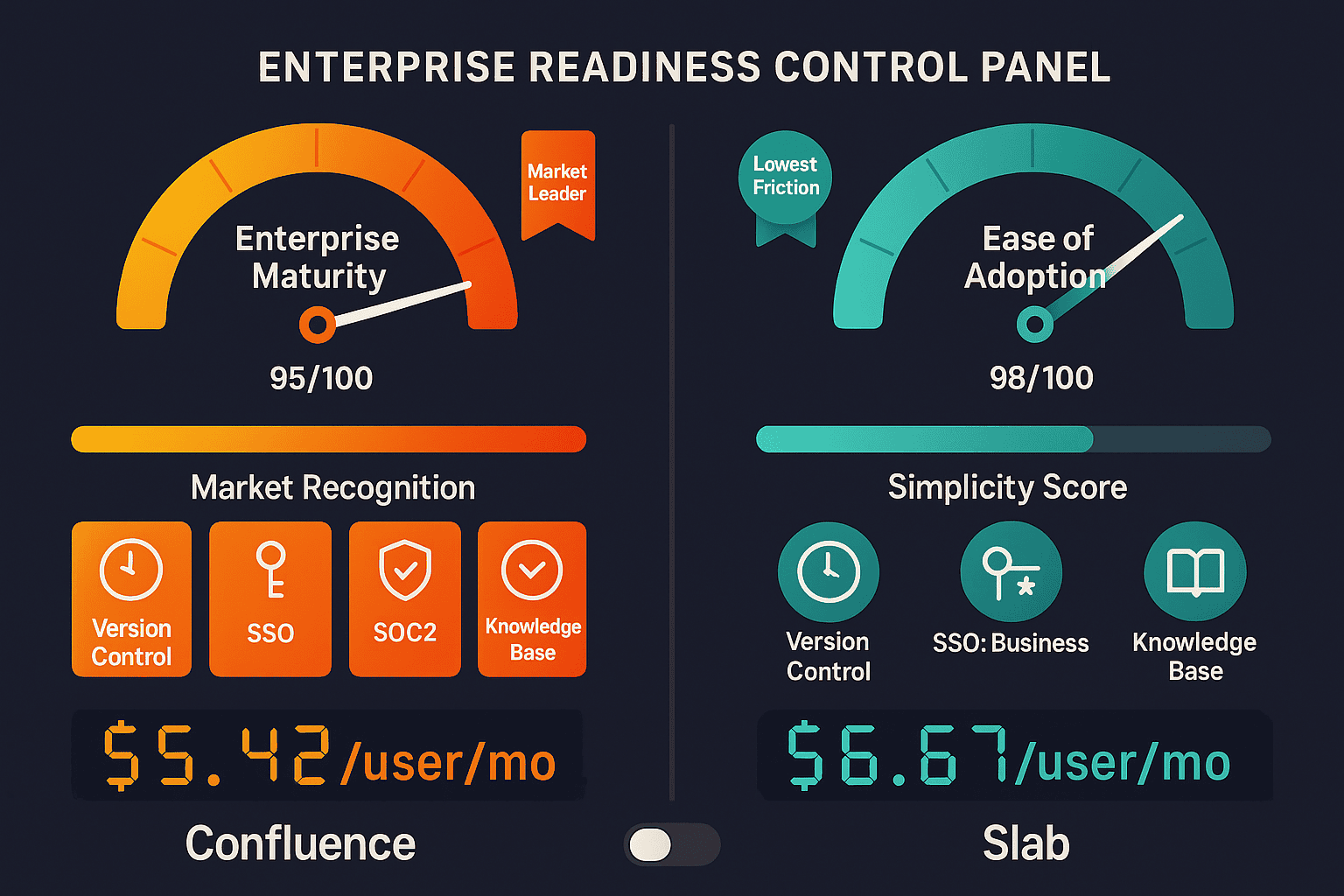
Popular with startups and mid-size companies, Slab offers the most generous free tier in the category (10 users with full collaboration features) and the lowest paid tier pricing at $6.67 per user per month. The interface deliberately avoids feature bloat, making it the fastest internal wiki to deploy and adopt.
But this simplicity comes with significant trade-offs. Slab has no AI features whatsoever—a striking gap in 2026 when AI-powered search, content generation, and automated documentation have become table stakes. It also lacks API access on lower tiers, has no SOC 2 compliance, and provides no enterprise governance capabilities. Like Confluence, Slab is internal-only with no support for customer-facing documentation or multi-tenant portals.
Enterprise Readiness: Four Critical Dimensions
1. Compliance and Security
For regulated industries—healthcare, finance, government contractors—compliance isn't optional. Documentation platforms handle sensitive internal processes, customer data, and intellectual property that require audit trails and certifications.
Confluence delivers enterprise-grade compliance with SOC 2, ISO 27001, and GDPR certifications. Detailed audit logs track every page view, edit, and permission change—critical for regulatory audits. The platform supports multiple identity providers (Okta, Azure AD, Google Workspace), enforces SSO, and provides granular permission controls down to the space and page level.
Slab has no SOC 2 compliance and limited security certifications. While it offers SSO through Google or Okta on the Business tier, it lacks the comprehensive audit logging and compliance documentation that regulated industries require. For startups in non-regulated sectors, this may not matter. For enterprises in healthcare, finance, or defense, it's a showstopper.
The gap: Neither platform offers HIPAA-ready Business Associate Agreements or multi-tenant data isolation for serving multiple clients from a single instance. Organizations needing customer-facing documentation portals require a different class of tool entirely.
2. Scale and Performance
Enterprise documentation platforms must support thousands of users, millions of page views, and global teams across time zones without performance degradation.
Confluence scales to 150,000 users with a 99.9% uptime SLA and 24/7 support. Atlassian provides dedicated customer success managers, premium support tiers, and proven architecture that handles massive deployments. The Data Center and Cloud Enterprise tiers include high availability, disaster recovery, and performance analytics.
Slab doesn't publish maximum user limits or uptime SLAs. The platform works well for teams under 500 users, but there's limited transparency around performance at enterprise scale. Support is email-based with no 24/7 option, and there's no dedicated customer success program.
For companies with 50-200 employees, Slab's scale limitations may never materialize. For enterprises planning multi-year growth or expecting rapid hiring, Confluence's proven scalability provides critical risk mitigation.
3. AI Capabilities
2026 marks the point where AI transitions from competitive advantage to baseline expectation in documentation platforms. Users expect semantic search, automated content generation, and intelligent assistance.
Confluence includes Rovo AI across all paid plans—a significant advantage. Rovo provides AI-powered search across Confluence pages and connected tools, pre-built automation agents for common documentation workflows, and content generation capabilities. The platform includes 20+ specialized agents that can summarize meeting notes, generate page templates, and answer questions by synthesizing information across multiple sources.
The Rovo AI integration extends beyond Confluence itself, connecting to 80+ apps in the Atlassian ecosystem and beyond. This means search queries can surface relevant context from Jira tickets, Slack conversations, and Google Drive documents simultaneously—a powerful capability for organizations with sprawling tool stacks.
Slab has zero AI features. No semantic search, no content generation, no automated summarization. In 2026, this represents a fundamental competitive disadvantage. While Slab's traditional keyword search is fast and clean, it can't match the contextual understanding and natural language queries that AI-powered systems provide.
For enterprises evaluating multi-year investments, betting on a platform without AI capabilities means accepting increasing technical debt as competitors adopt more sophisticated knowledge management.
4. Integration Ecosystem and Extensibility
Enterprise tools don't exist in isolation. Documentation platforms must integrate with project management, customer support, development workflows, and business intelligence systems.
Confluence offers the deepest integration ecosystem in the category. Native Atlassian integrations (Jira, Trello, Bitbucket, Opsgenie) provide bidirectional data flow, embedded widgets, and automated updates. Third-party integrations through the Atlassian Marketplace include thousands of apps for diagramming (Lucidchart, Draw.io), project management (Asana, Monday), and communication (Slack, Microsoft Teams).
The REST API enables custom integrations, and Forge (Atlassian's app development platform) allows organizations to build proprietary extensions that deploy directly within Confluence.
Slab provides limited integrations—GitHub, Slack, and basic SSO providers. The API is only available on the Business tier ($12.50/user/month), eliminating programmatic access for teams on the Startup tier. There's no app marketplace and no platform for building custom extensions.
For organizations with simple tool stacks, Slab's integration limitations may not matter. For enterprises with complex workflows spanning dozens of systems, Confluence's extensibility is essential.
Who Should Choose What?
Choose Confluence If You Need...
Confluence makes sense for organizations where enterprise governance, proven scale, and Atlassian ecosystem integration justify the complexity and per-user costs:
- Regulated industry compliance: SOC 2, ISO 27001, and GDPR with comprehensive audit logging
- Proven scalability: Deployments supporting 1,000+ users with 99.9% uptime guarantees
- Atlassian ecosystem: Deep Jira integration for engineering teams already standardized on Atlassian tools
- AI capabilities: Rovo AI for semantic search, content generation, and workflow automation
- Enterprise administration: Multiple IDPs, granular permissions, and sophisticated governance controls
Confluence works best for established enterprises, large engineering organizations, and companies requiring maximum compliance and scalability—when complexity is acceptable because the alternative is ungoverned chaos.
Choose Slab If You Need...
Slab serves organizations where simplicity and affordability outweigh enterprise features:
- Minimal learning curve: The fastest internal wiki to deploy without training requirements
- Budget constraints: $6.67/user/month—cheapest paid tier in the category
- Small teams: Under 50 users where advanced governance provides minimal value
- Fast deployment: Clean interface that requires no configuration or customization
- Non-regulated industries: Startups without SOC 2 or compliance requirements
Slab excels for early-stage startups, small remote teams, and organizations deliberately avoiding feature complexity. It's the right choice when your biggest documentation problem is adoption, not governance.
The Problem Both Tools Can't Solve
Here's what neither Confluence nor Slab provides: customer-facing documentation delivery through multi-tenant portals.
Both platforms are internal-only tools. They don't support:
- Multi-tenant architectures for serving different clients from one system
- Custom domains for external documentation delivery
- White-label branding for customer portals
- Video-to-documentation conversion for processing training content
- Combined internal/external workflows where the same content serves employees and customers
This limitation matters because enterprises increasingly need documentation systems that serve multiple audiences. Customer success teams need client portals. Professional services firms need branded knowledge bases per client. Product companies need both internal wikis and public documentation sites.
For a complete comparison of these platforms across all enterprise dimensions, see our detailed Confluence vs Slab Enterprise Readiness analysis.
Why Docsie Outperforms Both for Modern Enterprises
Docsie provides enterprise-grade compliance and AI capabilities while solving the multi-tenant, customer-facing delivery challenges that Confluence and Slab ignore.
Enterprise compliance without compromise: SOC 2 Type II, GDPR compliance, and HIPAA-ready capabilities match Confluence's security posture while using workspace pricing instead of per-user costs—dramatically reducing total cost of ownership for growing teams.
Video-to-documentation conversion: Docsie's multimodal AI processes training videos, screen recordings, and real-world footage into structured, searchable knowledge bases—a capability neither competitor offers. Organizations can leverage existing video content instead of recreating everything as written documentation.
Multi-tenant portals: Serve unlimited clients from one system with individual branded portals, custom domains, and isolated access controls. Professional services firms can maintain separate knowledge bases per client. Product companies can operate internal wikis and customer-facing documentation simultaneously.
Complete CONVERT → MANAGE → DELIVER workflow: Beyond basic wiki functionality, Docsie handles the entire documentation lifecycle with 100+ language auto-translation, version control, embeddable widgets, and API access. The agentic AI chatbot answers questions by synthesizing content across your entire knowledge base.
Flexible architecture: Docsie works equally well for internal teams (like Confluence and Slab) and external customers (which neither competitor supports). This flexibility eliminates the need for separate internal wiki and customer portal solutions—reducing tool sprawl and administrative overhead.
Your Next Step
If you're evaluating Confluence or Slab, you're thinking about internal wikis—but modern enterprises need knowledge orchestration that serves both employees and customers. They need platforms that convert existing video content, support multi-tenant delivery, and provide enterprise security without per-user pricing traps.
Try Docsie free for 14 days and see how video-to-documentation AI, multi-tenant portals, and complete documentation workflows solve problems that traditional wikis can't address. No credit card required.
The question isn't whether Confluence's complexity or Slab's simplicity fits your team—it's whether internal-only wikis still match your documentation requirements in 2026. For most enterprises, the answer is no.