
Confluence vs ReadMe: Which Documentation Platform Meets Enterprise Requirements in 2026?
Enterprise software decisions require clarity, not marketing spin. When your CFO asks why you need to spend six figures on documentation infrastructure, "because everyone uses it" won't cut it. You need concrete evidence that your chosen platform meets security, compliance, scalability, and integration requirements that pass boardroom scrutiny.
The documentation tool market has bifurcated into specialized camps. Confluence dominates internal knowledge management for Atlassian-heavy organizations. ReadMe owns the developer documentation space with interactive API explorers. But here's the problem: most enterprises don't need just an internal wiki or only API documentation. They need comprehensive knowledge orchestration—converting videos into structured docs, delivering multi-tenant portals to implementation partners, and publishing content in 100+ languages without hiring translation agencies.
This comparison examines Confluence and ReadMe through the enterprise readiness lens, then reveals why neither solves the documentation challenges that keep enterprise leaders awake at night.
What You're Actually Comparing
Confluence: The Atlassian Wiki Standard
Atlassian's Confluence has achieved something rare in enterprise software: it became the default choice. With deep Jira integration and proven deployments supporting 150,000+ users, Confluence serves as the central nervous system for internal documentation, project tracking, and team collaboration. The recent inclusion of Rovo AI across all paid plans—featuring 20+ pre-built AI agents for documentation tasks—signals Atlassian's commitment to maintaining relevance as AI reshapes knowledge work.
Confluence excels at what it was built for: giving engineering and product teams a structured wiki environment where context lives alongside tickets, requirements, and retrospectives. If your organization runs on Atlassian's ecosystem, Confluence becomes the obvious internal documentation hub.
ReadMe: Developer Portal Excellence
ReadMe carved out the premium end of API documentation by solving a problem that frustrated every developer relations team: making API documentation interactive, versioned, and actually usable. Their October 2025 launch of Agent Owlbert AI—featuring intelligent doc linting and style consistency enforcement—demonstrates their commitment to documentation quality, not just presentation.
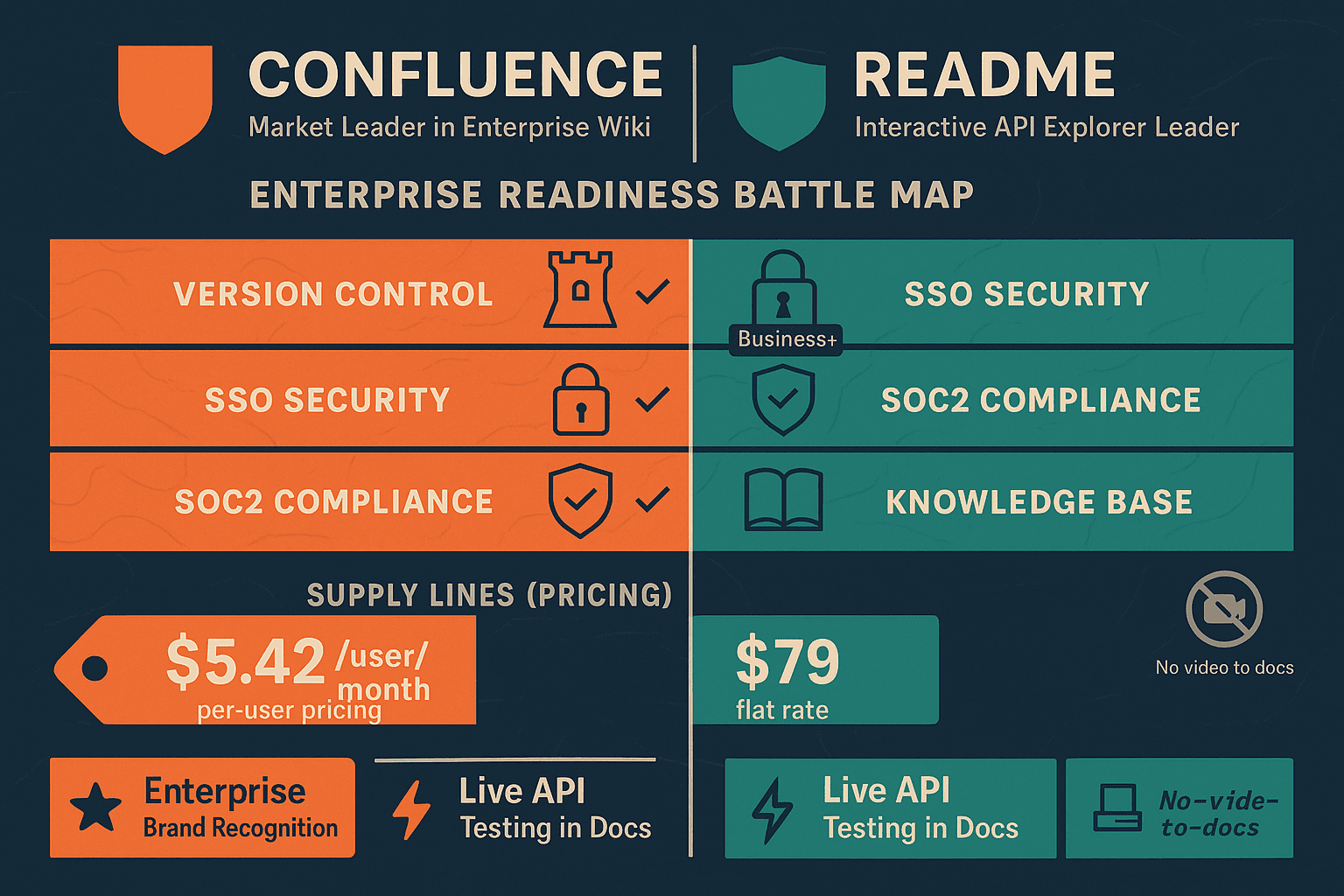
Companies choose ReadMe when their developer experience directly impacts revenue. The ability to test API calls within documentation, manage multiple API versions simultaneously, and maintain custom-branded developer portals justifies enterprise pricing ($3,000+/month) for product-led SaaS companies where developer adoption drives growth.
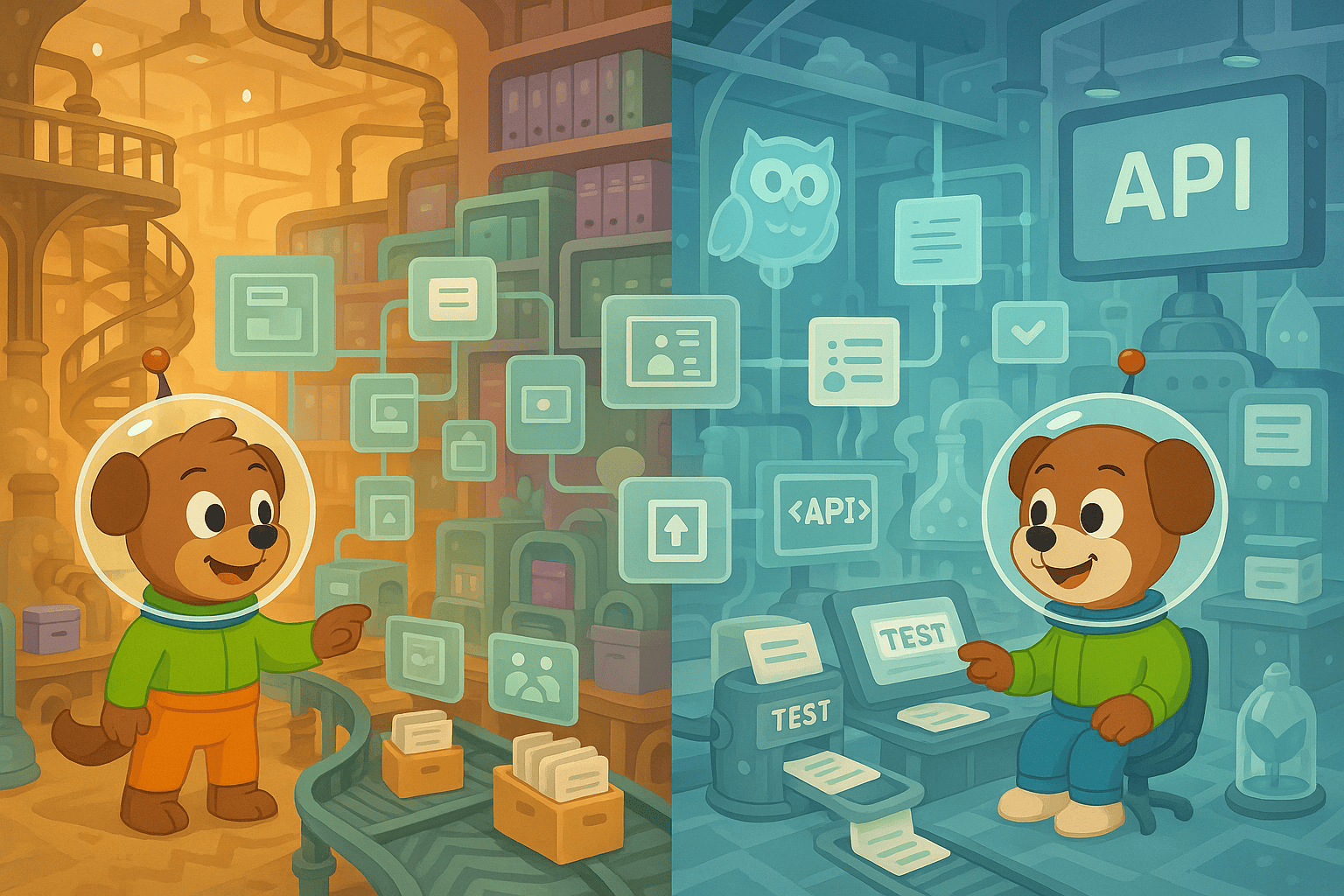
Enterprise Readiness: Where They Stand
For a detailed feature-by-feature breakdown, see our complete Confluence vs ReadMe enterprise comparison. Here's what matters for enterprise procurement:
Security & Compliance Infrastructure
Both platforms meet baseline enterprise security requirements, but with different certification portfolios. Confluence provides ISO 27001 certification alongside SOC 2 Type II and GDPR compliance—critical for regulated industries like healthcare and finance that require internationally recognized security frameworks. ReadMe focuses on SOC 2 Type II and GDPR compliance, sufficient for most SaaS companies but potentially limiting for enterprises operating under sector-specific regulations.
Neither platform, however, offers HIPAA-ready configurations out of the box. If you're documenting healthcare implementation processes or handling protected health information in documentation workflows, both require additional security layers and business associate agreements.
The missing piece: Video-to-documentation conversion with automatic PII redaction and content classification. Enterprise training videos often contain sensitive information that requires intelligent processing before publication—something neither Confluence nor ReadMe addresses.
Scalability & Performance Guarantees
Confluence demonstrates massive proven scale with deployments exceeding 150,000 users and a 99.9% uptime SLA starting at Premium tier ($10.44/user/month). Their infrastructure handles Wikipedia-scale internal knowledge bases without performance degradation.
ReadMe focuses on developer portal traffic rather than internal user count. Their infrastructure excels at serving public-facing API documentation to millions of monthly visitors, but pricing becomes prohibitive as team size grows. At $3,000+ monthly for Enterprise plans, per-seat costs can escalate quickly for large technical writing teams.
The missing piece: Multi-tenant architecture. Both platforms assume a single documentation instance. Modern enterprises need to deliver one knowledge base to unlimited branded client portals—think implementation partners, reseller training programs, or white-labeled customer academies. Neither Confluence nor ReadMe supports this architecture without manual duplication and maintenance overhead.
Administration & Governance
Confluence provides granular permission controls designed for complex organizational hierarchies. Space permissions, page restrictions, and audit logging accommodate enterprises with strict need-to-know requirements. Integration with Atlassian Access enables SAML SSO and centralized user lifecycle management across the entire Atlassian suite.
ReadMe's administration focuses on developer portal management rather than internal governance. Version management, changelog workflows, and API key controls serve external documentation needs effectively, but lack the internal user provisioning sophistication that enterprises require for employee onboarding/offboarding workflows.
The missing piece: Content lifecycle automation. Neither platform addresses version management for documentation delivered to multiple audiences simultaneously. Enterprise knowledge teams need to publish version 3.0 to current customers while maintaining version 2.5 for partners on legacy implementations—without manual duplication.
AI Capabilities & Content Intelligence
Confluence's Rovo AI inclusion across all paid plans (not a costly add-on) represents significant value. Twenty pre-built AI agents handle common documentation tasks: content generation, cross-tool search, and meeting summarization. For Atlassian-heavy organizations, Rovo's ability to search across Jira, Confluence, and connected tools solves the "where did we document that?" problem that plagues large teams.
ReadMe's Agent Owlbert AI takes a quality-enforcement approach. Rather than generating content, Owlbert lints documentation for consistency, enforces style guidelines, and powers Ask AI search for developer questions. This quality-first approach matches ReadMe's premium positioning—companies pay for polish, not just productivity.
The missing piece: Multimodal content conversion. Both platforms assume you start with text. Enterprise reality differs dramatically. You have 500 hours of training videos, 200 PDF manuals from acquired companies, and legacy website content that needs converting to structured documentation. Neither Confluence nor ReadMe offers video-to-docs transcription, PDF parsing, or website-to-documentation conversion. This isn't a minor feature gap—it's a foundational limitation that forces enterprises to maintain separate content conversion workflows before documentation even enters these platforms.
Who Should Choose What (And Who Should Choose Neither)
Choose Confluence if you're an Atlassian-centric organization needing internal documentation infrastructure. The Jira integration alone justifies the investment for engineering teams tracking requirements, designs, and technical decisions alongside code. With proven enterprise scale, ISO 27001 certification, and Rovo AI included, Confluence delivers comprehensive internal wiki functionality at predictable per-user pricing. However, recognize its limitations: it's an internal tool that doesn't support external documentation delivery, multi-tenant architectures, or content conversion from non-text sources.
Choose ReadMe if your developer experience directly impacts revenue and you need best-in-class API documentation with interactive testing capabilities. Companies building developer platforms, offering public APIs, or competing on developer adoption find ReadMe's premium positioning justified by conversion metrics. Agent Owlbert's quality enforcement maintains documentation standards that reflect brand investment. But understand the constraints: ReadMe serves one purpose brilliantly while ignoring broader enterprise documentation needs like multi-language support, multi-tenant delivery, and content conversion.
Choose neither if you recognize the enterprise documentation challenge has evolved beyond simple wikis and API hubs. Modern enterprises need knowledge orchestration—converting existing videos, PDFs, and websites into structured documentation, then delivering that knowledge to multiple audiences (employees, partners, customers) through branded portals in 100+ languages. This isn't a nice-to-have. It's table stakes for global implementation programs, partner enablement, and customer success at scale.
Why Enterprise Documentation Requires a Different Approach
The verdict from our detailed enterprise comparison reveals an uncomfortable truth: Confluence and ReadMe both excel at specialized tasks while missing the comprehensive knowledge orchestration that enterprise documentation actually requires.
Consider the real-world scenario facing enterprise knowledge managers:
- Convert: 200 hours of implementation training videos need transcription, structuring, and conversion to searchable documentation
- Manage: Documentation must support three product versions simultaneously for customers on different release schedules
- Deliver: Content must reach 15 regional implementation partners through branded portals in 12 languages
- Govern: Audit logs must track every change for SOC 2 compliance while maintaining GDPR data residency requirements
Neither Confluence nor ReadMe addresses this complete workflow. Confluence handles internal management but can't convert videos or deliver multi-tenant portals. ReadMe excels at API documentation but lacks multi-language support, video conversion, and version management for multiple client contexts.
This is where Docsie fundamentally differs.
Docsie built enterprise documentation infrastructure around knowledge orchestration, not specialized silos:
- Multimodal AI conversion: Upload training videos, PDFs, or provide website URLs—Docsie's AI extracts, structures, and converts content into documentation automatically
- Multi-tenant architecture: Maintain one knowledge base, deliver unlimited branded portals to different clients, partners, or customer segments
- 100+ language auto-translation: Publish globally without translation agency bottlenecks or cost-per-language pricing
- Workspace pricing, not per-seat: Avoid the cost inflation trap where adding documentation contributors triggers budget approvals
- Complete compliance: SOC 2 Type II, GDPR, HIPAA-ready with audit logs, EU data residency, and granular permissions
- Version management: Support multiple product versions simultaneously with audience-specific content delivery
The enterprise value proposition isn't about choosing between internal wikis and API documentation. It's about choosing platforms that handle the complete CONVERT → MANAGE → DELIVER workflow that modern global enterprises require.
Start With a Platform That Understands Enterprise Complexity
Documentation decisions compound over years. Choose a specialized tool like Confluence or ReadMe, and you'll eventually need additional platforms to fill the gaps. Choose a platform built for knowledge orchestration, and you solve video conversion, multi-tenant delivery, global translation, and compliance governance in one integrated environment.
Try Docsie free and experience what enterprise-ready documentation infrastructure actually means. Upload a training video and watch it convert to structured documentation automatically. Configure a multi-tenant portal for your implementation partners. Enable 100+ language translation with one click. This isn't incremental improvement over Confluence or ReadMe—it's a fundamentally different approach to enterprise knowledge management.
Your CFO will appreciate the clear ROI. Your teams will appreciate finally having tools that match how enterprise documentation actually works.