
Confluence vs Guru: Which Enterprise Knowledge Platform Actually Delivers in 2026?
Choosing an enterprise knowledge management platform shouldn't feel like picking between two incomplete solutions. Yet here we are: Confluence dominates the market with Atlassian's enterprise clout, while Guru promises AI-powered verification workflows that keep knowledge accurate. Both claim enterprise readiness. Both cost real money. But only one might actually fit your organization's needs—or neither might be the right answer.
If you're evaluating these platforms for a deployment spanning hundreds or thousands of users, you need specifics on security certifications, scalability limits, administration capabilities, and what happens when things break at 2 AM. This comparison cuts through the marketing to examine what Confluence and Guru actually deliver for enterprise teams in 2026.
What Is Confluence?
Confluence is Atlassian's enterprise wiki and collaboration platform, functioning as the documentation backbone for organizations already invested in the Atlassian ecosystem. Engineering teams use it for technical documentation, product managers maintain roadmap pages, and HR departments build employee handbooks—all within the same workspace that connects directly to Jira tickets, Bitbucket repositories, and Opsgenie incidents.
The platform now includes Rovo AI across all paid plans without additional costs, offering 20+ pre-built AI agents for documentation tasks like summarizing meeting notes, drafting project pages, and answering questions across your knowledge base. Confluence scales to 150,000 users with documented performance benchmarks, making it the default choice for large enterprises that prioritize proven scalability over cutting-edge features.
What Is Guru?
Guru takes a different approach: instead of building another wiki, it focuses on delivering verified knowledge wherever employees already work. The platform's expert verification workflows ensure that subject matter experts regularly review and validate critical information, preventing the knowledge decay that plagues most internal documentation systems.
Launched in 2025, Guru's Knowledge Agents (Chat, Research, and MCP Server) represent their AI-powered answer to enterprise knowledge retrieval. The browser extension surfaces contextual knowledge across any web application, while Slack integration delivers answers directly in messaging threads. However, Guru's per-seat pricing model includes a 10-seat minimum, creating a $250/month floor that makes it expensive for smaller teams even when they need enterprise features.
Enterprise Readiness: Security & Compliance
Confluence's Security Foundation
Confluence delivers ISO 27001 certification alongside SOC 2 Type II compliance, providing the dual certifications most regulated industries require. SAML-based single sign-on (SSO) integrates with Okta, Azure AD, and other enterprise identity providers, while data residency options keep information in specific geographic regions for GDPR compliance.
The platform's comprehensive audit logs track every page view, edit, permission change, and export—critical for demonstrating compliance during regulatory audits. Enterprise and Premium plans include IP allowlisting, enforced two-factor authentication (2FA), and data loss prevention (DLP) capabilities that prevent sensitive information from leaving your workspace.
Guru's Security Approach
Guru provides SOC 2 Type II compliance and GDPR readiness with EU data residency options, covering the baseline security requirements for enterprise deployment. SSO support through SAML works with major identity providers, and the platform encrypts data both in transit and at rest using industry-standard protocols.
However, Guru lacks the audit logging depth that Confluence provides. While you can track content changes and verification workflows, the granular audit trails needed for regulated industries (finance, healthcare, government) aren't as comprehensive. This gap becomes significant when compliance teams need to demonstrate exactly who accessed what information and when.
Scalability & Performance: How Far Can Each Platform Stretch?
Confluence's Proven Scale
Confluence publicly documents its ability to support 150,000 users with specific performance benchmarks. The Premium tier includes a 99.9% uptime SLA with financial credits when availability drops below that threshold. Atlassian's Cloud infrastructure automatically scales storage and compute resources, though organizations with extreme performance requirements can opt for Data Center deployments with dedicated infrastructure.
The platform handles massive knowledge bases with thousands of spaces and hundreds of thousands of pages, though search performance can degrade without proper information architecture. Confluence's biggest scalability advantage isn't technical—it's proven. When you deploy to 10,000 employees, you're following a path thousands of other enterprises have already validated.
Guru's Scalability Reality
Guru doesn't publish specific user limits or performance benchmarks, which creates uncertainty for large-scale deployments. The platform works effectively for teams ranging from the 10-seat minimum up to several hundred users, but enterprises planning 1,000+ seat deployments face questions about proven performance at that scale.
There's no published uptime SLA, meaning you can't point to guaranteed availability when stakeholders ask about reliability commitments. For organizations where knowledge platform downtime directly impacts revenue (customer support teams, implementation consultants), this lack of SLA guarantees becomes a meaningful risk factor.
That said, Guru's verification workflows actually improve with scale—more subject matter experts means more thorough knowledge validation. If your primary concern is knowledge accuracy rather than raw user capacity, Guru's approach may outweigh the scalability uncertainty.
Administration & User Management
Confluence's Administrative Depth
Confluence provides granular permissions at space, page, and even inline comment levels. Administrators can create custom user groups, assign space permissions to entire departments, and restrict sensitive documentation to specific teams—all while maintaining inheritance models that simplify permission management across thousands of pages.
The platform's integration with Atlassian Access (their enterprise identity management tool) enables advanced capabilities like automated user provisioning, centralized team management across multiple Atlassian products, and enforcement of security policies. For organizations already using Jira, Bitbucket, and other Atlassian tools, this unified administration significantly reduces overhead.
Bulk operations allow administrators to migrate hundreds of users between groups, archive entire space hierarchies, or update permissions across multiple spaces simultaneously. When restructuring a 5,000-person organization, these capabilities matter.
Guru's Streamlined Administration
Guru simplifies administration by focusing on verification workflows rather than complex permission hierarchies. You designate subject matter experts for different knowledge domains (product specs, customer policies, technical procedures), and the platform routes content to the right reviewers automatically.
The browser extension and Slack integration reduce the need for complex permission management—knowledge appears contextually based on what employees are working on, rather than requiring them to navigate folder structures. This approach works beautifully for organizations prioritizing knowledge delivery over information security boundaries.
However, organizations with strict need-to-know requirements (defense contractors, financial institutions, healthcare providers) may find Guru's simplified permissions insufficient. When regulatory compliance demands that only specific roles access certain information, Confluence's granular controls become necessary rather than optional.
Support & Success: What Happens When You Need Help?
Confluence's Support Tiers
Standard plans ($6.22/user/month) include business hours support through Atlassian's ticketing system, with typical response times of 8-24 hours for non-critical issues. Premium plans ($10.44/user/month) unlock 24/7 support with 1-hour response times for critical issues—when your documentation platform is down and blocking employee work, that matters.
Enterprise plans add designated Customer Success Managers who understand your specific implementation, conduct quarterly business reviews, and proactively identify opportunities to improve your deployment. Atlassian's extensive documentation, community forums, and third-party training programs mean you're never far from someone who's solved your exact problem before.
Guru's Support Model
Guru provides email and chat support across all plans, with response times that vary by severity. The platform's smaller customer base means you often communicate directly with team members who understand the product deeply, rather than working through scripted support tiers.
However, Guru doesn't offer published SLA-backed support response times or 24/7 coverage guarantees. For global enterprises operating across time zones where knowledge platform downtime in Singapore can't wait for US business hours, this creates operational risk.
The Knowledge Agents feature includes dedicated training sessions to help teams maximize AI-powered knowledge retrieval, showing Guru's commitment to ensuring customers succeed with their newest capabilities.
Who Should Choose What?
Choose Confluence if you need:
A proven enterprise wiki that scales to 150,000+ users with documented performance benchmarks and 99.9% uptime SLA guarantees. Organizations already invested in Atlassian products (Jira, Bitbucket, Opsgenie) gain enormous value from unified workflows where documentation lives alongside project tracking and incident management.
Regulated industries requiring ISO 27001 certification and comprehensive audit logs find Confluence's compliance capabilities essential. The inclusion of Rovo AI across all paid plans without credit-based restrictions means unlimited AI usage for documentation tasks, question answering, and content generation—a significant advantage as AI capabilities become central to knowledge work.
Choose Guru if you need:
Expert verification workflows that maintain knowledge accuracy through systematic subject matter expert review cycles. Organizations struggling with outdated documentation benefit from Guru's approach of treating knowledge validation as an ongoing process rather than a one-time authoring task.
The Knowledge Agents (Chat, Research, MCP Server) provide sophisticated AI-powered knowledge retrieval for teams ready to embrace agentic AI workflows. The browser extension that surfaces contextual knowledge across any web application works exceptionally well for distributed teams using dozens of different SaaS tools.
If your organization works primarily in Slack and needs knowledge delivered directly in messaging threads rather than requiring employees to context-switch to a wiki, Guru's Slack-first approach delivers significant productivity gains.
The Superior Alternative: Why Docsie Solves What Both Platforms Miss
Here's what neither Confluence nor Guru addresses: delivering branded, customized knowledge bases to external clients at scale.
Consultancies managing documentation for 50+ clients need multi-tenant portals with separate branding, custom domains, and isolated access controls. Implementation partners deploying SaaS products require customer-facing documentation that looks like the client's brand, not generic wiki pages. Neither Confluence nor Guru provides these capabilities—they're built for internal knowledge management, not external documentation delivery.
Docsie solves this with multi-tenant architecture that lets you deliver one knowledge base to unlimited clients, each with custom branding, domains, and access controls. Professional services firms can maintain separate documentation portals for every client without multiplying administrative overhead.
Docsie also converts videos into structured documentation using multimodal AI with computer vision and OCR—transforming training recordings, screen captures, and real-world footage into searchable, translatable content. Neither Confluence nor Guru offers video-to-documentation conversion, yet video represents one of the richest sources of undocumented knowledge in modern organizations.
With workspace-based pricing instead of per-seat models, Docsie eliminates the cost inflation that makes Confluence and Guru expensive at enterprise scale. Add 100+ language auto-translation, agentic AI chatbots for external knowledge delivery, and the same enterprise compliance (SOC 2 Type II, GDPR, HIPAA-ready, 99.9% uptime SLA) that Confluence provides, and you get a platform designed for both internal knowledge management and external client documentation.
Make the Right Choice for Your Enterprise
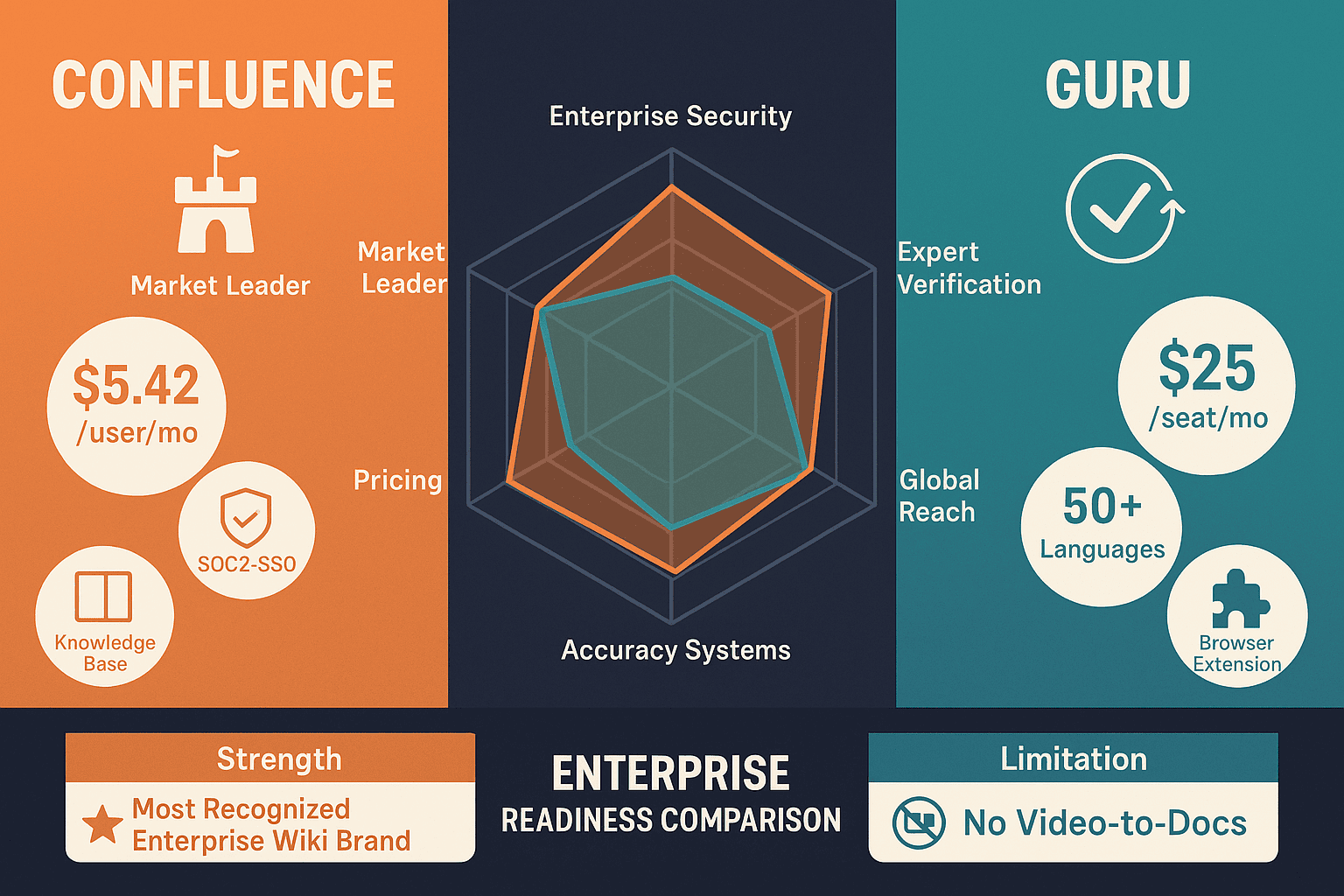
Confluence delivers proven scalability and deep Atlassian integration for organizations already committed to that ecosystem. Guru provides verified knowledge with AI-powered agents for teams prioritizing accuracy over administrative depth. Both platforms serve internal knowledge management effectively.
But if your organization needs to deliver documentation to external clients, convert video content into searchable knowledge, or provide branded documentation portals at scale, you need capabilities neither Confluence nor Guru provides.
See the detailed enterprise comparison for specific feature-by-feature analysis, or try Docsie free to experience what enterprise documentation looks like when it's designed for both internal teams and external client delivery.