
Confluence vs Document360: Which Enterprise Documentation Platform Fits Your 2026 Strategy?
Enterprise documentation teams face a critical choice: invest in a collaboration-first wiki that integrates with your existing development tools, or adopt a purpose-built knowledge base platform designed for customer-facing content. The wrong decision can cost hundreds of thousands in licensing fees, require painful migrations, or leave your team cobbling together workarounds for missing capabilities.
Confluence and Document360 represent two distinct approaches to enterprise documentation. Confluence brings the power of Atlassian's ecosystem with deep Jira integration and proven scalability to 150,000+ users. Document360 focuses exclusively on customer knowledge bases with strong AI capabilities and multi-language support. But both tools show critical gaps in modern enterprise requirements—particularly multi-tenant portal delivery and comprehensive video-to-documentation conversion.
This comparison examines both platforms through an enterprise readiness lens, evaluating scalability, AI capabilities, deployment flexibility, and total cost of ownership. We'll help you understand which tool fits your specific use case—and why neither may fully meet the needs of organizations managing documentation for multiple clients or converting existing video training libraries into structured knowledge bases.
What Is Confluence?
Confluence is Atlassian's enterprise wiki and team workspace platform, serving as the market-leading internal documentation solution for organizations already invested in the Atlassian ecosystem. If your development and product teams live in Jira, use Bitbucket for version control, or rely on Trello and other Atlassian products, Confluence provides the natural hub for project documentation, technical specs, and internal knowledge management.
The platform now includes Rovo AI across all paid plans—not as an expensive add-on, but as a core feature. This gives teams 20+ pre-built AI agents for documentation tasks and unified search across 80+ integrated applications. For enterprises managing complex internal knowledge across multiple tools, this integration depth represents Confluence's most compelling value proposition.

What Is Document360?
Document360 is a purpose-built knowledge base platform designed specifically for external customer-facing documentation. Part of the Kovai.co family and backed by the recent acquisition of Floik for screen-recording capabilities, Document360 positions itself as an AI-powered alternative to generic wikis.
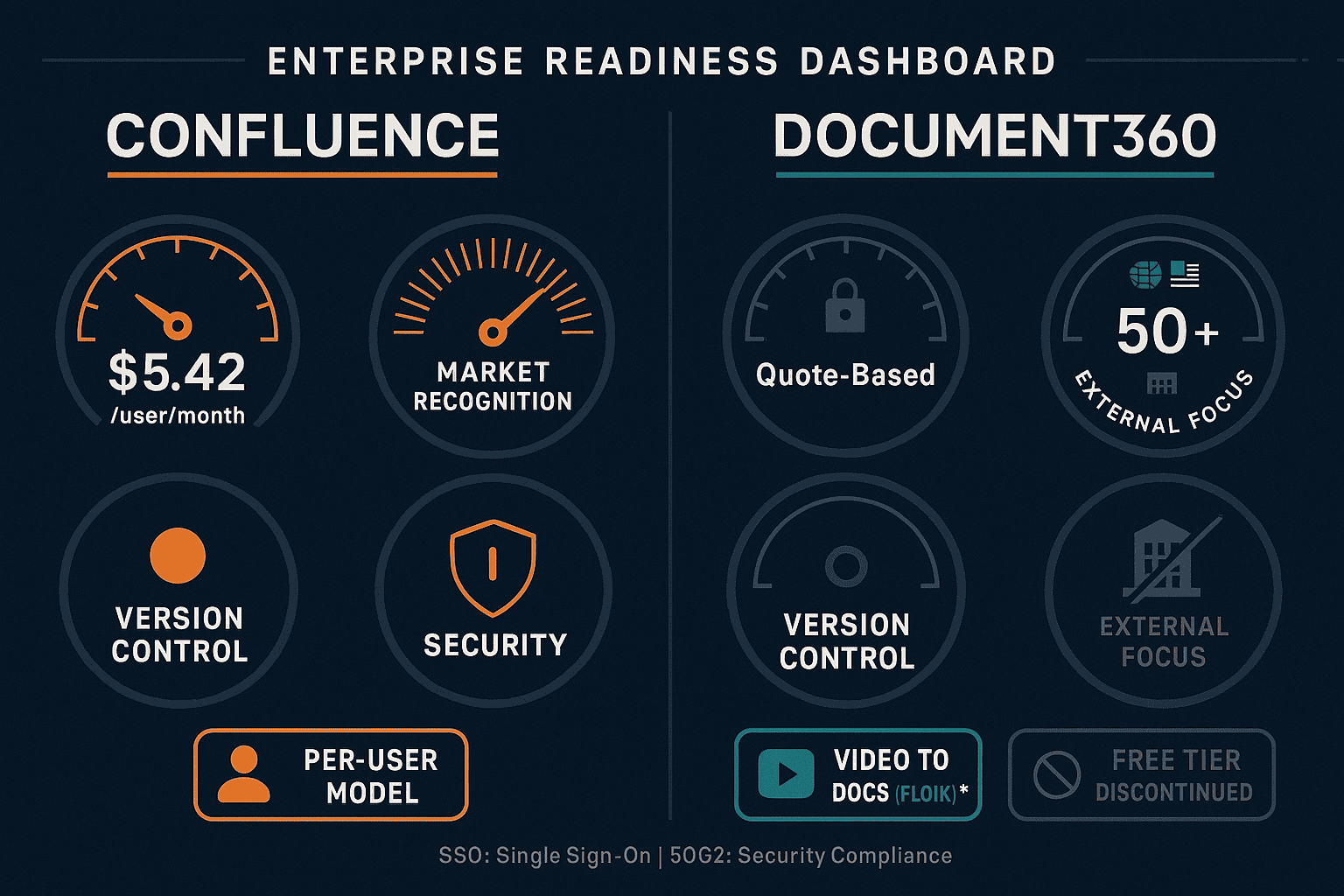
The platform discontinued its free tier in November 2024, shifting to a fully sales-led model with quote-based pricing. This change signals Document360's focus on mid-market and enterprise customers who need robust content governance, multi-language support through Eddy AI (covering 50+ languages), and strong integrations with help desk platforms like Zendesk, Intercom, and Freshdesk.
Enterprise Readiness: Scalability and Security
Confluence provides transparent scalability with published pricing tiers that support up to 150,000 users. Enterprise teams know exactly what they're getting: 99.9% uptime SLA, SOC 2 compliance, multiple identity provider support for complex SSO requirements, and clear data residency options. The platform's maturity shows in its security certifications and track record with Fortune 500 companies managing tens of thousands of internal documentation pages.
Document360 offers enterprise security features including SSO, role-based access control, and compliance with GDPR and SOC 2 standards. However, the shift to hidden pricing creates friction for procurement teams accustomed to transparent evaluation processes. The platform scales well for external knowledge bases serving millions of monthly visitors, but lacks the published user limits and SLA commitments that enterprise buyers typically require during vendor evaluation.
The Critical Gap: Neither platform supports multi-tenant portal architecture. If you're a consultancy serving 50 clients, an implementation partner managing documentation for multiple customers, or a SaaS company providing white-labeled knowledge bases, you'll need separate instances for each client. This dramatically increases licensing costs, administrative overhead, and complexity—turning what should be centralized knowledge management into a sprawling multi-instance nightmare.
AI Capabilities and Content Intelligence
Confluence's Rovo AI focuses on knowledge discovery and synthesis across the Atlassian ecosystem. The 20+ pre-built agents handle common documentation tasks like summarizing project pages, generating meeting notes, and surfacing relevant information from connected tools. For teams drowning in Jira tickets, Slack messages, and scattered wiki pages, Rovo provides intelligent search that understands context across your entire toolchain.
Document360's Eddy AI specializes in content creation and localization. The AI suite handles auto-translation across 50+ languages, converts video and audio content into documentation, and generates documentation from scratch based on prompts. For organizations publishing customer-facing content in multiple languages or converting recorded demos into written guides, Eddy AI provides substantial productivity gains.
The Critical Gap: Neither platform offers true video-to-documentation conversion from arbitrary video sources. Document360's Floik acquisition provides screen-recording-to-demo capability—useful for creating software walkthroughs—but can't process existing training videos, conference presentations, or real-world footage into structured knowledge base content. Confluence lacks video conversion entirely. For enterprises sitting on libraries of training videos that need to become searchable, structured documentation, both tools require manual transcription and formatting.
Deployment Flexibility and External Delivery
Confluence excels at internal deployment with self-hosted Data Center options for organizations with strict data sovereignty requirements, plus Atlassian Cloud for teams preferring managed infrastructure. However, Confluence wasn't designed for external content delivery. You can't provide custom domains for client-facing portals, can't white-label instances for different audiences, and can't create the branded, self-service customer experience that modern SaaS companies require.
Document360 was purpose-built for external knowledge bases with custom branding, domain mapping, and help desk integrations that make sense for customer support teams. The platform provides embeddable widgets, article feedback mechanisms, and analytics focused on external content consumption. But like Confluence, Document360 lacks multi-tenant architecture—serving multiple clients means paying for multiple instances and managing separate documentation sets without centralized oversight.
What Enterprise Teams Actually Need: Modern enterprises don't fit neatly into "internal wiki" or "external knowledge base" categories. Implementation partners need to deliver branded documentation portals to dozens of clients. Training organizations need to convert existing video libraries into searchable knowledge bases. Global companies need to manage documentation across 100+ languages while maintaining content governance. Neither Confluence nor Document360 addresses these modern enterprise requirements without expensive workarounds.
Total Cost of Ownership
Confluence pricing is transparent: Standard at $6.05/user/month (annual) or Premium at $11.55/user/month. For a 500-user enterprise deployment, that's $36,300 or $69,300 annually. The cost scales predictably, and you're buying into the broader Atlassian ecosystem where those users likely already exist across other products.
Document360 moved to quote-based pricing in late 2024, eliminating pricing transparency from the buying process. Enterprise teams must engage sales to understand costs, making competitive evaluation more time-consuming. The pricing model reportedly focuses on workspace-based licensing rather than per-user, but without published figures, budget planning becomes difficult during the vendor selection phase.
The Hidden Costs: Both platforms create massive hidden costs for multi-client scenarios. If you're serving 50 clients, you're potentially paying for 50 separate Confluence instances or 50 Document360 workspaces. The administrative burden of managing separate instances—handling updates, maintaining consistent branding, coordinating content changes—creates ongoing operational costs that dwarf the licensing fees.
Who Should Choose What?
Choose Confluence if your enterprise documentation needs center on internal collaboration for development and product teams already invested in Atlassian tools. Confluence makes sense when you need proven scalability to 150,000+ users, require Rovo AI integration across 80+ applications for unified knowledge search, or have complex SSO requirements with multiple identity providers. The platform delivers maximum value when documentation serves primarily internal audiences and connects to existing Jira workflows.
Choose Document360 if your primary need is external customer-facing knowledge bases with custom branding and help desk integrations. Document360 fits when you need strong multi-language support through auto-translation, screen-recording capabilities for visual how-to content, and content governance with approval workflows for regulated documentation. The platform works best for mid-market companies with straightforward external knowledge base requirements.
Consider Docsie if you face any of these modern enterprise scenarios that neither Confluence nor Document360 adequately addresses:
- Multi-tenant requirements: You need to deliver one centralized knowledge base to unlimited clients with custom branding for each—impossible with either competitor without paying for multiple separate instances
- Video conversion needs: You have existing training videos, conference presentations, or real-world footage that must become structured, searchable documentation—not just screen recordings
- Global documentation management: You need 100+ language auto-translation combined with enterprise security (SOC 2, GDPR, HIPAA-ready) and transparent workspace-based pricing
- Modern delivery requirements: You need agentic AI chatbots, embeddable widgets, API access, and custom integrations for documentation delivery across multiple channels
The Modern Enterprise Reality
Confluence and Document360 both represent mature, capable platforms for specific documentation use cases. Confluence dominates internal enterprise wikis for Atlassian-centric organizations. Document360 serves external knowledge base needs for mid-market companies. Both provide enterprise-grade security, AI capabilities, and proven track records.
But neither addresses the core challenges facing modern enterprise documentation teams: efficiently serving multiple clients from a single platform, converting existing video assets into structured documentation, and managing complex multi-language content delivery without operational overhead spiraling out of control.
For enterprises managing documentation across multiple clients, geographies, or brands, the traditional "internal wiki vs. external knowledge base" choice creates false constraints. You need multi-tenant architecture, comprehensive video conversion, and modern delivery capabilities—requirements that emerged after both Confluence and Document360 established their core architectures.
Compare Confluence vs Document360 in detail to see the complete feature breakdown, or try Docsie free to experience multi-tenant documentation delivery, video-to-docs conversion, and modern knowledge orchestration capabilities that both competitors lack. For enterprise teams facing the limitations of traditional documentation platforms, Docsie provides the complete CONVERT → MANAGE → DELIVER workflow without the per-user licensing costs or multi-instance complexity that make scaling painful.
The choice isn't just about features—it's about whether your documentation platform enables or constrains your business model for the next five years.