
Clueso vs Scribe: Enterprise Readiness Comparison 2026
You've narrowed your documentation tool search to Clueso and Scribe. Both promise to transform screen recordings into documentation with minimal effort. Both claim enterprise readiness. But when it comes time to deploy across your organization—integrating with identity providers, managing permissions for hundreds of users, and ensuring compliance with SOC 2 auditors—do these tools actually deliver?
The answer isn't straightforward. While both platforms have evolved beyond simple screen capture utilities, they approach enterprise documentation from fundamentally different angles. More importantly, neither offers the comprehensive knowledge management capabilities that true enterprise deployment demands.
Let's examine how Clueso and Scribe stack up for enterprise use—and why you might need to look beyond both.
What Is Clueso?
Clueso positions itself as an AI video editing platform that transforms screen recordings into professionally polished product videos. The tool automatically applies branded styling, AI voiceovers, auto-zoom effects, and cursor smoothing to create customer education content that looks professionally produced. As a bonus, it generates step-by-step text articles alongside the video output.
The platform targets SaaS companies creating customer-facing training materials. Clueso has secured SOC 2 Type II and ISO 27001 certifications, signaling serious attention to security compliance. However, the tool remains focused on video creation rather than comprehensive documentation management—it lacks version control, multi-tenant portals, and the administrative infrastructure enterprises typically require.

What Is Scribe?
Scribe takes a different approach: it's a browser extension that auto-captures your screen actions and generates step-by-step guides with annotated screenshots. Install the extension, click record, perform your process, and Scribe produces a clean screenshot-based standard operating procedure.
The platform excels at internal process documentation. Its zero learning curve and integrations with tools like Notion, Confluence, and SharePoint make it popular for teams documenting repetitive workflows. Scribe's Enterprise plan includes SSO and SCIM provisioning, addressing basic identity management needs. However, the tool completely lacks video capabilities—it cannot process existing training videos or produce any video output whatsoever.
Enterprise Readiness: The Critical Dimensions
When evaluating documentation tools for enterprise deployment, four dimensions matter most: security and compliance, scalability and architecture, administration and control, and support and SLAs. Let's see how Clueso and Scribe measure up.
Security and Compliance
Clueso has invested heavily in compliance certifications. The platform holds both SOC 2 Type II and ISO 27001 certifications—among the strongest compliance credentials in the documentation space. This dual certification demonstrates rigorous security controls and makes Clueso attractive to security-conscious buyers navigating vendor risk assessments.
However, Clueso lacks single sign-on (SSO) capabilities, a significant gap for enterprise identity management. Organizations using Okta, Azure AD, or other identity providers cannot integrate Clueso into their authentication infrastructure, creating potential security vulnerabilities and administrative overhead.
Scribe offers SOC 2 Type II compliance and includes SSO and SCIM provisioning on its Enterprise plan. This identity management integration is crucial for organizations with centralized authentication requirements. Scribe also provides AI-powered PII/PHI redaction, making it suitable for HIPAA compliance scenarios where sensitive information must be automatically masked.
The trade-off? Scribe lacks ISO 27001 certification and has fewer published security controls than Clueso. For organizations where identity integration matters more than certification breadth, Scribe edges ahead. For those facing strict ISO 27001 requirements from clients or regulators, Clueso is the safer choice.
The gap both tools share: Neither offers data residency options, audit logs accessible to customers, or granular security controls that enterprises managing multi-jurisdictional deployments require.
Scalability and Architecture
This is where both tools reveal significant limitations.
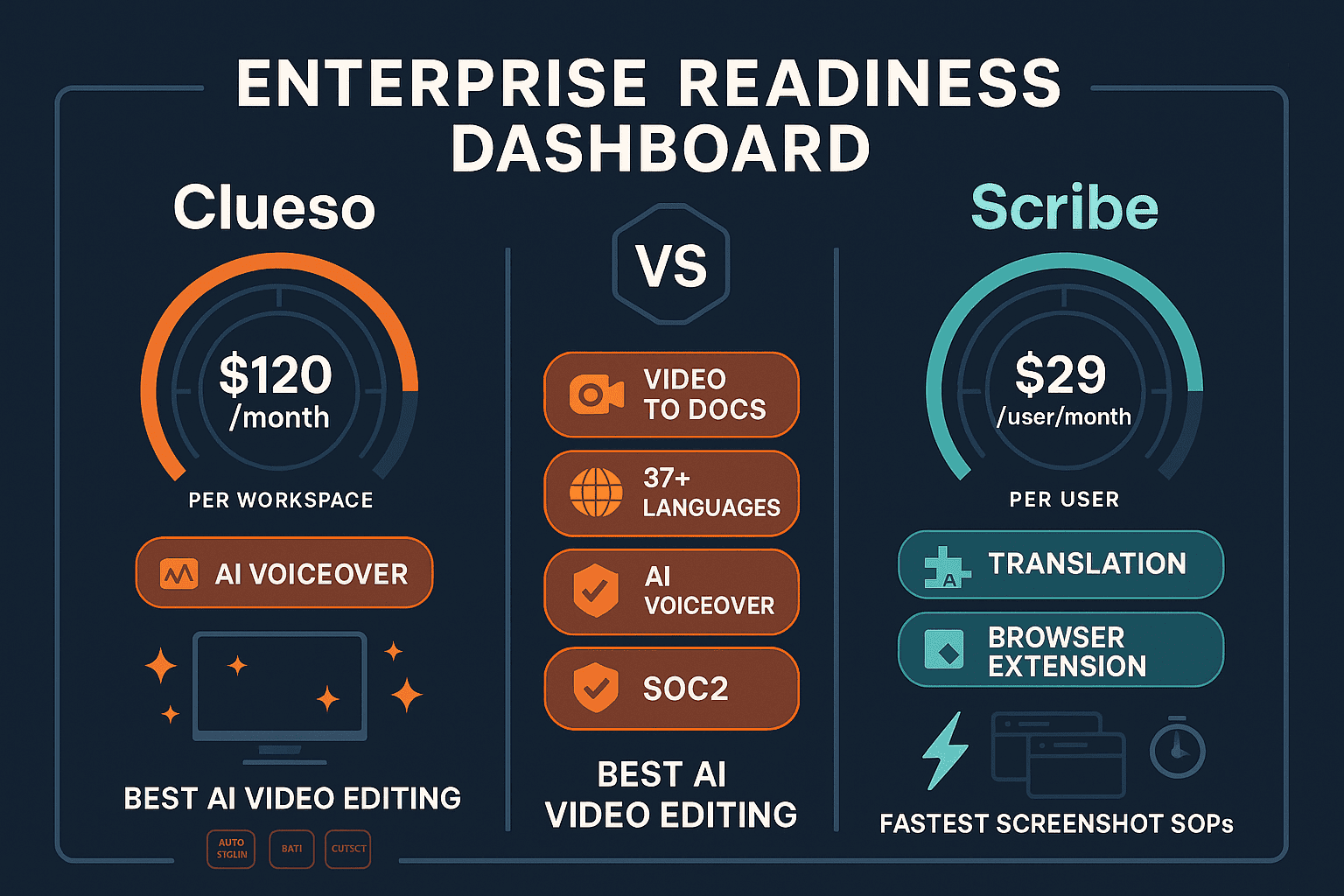
Clueso uses workspace pricing rather than per-user licensing, which benefits small teams (under 15 users) by avoiding per-seat cost inflation. However, the platform is explicitly screen-recording focused—it cannot process real-world video footage or arbitrary video files. If your organization has an existing library of training videos, product demos, or conference recordings you want to convert into documentation, Clueso cannot help.
More critically, Clueso lacks multi-tenant architecture. Organizations serving multiple clients cannot create branded portals for each customer, manage separate permission sets, or deliver client-specific documentation from a single system.
Scribe faces different scalability challenges. The per-user pricing model becomes prohibitively expensive as teams grow. An organization with 200 employees documenting processes faces monthly costs exceeding $20,000 on Business plans—before reaching Enterprise tier pricing (which isn't publicly disclosed but reportedly starts at $50,000+ annually).
Scribe also cannot scale beyond screenshot-based documentation. The platform has zero video capabilities, cannot process existing video content, and lacks audio or voice processing. For organizations with multimedia knowledge bases, Scribe simply cannot handle the full documentation spectrum.
Neither platform offers API access for programmatic content management, webhooks for automation, or the ability to manage thousands of documentation sites from a central system.
Administration and Control
Clueso provides basic workspace administration but lacks enterprise-grade permission management. There's no granular role-based access control, no approval workflows for content changes, and no version control system. When a team member edits a video guide, there's no audit trail showing what changed or ability to roll back to previous versions.
For content governance—ensuring documentation meets quality standards before publication—Clueso offers no systematic controls. This becomes problematic when documentation represents your official training materials or compliance-required procedures.
Scribe offers better permission controls through its integration with existing identity providers via SSO/SCIM. Organizations can leverage existing security groups and access policies. However, Scribe similarly lacks version control, approval workflows, and content governance capabilities. Once a Scribe guide is created, tracking changes and managing documentation evolution becomes a manual process.
Neither tool provides the administrative infrastructure enterprises need: granular permissions matrices, approval workflows with multiple reviewers, change tracking with rollback capabilities, or scheduled content review reminders.
Support and Service Level Agreements
This is perhaps the most concerning gap for enterprise buyers.
Clueso doesn't publish specific SLAs, uptime guarantees, or support response time commitments. Enterprise buyers typically need contractual guarantees: 99.9% uptime SLAs, priority support with defined response times, and dedicated customer success resources. Without published SLAs, organizations cannot plan for downtime or escalate issues with contractual backing.
Scribe similarly lacks transparent SLA commitments. While Enterprise plans likely include priority support, specific uptime guarantees and response time SLAs aren't publicly available. For organizations where documentation downtime means customer support teams cannot access critical procedures, this absence of guaranteed availability creates risk.
Neither platform appears to offer dedicated implementation support, custom onboarding programs, or the enterprise success resources that complex deployments require.
Who Should Choose What?
Choose Clueso If You Need...
Clueso makes sense for organizations with specific requirements:
-
Polished branded video output for customer education with minimal IT involvement. If your priority is creating professional-looking product videos from screen recordings without video editing expertise, Clueso delivers the best AI-powered video quality.
-
ISO 27001 + SOC 2 Type II compliance for security-conscious buyers. If your vendor risk assessment process requires these specific certifications, Clueso's dual compliance gives you clear documentation for auditors.
-
Workspace pricing to avoid per-seat cost inflation for small teams under 15 users. If you're a small customer success team creating video guides without needing to scale to hundreds of users, Clueso's pricing model offers predictability.
Choose Scribe If You Need...
Scribe is the better choice for organizations requiring:
-
Internal process documentation with SSO/SCIM integration to existing identity providers. If you're documenting internal workflows and need centralized authentication management through Okta or Azure AD, Scribe's Enterprise plan delivers this integration.
-
AI-powered PII/PHI redaction for HIPAA compliance scenarios. If your documentation includes sensitive patient or personal information that must be automatically masked, Scribe's redaction capabilities address this compliance requirement.
-
Fast deployment with browser extension for screenshot-based SOPs. If your immediate need is getting teams to document processes quickly without training on new software, Scribe's zero-learning-curve extension offers the fastest time-to-value.
The Real Enterprise Alternative: Why Docsie Outperforms Both
Here's the uncomfortable truth: neither Clueso nor Scribe provides true enterprise knowledge management.
Both are capture-and-create tools. Clueso creates videos from screen recordings. Scribe creates screenshot guides from browser actions. Neither offers the comprehensive CONVERT → MANAGE → DELIVER workflow that enterprise documentation requires.
Docsie addresses the full enterprise knowledge management lifecycle with capabilities neither competitor can match:
-
True enterprise compliance and security: SOC 2 Type II certification, GDPR compliance, HIPAA-ready infrastructure, comprehensive audit logs, SSO supporting SAML/OAuth/OIDC, and 99.9% uptime SLA with contractual guarantees. Unlike competitors, Docsie offers data residency options for organizations with jurisdictional requirements.
-
Multi-tenant architecture at scale: Deliver branded documentation to unlimited clients from one system with separate permission structures, custom domains, and client-specific content libraries. Manage 10,000+ documentation sites from a central platform—something neither Clueso nor Scribe can approach.
-
Complete documentation platform: Version control with full change history, API access for programmatic management, webhooks for workflow automation, approval workflows with multiple reviewer levels, content governance policies, and scheduled review reminders. These aren't add-ons—they're core platform capabilities.
-
Universal video conversion: Process any video type—screen recordings, training videos, conference presentations, real-world footage—into structured knowledge bases across 100+ languages. Where Clueso only handles screen recordings and Scribe handles no video at all, Docsie converts your entire multimedia knowledge library.
For a detailed comparison of how these platforms stack up across specific features, see our comprehensive Clueso vs Scribe enterprise readiness analysis.
The Bottom Line
If you're choosing between Clueso and Scribe, your decision comes down to whether you need video creation (Clueso) or identity integration (Scribe). Both offer baseline enterprise compliance, but neither provides the scalability, administration, or architectural sophistication that true enterprise documentation demands.
But you're not limited to choosing between these two tools.
Docsie delivers enterprise knowledge management purpose-built for organizations managing documentation at scale across multiple clients, languages, and regulatory environments. You get the compliance and security that Clueso offers, the identity integration that Scribe provides, plus the version control, API access, multi-tenant architecture, and administrative controls that neither competitor can deliver.
Ready to see what enterprise-grade documentation actually looks like? Start your free trial of Docsie and experience the difference between capture tools and true knowledge management platforms. No credit card required.