
Clueso vs Guidde: Which Video Documentation Tool Is Enterprise-Ready in 2026?
Choosing documentation tools for enterprise deployment means evaluating far more than feature lists. Security certifications, multi-tenant capabilities, administrative controls, and scalability separate platforms built for small teams from those designed for organizational deployment. This becomes especially critical when evaluating AI-powered video documentation tools like Clueso and Guidde—both transform screen recordings into polished tutorials, but their enterprise readiness differs substantially.
This comparison examines Clueso and Guidde through an enterprise lens, evaluating security infrastructure, administrative capabilities, scalability limitations, and deployment considerations. We'll also explore why organizations with serious knowledge management requirements may need to look beyond specialized video creation tools entirely.
What is Clueso?
Clueso positions itself as an AI platform that transforms screen recordings into professionally edited videos with AI voiceovers, auto-zoom, and branded styling. The platform's core strength lies in its video editing intelligence—automatically applying cursor smoothing, dynamic zoom, and pan effects that make screen captures look professionally produced. Clueso generates dual outputs from a single recording: a polished video and a step-by-step written article, making it particularly attractive for SaaS customer education teams.
From a compliance perspective, Clueso holds both SOC 2 Type II and ISO 27001 certifications, positioning it as the more security-conscious option in the video documentation space. However, its enterprise capabilities stop at compliance—the platform lacks SSO integration, multi-tenant architecture, and version control systems that enterprise deployments typically require.

What is Guidde?
Guidde operates as a browser extension that captures screen workflows and auto-generates tutorial videos with AI voiceovers alongside step-by-step text guides. Its standout feature is voice quality—offering 400+ studio-grade AI voices across multiple languages, plus "Magic Mic" functionality that transcribes your narration as you record. Like Clueso, Guidde produces both video and text documentation from a single capture session.
Guidde's enterprise tier adds SSO support and role-based access control (RBAC), giving it a slight administrative advantage over Clueso. However, its compliance profile is weaker, and it shares the same fundamental limitation: it's built exclusively for screen capture workflows, not comprehensive enterprise knowledge management.
Enterprise Readiness Comparison: Security & Compliance
Compliance Certifications
Clueso takes a decisive lead in compliance infrastructure with both SOC 2 Type II and ISO 27001 certifications. For regulated industries—healthcare, financial services, or government contractors—these certifications aren't optional; they're prerequisites for vendor approval. ISO 27001 specifically demonstrates systematic information security management, while SOC 2 Type II proves ongoing operational effectiveness through independent auditing.
Guidde doesn't publicly advertise equivalent compliance certifications, which immediately disqualifies it for many enterprise procurement processes. Organizations with strict vendor security requirements will find Clueso the only viable option between these two.
Identity & Access Management
Here the tables turn. Guidde's Enterprise tier includes SSO support, enabling centralized identity management through existing identity providers. This allows IT teams to enforce authentication policies, enable multi-factor authentication organization-wide, and automatically revoke access when employees leave.
Clueso lacks SSO integration entirely—a significant gap for enterprise deployment. Without SSO, organizations face manual user provisioning, inconsistent authentication policies, and increased security risk from orphaned accounts. For companies with mature IT governance, this absence is disqualifying.
Data Residency & Privacy Controls
Neither platform offers EU data residency options, GDPR-specific data processing agreements beyond standard terms, or granular data retention controls. Enterprise organizations with data sovereignty requirements—particularly those serving European customers or operating under strict privacy regulations—will find both platforms inadequate.
See the full security comparison
Administrative Capabilities & Team Management
Access Controls
Guidde implements role-based access control (RBAC) in its Enterprise tier, allowing administrators to define permissions by role rather than managing individual user access. This becomes essential as teams grow beyond 10-15 people—without RBAC, permission management becomes exponentially complex.
Clueso offers basic team collaboration but lacks granular permission systems. There's no way to separate content creators from reviewers, restrict editing permissions to specific content collections, or implement approval workflows before publication.
Multi-Tenant Architecture
Neither platform offers true multi-tenant capabilities. Both are designed for single-organization use, producing content for one branded destination. Enterprise organizations serving multiple clients—MSPs, training companies, SaaS platforms with customer-facing documentation—cannot use either tool to deliver separate, branded knowledge bases to different customers.
This architectural limitation means you cannot: - Deliver client-specific documentation portals with separate branding - Implement client-level access controls and analytics - Scale to hundreds or thousands of separate customer deployments - Share content templates across tenants while maintaining isolation
Version Control & Content Governance
Both platforms lack enterprise-grade version control. There's no content branching, no approval workflows before publishing, and no version inheritance systems that allow updates to cascade through related content. When documentation requires review cycles, compliance sign-off, or coordinated releases across multiple pieces of content, neither tool provides the infrastructure.
Scalability & Platform Limitations
Pricing Model Constraints
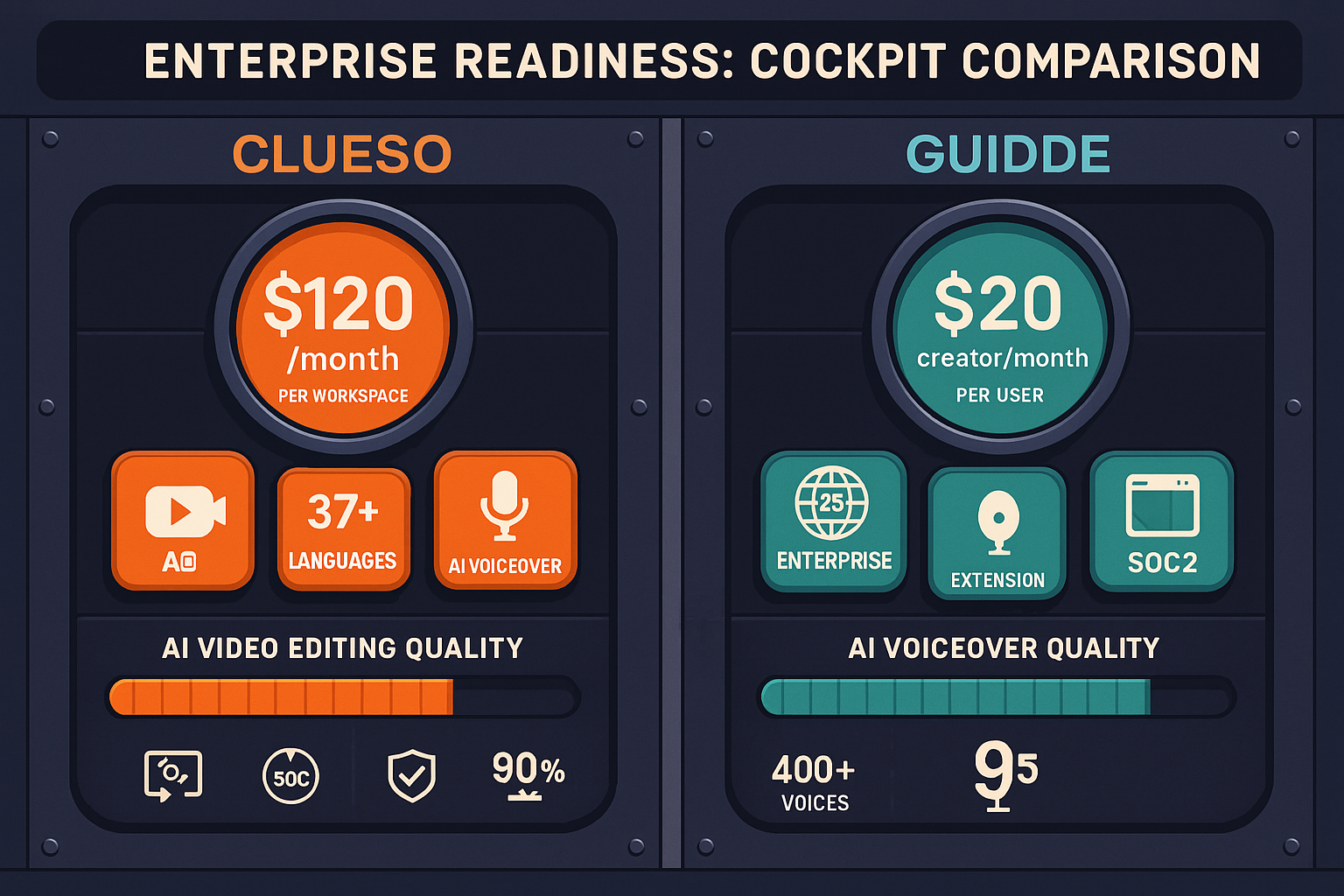
Both tools charge per creator seat monthly. Guidde starts at $20/creator/month, while Clueso's pricing requires direct contact. This per-seat model creates budget pressure as documentation teams scale. An organization with 50 content creators faces $12,000+ in annual costs just for user licenses, before considering enterprise tier features.
More problematically, neither offers workspace or project-based pricing that would allow unlimited collaborators within a fixed cost structure. As documentation becomes democratized across product, support, and customer success teams, seat-based pricing becomes prohibitively expensive.
Content Volume Limitations
Both platforms are optimized for teams producing dozens or perhaps hundreds of tutorial videos annually—not thousands. There's no API access for programmatic content creation, no bulk import capabilities for existing video libraries, and no workflows designed for managing large content repositories.
Input Source Restrictions
The most significant limitation: both tools work exclusively with screen recordings. Neither can process: - Real-world training footage from manufacturing floors - Product demonstration videos shot with cameras - Existing training video libraries created before platform adoption - Mixed-media content combining screen capture with live video
This makes both tools unsuitable for organizations needing comprehensive video documentation across diverse source types.
Who Should Choose What?
Choose Clueso if you need:
- The strongest available compliance profile (SOC 2 Type II + ISO 27001) for regulated industries
- Highest quality AI video editing with professional polish for customer-facing content
- Dual output creating both videos and written articles from screen recordings
- A small team (under 10 people) producing limited training video content annually
Clueso works best for security-conscious SaaS companies with small customer education teams creating polished product tutorials. The compliance certifications justify vendor approval processes, and the video quality ensures professional output without expensive post-production.
Choose Guidde if you need:
- Best-in-class AI voiceover capabilities with 400+ studio voices
- SSO support for centralized identity management
- Quick browser-based capture workflow with Chrome extension
- Role-based access control for team collaboration
- Lower entry price point for small teams
Guidde suits organizations prioritizing ease of use and voice quality over compliance documentation. The SSO integration makes it viable for IT-governed environments, while the browser extension enables rapid content creation without separate recording software.
Choose Docsie if you need:
Neither Clueso nor Guidde addresses enterprise knowledge management requirements. If your organization needs any of the following, you're evaluating the wrong category of tools:
- Multi-tenant architecture delivering one knowledge base to unlimited branded client portals
- Comprehensive security infrastructure with SOC 2 Type II, GDPR compliance, HIPAA-ready controls, multiple SSO methods (SAML, OAuth, OIDC, Azure AD, Okta), EU data residency, audit logs, and 99.9% uptime SLA
- Complete administrative control with granular permissions, version control with inheritance, content approval workflows, and API access with webhooks
- Video conversion from any source—converting training recordings, real-world footage, and screen captures into structured documentation using computer vision and multimodal AI
- Unlimited scale to 10,000+ documentation sites with workspace-based pricing instead of per-creator fees
- Global delivery with 100+ language auto-translation and agentic AI chatbot
Docsie is an enterprise documentation platform, not a video creation tool. It converts existing video libraries—regardless of source—into searchable, structured documentation while providing the multi-tenant delivery, version management, and security controls that enterprise deployments require.
The Bottom Line: Video Tools vs. Documentation Platforms
Clueso and Guidde solve the same narrow problem: creating tutorial videos from screen recordings. Clueso does it with stronger compliance and better automated editing. Guidde does it with superior voice quality and better administrative features. Both work well for small teams with simple video creation needs.
Neither is an enterprise documentation platform.
Enterprise organizations don't just need to create new video tutorials—they need to manage thousands of existing documentation assets, deliver them to multiple customer segments with separate branding, maintain version control across content lifecycles, ensure compliance with industry regulations, and scale to hundreds of contributors without exponential cost increases.
That requires purpose-built knowledge management infrastructure, not specialized video creation tools.
If you're evaluating Clueso and Guidde for enterprise deployment, you've likely outgrown both options before implementation. The question isn't which video tool has better features—it's whether video creation tools can address enterprise knowledge management requirements at all.
For most organizations, the answer is no.
Compare Clueso and Guidde in detail or start a free trial of Docsie to see what enterprise-grade documentation infrastructure actually looks like.