
Archbee vs Trainual: Enterprise Readiness 2026
You're evaluating documentation platforms for your enterprise, and you've encountered two popular names: Archbee and Trainual. Here's what most comparison articles won't tell you upfront—these tools aren't even in the same category. Archbee is a developer documentation platform focused on API references and technical content. Trainual is an employee training and onboarding system built for HR teams and franchise operations. Comparing them is like comparing a CRM to an email marketing tool—they solve fundamentally different problems.
For enterprise decision-makers, this creates a critical blind spot. If you're searching for a solution to deliver documentation to multiple clients, orchestrate knowledge across implementation teams, or scale documentation delivery to hundreds of branded portals, neither platform was designed for your use case. Let's break down what each tool actually does, where they excel, and what enterprises truly need when documentation becomes a strategic delivery mechanism rather than an internal reference library.
What Is Archbee? Developer Documentation for Technical Teams
Archbee markets itself as a product and API documentation platform for developer teams. It's designed for software companies that need to publish technical documentation, API references, and developer guides with OpenAPI/Swagger integration. The platform features a clean, modern UI that appeals to engineering teams, and it advertises an attractive entry price of $50/month.
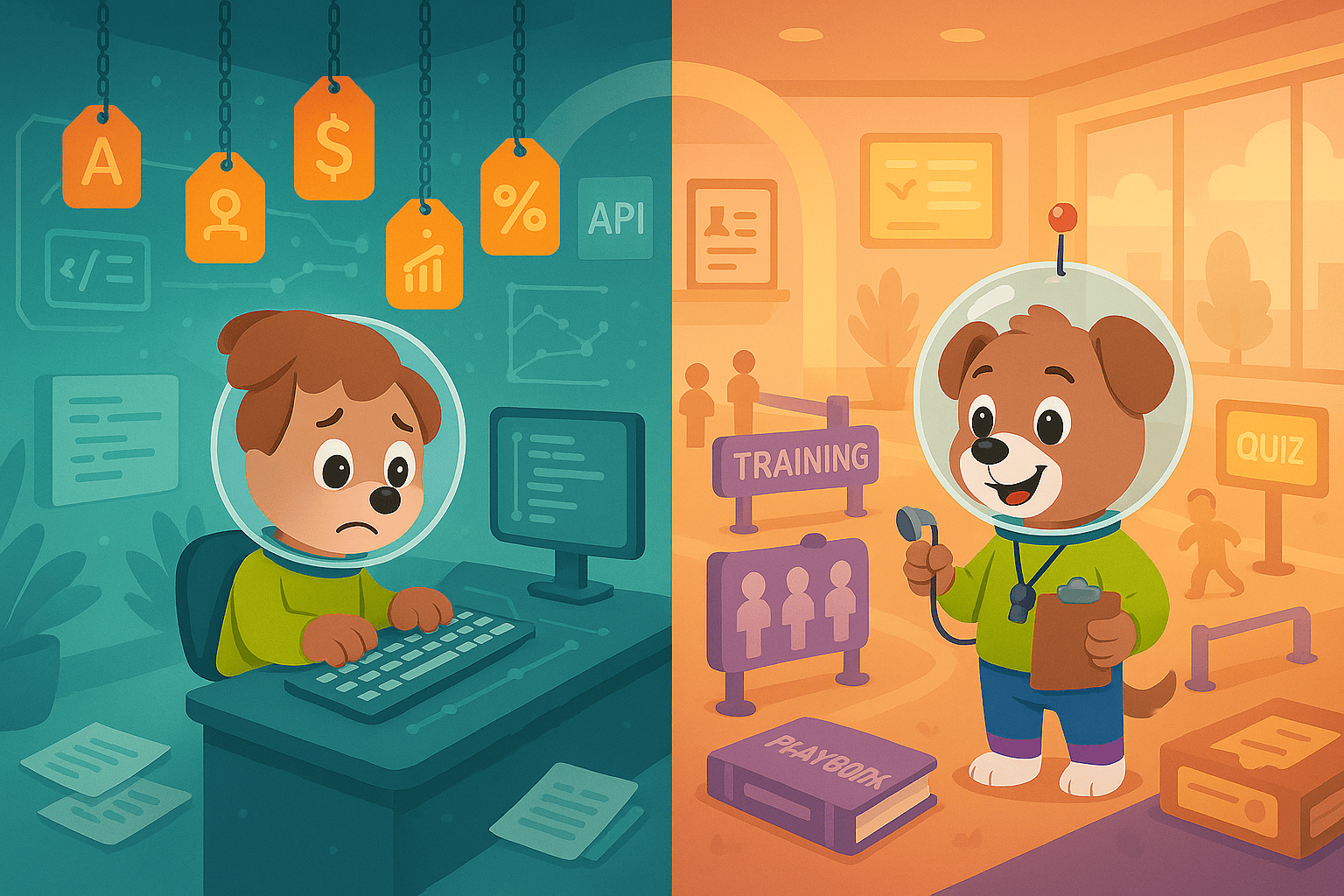
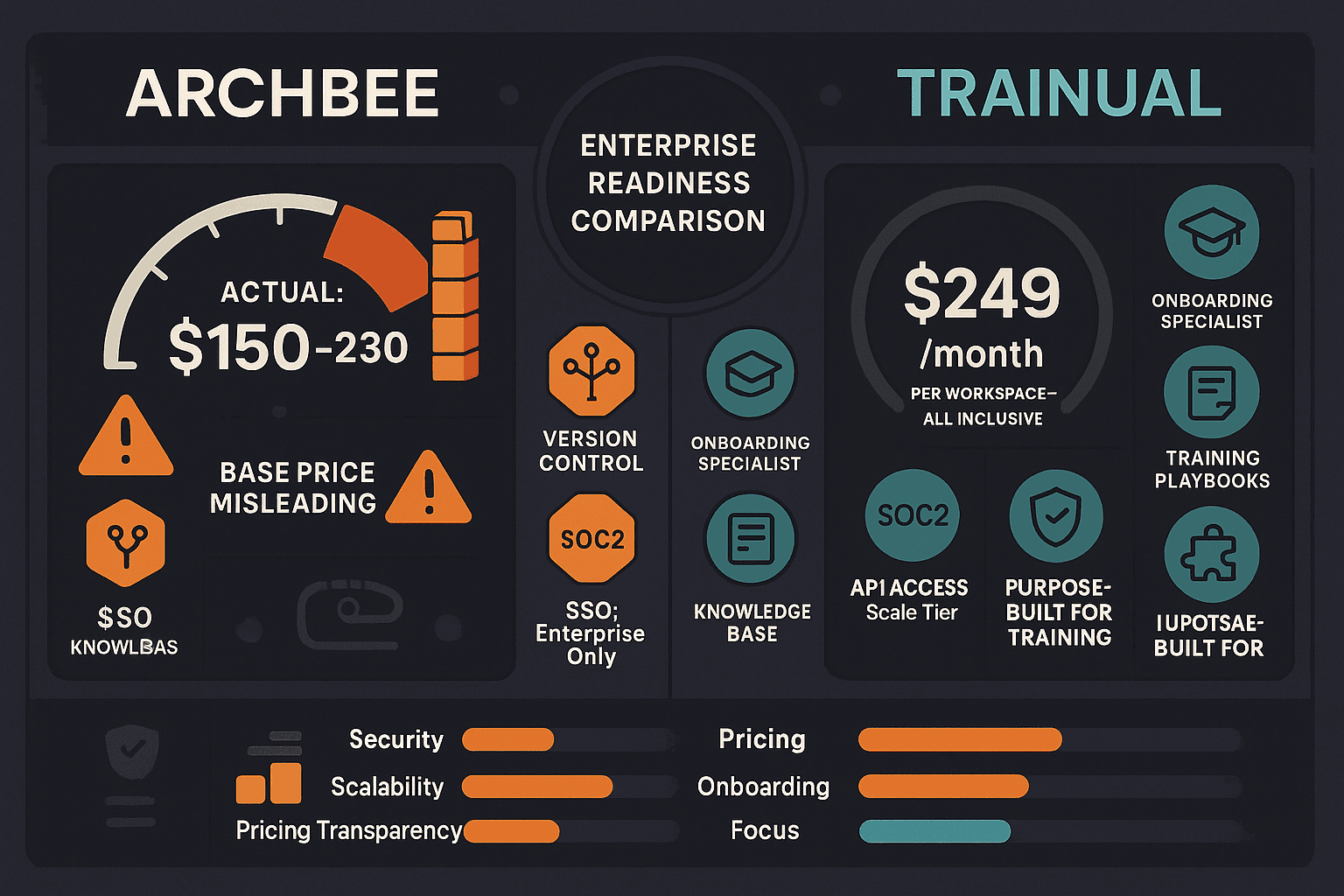
Here's the catch: That base price is highly misleading. The $50/month tier doesn't include AI-assisted writing ($20/month add-on), analytics ($80/month add-on), API access, or the App Widget. For a realistic deployment with the features most teams actually need, you're looking at $150-230/month. Archbee is fundamentally a single-tenant solution—it serves one documentation site for one team. If you're an implementation partner managing documentation for 20 clients, you'd need 20 separate Archbee accounts, each with its own billing, administration, and access control.
For what it's designed to do—technical documentation for a single product or API—Archbee performs well. It offers up to 5 years of version history, excellent OpenAPI integration, and a developer-friendly authoring experience. But it's not built for enterprise knowledge orchestration, multi-client delivery, or the operational complexity of agencies and consulting firms serving external customers.
What Is Trainual? Employee Training, Not Documentation
Trainual serves an entirely different market. It's an employee onboarding and standard operating procedure (SOP) platform built for HR teams, franchise operations, and multi-location businesses. Trainual excels at creating structured training playbooks, tracking employee completion rates, delivering quizzes for compliance verification, and integrating with HRIS systems like BambooHR, Gusto, and Rippling.
This is not a documentation platform. Trainual is purpose-built for internal employee training workflows. It tracks who completed which training module, assigns role-based learning paths, and ensures new hires follow a structured onboarding curriculum. If your use case involves documenting product features for external customers, creating user guides for software implementations, or delivering technical knowledge to clients, Trainual isn't designed for that scenario.
Trainual's AI content generation helps HR teams build training materials faster, and its completion tracking satisfies compliance requirements. But it offers no multi-tenant client portals, no video-to-documentation conversion, and no architecture for delivering branded knowledge bases to external audiences. It's an internal training system, not an external documentation delivery platform.
Enterprise Readiness: Where Both Tools Fall Short
Multi-Tenant Architecture and Client Portal Management
Enterprise implementation partners, SaaS companies serving multiple customers, and consulting firms need to deliver documentation to dozens or hundreds of clients—each with their own branding, access controls, user permissions, and content variations. This requires multi-tenant architecture where one centralized system manages multiple isolated client portals.
Neither Archbee nor Trainual offers this capability. Archbee's single-tenant design means each client requires a separate account, separate billing, and separate administration. Trainual's internal training focus means external client portals aren't part of the product roadmap at all. For enterprises managing 50+ client documentation portals, this architectural limitation creates unsustainable operational overhead and makes centralized content governance impossible.
Knowledge Orchestration and Content Reuse at Scale
Enterprise documentation isn't a collection of isolated articles—it's an orchestrated knowledge system where content blocks, templates, and procedures are reused across multiple contexts, versions, and client deliverables. Pharmaceutical companies need to maintain regulatory documentation across product lines. Software implementation partners need to customize deployment guides for each client while maintaining consistent core content. Manufacturing firms need to version technical manuals for equipment variants while ensuring regulatory compliance.
Archbee handles version control for a single documentation site, but it doesn't provide the content reuse architecture necessary for enterprise knowledge orchestration. Trainual's training playbook model isn't designed for content reuse across external audiences—it's built for internal role-based training paths. Neither platform addresses the fundamental challenge of maintaining one source of truth that dynamically generates hundreds of customized documentation deliverables.
Enterprise Security, Compliance, and Administration
Enterprise buyers require SOC 2 compliance, GDPR readiness, HIPAA-capable infrastructure, and granular audit logging. They need SSO integration with Azure AD, Okta, SAML, OAuth, and OIDC. They need role-based access control (RBAC) with granular permissions at the document, section, and workspace level. They need 99.9% uptime SLAs backed by infrastructure redundancy.
Archbee offers basic team permissions and version history but lacks enterprise-grade audit logging, advanced SSO options, and the compliance certifications required for regulated industries. Trainual focuses on HRIS integrations for employee workflows, not the security infrastructure demanded by enterprise procurement teams. For organizations in healthcare, finance, or government sectors, these gaps are dealbreakers that no amount of feature customization can overcome.
Video-to-Documentation Conversion and Content Transformation
Modern enterprises capture knowledge in multiple formats—training videos, screen recordings, customer support calls, field technician footage, subject matter expert interviews. The ability to convert video content into searchable, structured documentation eliminates weeks of manual transcription and editing.
Neither Archbee nor Trainual offers video-to-documentation capabilities. Archbee expects written content authored in its editor. Trainual supports video uploads within training modules but doesn't extract that content into searchable documentation. For enterprises sitting on hundreds of hours of training videos, product demonstrations, and recorded procedures, this represents a massive knowledge asset that remains locked in unsearchable video formats.
Who Should Choose What?
Choose Archbee If...
You're a software company with a single technical team that needs to publish developer documentation and API references. Your primary use case is documenting one product for one developer audience, and you're comfortable with $150-230/month pricing once you add the necessary features. You value OpenAPI/Swagger integration and need up to 5 years of version history. You're not managing documentation for multiple clients or external customers—this is purely for your own product's technical documentation.
Choose Trainual If...
You're an HR team, franchise operation, or multi-location business focused on employee onboarding and internal training. You need completion tracking, quiz functionality, and integration with HRIS systems. Your goal is structured training playbooks for new hires, role-based learning paths for different positions, and compliance verification for regulatory requirements. You're documenting internal processes for employees—not delivering knowledge to external clients or customers.
Choose Docsie If...
You need enterprise knowledge orchestration that delivers documentation to multiple clients from one centralized system. You're an implementation partner, consulting firm, SaaS company, or enterprise organization managing documentation for dozens or hundreds of external audiences. You need video-to-documentation conversion to unlock knowledge trapped in training videos and screen recordings. You require 100+ language auto-translation for global documentation delivery. You demand enterprise security with SOC 2, GDPR, HIPAA-readiness, SSO (SAML/OAuth/OIDC/Azure AD/Okta), audit logs, and 99.9% uptime SLAs.
You need to scale to 10,000+ documentation sites with API access, webhooks, and custom integrations. You need content reuse, version control, and multi-tenant architecture that makes centralized governance possible while delivering customized client experiences. You need a knowledge orchestration platform—not just a documentation editor.
The Real Enterprise Documentation Challenge
The fundamental gap that both Archbee and Trainual leave unaddressed is enterprise knowledge orchestration for multi-client delivery. Modern implementation partners, consulting firms, and enterprise software companies don't just need to document their own products—they need to deliver customized, branded documentation to each client they serve, often numbering in the hundreds.
This requires architecture that neither competitor provides:
- Multi-tenant portals where one system manages hundreds of isolated client documentation sites
- Content transformation pipelines that convert videos, recordings, and unstructured content into searchable documentation
- Global localization with automated translation into 100+ languages
- Enterprise security and compliance with SOC 2, GDPR, HIPAA-readiness, and advanced SSO
- Scalable infrastructure supporting 10,000+ sites with API access and webhook integrations
Archbee serves technical teams documenting their own products. Trainual serves HR teams training their own employees. Neither serves enterprises delivering knowledge to external clients at scale.
Why Docsie Fills the Gap Both Competitors Leave
Docsie was purpose-built for enterprise knowledge orchestration across multiple clients, languages, and delivery contexts. While Archbee handles single-tenant developer docs and Trainual manages internal training, Docsie provides the multi-tenant architecture that implementation partners actually need.
Convert training videos into structured documentation with video-to-docs AI. Deliver branded portals to 500 clients from one centralized system. Auto-translate into 100+ languages for global deployment. Enforce enterprise security with SOC 2, GDPR, HIPAA-readiness, granular RBAC, audit logs, and SSO integration with Azure AD, Okta, SAML, and OAuth. Scale to 10,000+ documentation sites with 99.9% uptime SLAs.
For a detailed feature-by-feature breakdown, see our comprehensive Archbee vs Trainual enterprise comparison.
The difference isn't just features—it's architectural. Docsie was designed from the ground up for enterprises that deliver documentation as a service to external clients. If your organization manages knowledge delivery at scale, the choice becomes clear once you understand what enterprise knowledge orchestration actually requires.
Ready to See Enterprise Documentation Done Right?
Stop forcing single-tenant tools into multi-client workflows. Experience documentation infrastructure built for enterprise scale, security, and global delivery.
Start your free Docsie trial today and discover what enterprise knowledge orchestration actually looks like—no credit card required.