
Archbee vs ReadMe: Which Documentation Platform Is Actually Enterprise-Ready in 2026?
Choosing documentation software feels deceptively simple until you start comparing enterprise requirements. You need developer-friendly API docs, yes—but you also need compliance certifications, audit logs, scalability guarantees, and support SLAs that won't leave you stranded during a critical product launch. The difference between a tool that works for a startup and one that's truly enterprise-ready often only becomes clear after you've already committed.
Archbee and ReadMe both target developer-focused documentation with strong API capabilities, but how do they actually stack up when evaluated against enterprise criteria? Let's cut through the marketing and examine what these platforms really deliver for large organizations.
About Archbee: Developer Documentation With a Pricing Catch
Archbee positions itself as a "Product and API Documentation for Dev Teams" platform with an attractive $50/month entry point. The clean, modern interface and OpenAPI/Swagger support make it appealing for technical teams who need to ship API documentation quickly.
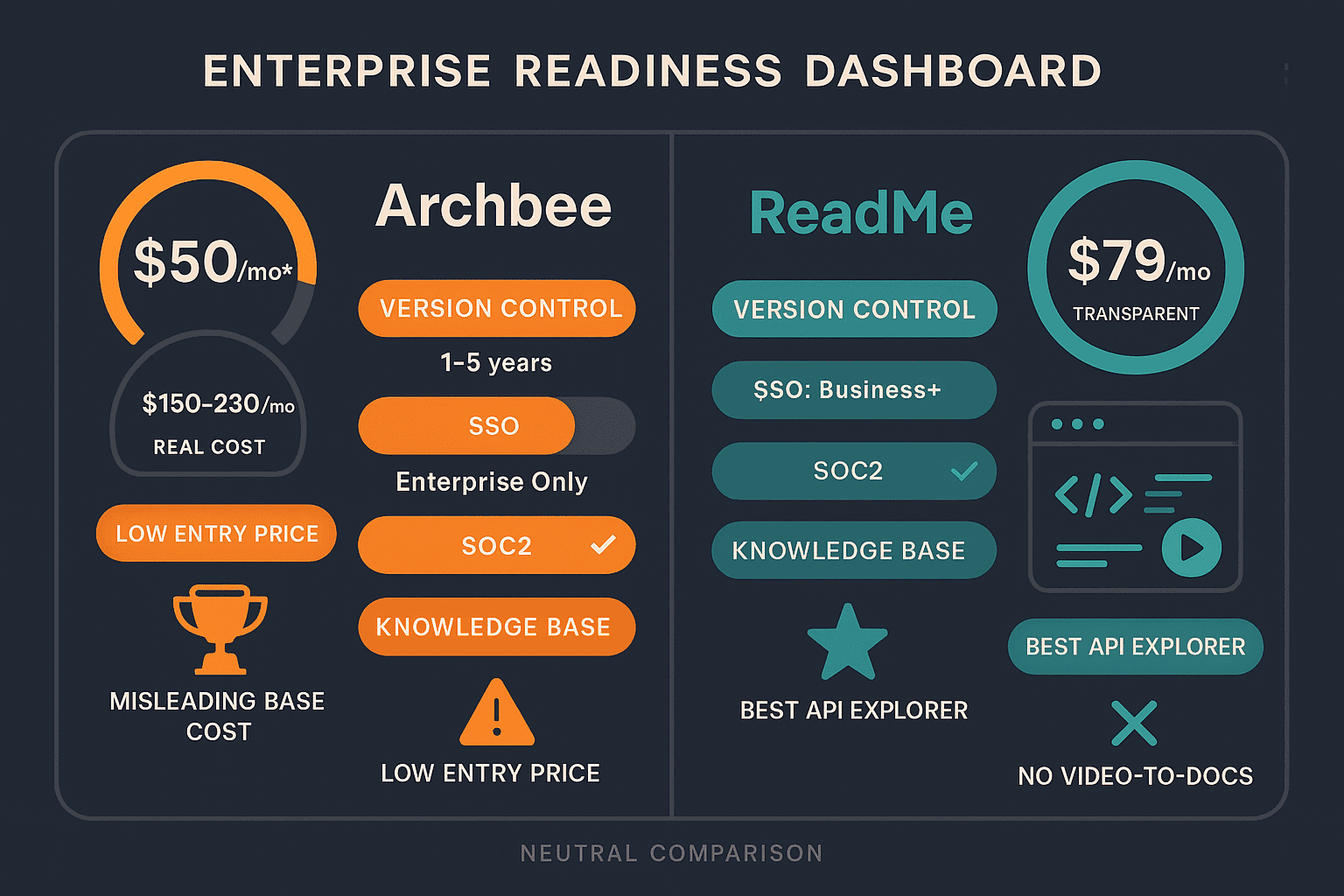
Here's the reality check: that $50/month base price is highly misleading. AI Write Assist costs an extra $20/month. Analytics? Another $80/month. API Access and App Widget are also separate paid add-ons. Once you add the features most teams actually need, you're looking at $150-230/month—still reasonable, but nowhere near the advertised price. This add-on pricing structure creates budget uncertainty and makes it difficult to forecast total cost of ownership as your documentation needs grow.

About ReadMe: Premium API Documentation at Premium Prices
ReadMe has established itself as the premium choice for interactive API documentation. The platform's signature feature—a best-in-class API explorer that lets developers test API calls directly within the documentation—sets it apart in the developer portal space.
In October 2025, ReadMe launched Agent Owlbert AI, which includes documentation linting and style consistency enforcement. Combined with Ask AI search for developer Q&A and excellent versioning for multi-version APIs, ReadMe delivers a comprehensive developer documentation experience.
The tradeoff? Cost. ReadMe's Enterprise tier starts at $3,000+/month, making it one of the most expensive documentation platforms in the category. You're paying for brand recognition, proven scalability, and the most polished interactive API experience available—but smaller teams and mid-market companies may struggle to justify the investment.
Enterprise Readiness: The Critical Dimensions
Security & Compliance
For enterprise buyers, security compliance isn't optional—it's a gatekeeper requirement. Both Archbee and ReadMe meet basic security standards with SOC 2 Type II certification, but that's where the similarities end.
The critical gaps both platforms share: Neither offers audit logs outside expensive Enterprise tiers, neither provides data residency options (crucial for GDPR and data sovereignty requirements), and neither is HIPAA-ready for healthcare or life sciences documentation needs.
Archbee provides version history up to 5 years, which helps with compliance documentation requirements. ReadMe offers similar version control with its superior versioning architecture designed specifically for managing multi-version APIs.
But here's what's missing: granular audit trails showing who accessed what documentation when, geographic data storage guarantees for EU customers, and the compliance frameworks necessary for regulated industries. For organizations in healthcare, finance, or government sectors, these aren't nice-to-haves—they're deal-breakers.
Scalability & Architecture
ReadMe demonstrates stronger enterprise maturity in scalability. Its established market presence with major tech companies proves it can handle high-traffic developer portals. The versioning architecture was purpose-built for organizations managing multiple API versions simultaneously—a common requirement as developer ecosystems mature.
Archbee scales adequately for most use cases, but lacks the proven track record with enterprise-scale deployments that ReadMe has accumulated. More importantly, neither platform offers multi-tenant portal architecture—the capability to deliver unlimited branded client portals from a single knowledge base.
This architectural limitation matters enormously for SaaS companies, managed service providers, and enterprises with multiple customer segments. If you need to provide customized documentation portals to different client groups while managing content centrally, neither Archbee nor ReadMe can deliver that capability.
Administration & User Management
Both platforms support Single Sign-On (SSO) via SAML and other enterprise identity providers, which is table stakes for enterprise software. Both offer role-based permissions, though the sophistication varies by pricing tier.
Archbee includes review workflows even in lower tiers, which is a genuine advantage for teams that need approval processes without jumping to Business-level pricing. ReadMe's collaborative features are solid but tend to require higher-tier plans for advanced workflows.
The administrative gap both share: limited support SLAs outside expensive Enterprise tiers, no dedicated customer success management for mid-market customers, and no advanced user management capabilities like automated provisioning or SCIM support.
Developer Experience & API Documentation
This is where both tools shine and justify their market positioning.
ReadMe's advantages: - The interactive API explorer remains unmatched—developers can test API calls with real credentials directly in the documentation - Agent Owlbert AI provides automated documentation linting and style consistency enforcement - Ask AI search helps developers find answers faster - Versioning handles complex multi-version API scenarios elegantly
Archbee's advantages: - Strong OpenAPI/Swagger integration at lower price points - Clean, distraction-free interface that developers appreciate - Good version control (up to 5 years) - Review workflows without enterprise pricing
Neither platform offers video-to-docs conversion capabilities, which limits their usefulness for training documentation, onboarding materials, or product walkthroughs that combine code and visual demonstration.
Pricing Reality Check
Archbee's advertised $50/month base price becomes $150-230/month once you add essential add-ons: - AI Write Assist: +$20/month - Analytics: +$80/month - API Access: additional cost - App Widget: additional cost
ReadMe's transparent but premium pricing starts much higher: - Basic tiers for smaller teams - Enterprise at $3,000+/month for full capabilities
The pricing models reflect different strategies: Archbee uses low-price acquisition with add-on revenue expansion, while ReadMe positions as a premium product from the start. Neither approach is inherently wrong, but the lack of pricing transparency in Archbee's model creates budget planning challenges.
Who Should Choose What?
Choose Archbee if you need...
Lower-cost developer documentation for small technical teams with limited budget. If you're a startup or small dev team documenting APIs and you can live with the base feature set, Archbee's real cost of $150-230/month (with necessary add-ons) is reasonable.
OpenAPI/Swagger integration for API docs with good version history. The up-to-5-year version history and solid OpenAPI support make Archbee capable for API documentation needs, assuming you don't require the interactive testing capabilities ReadMe provides.
Review workflows and basic collaboration without Business tier pricing. Unlike many competitors, Archbee includes approval workflows at lower pricing tiers, which helps teams maintain documentation quality without enterprise-level investment.
Choose ReadMe if you need...
Best-in-class interactive API explorer for external developer portals. If you're building a public developer ecosystem where API testing in documentation is critical, ReadMe's interactive explorer justifies the premium pricing.
Proven scalability and brand recognition in developer ecosystem. ReadMe's established presence with major tech companies provides confidence in its ability to scale with your developer community.
Agent Owlbert AI for documentation linting and style consistency. The October 2025 launch of Agent Owlbert adds genuine value for teams struggling to maintain consistent documentation quality across multiple contributors.
Excellent versioning architecture for multi-version API management. If you're managing complex multi-version API scenarios with different customer segments on different versions, ReadMe's versioning was purpose-built for this challenge.
The Enterprise Gap Both Platforms Share
Here's what's missing from both Archbee and ReadMe for true enterprise readiness:
- No audit logs outside expensive Enterprise tiers
- No data residency options for GDPR and data sovereignty compliance
- No HIPAA-ready compliance for healthcare and life sciences
- No multi-tenant portal architecture for delivering branded client portals
- No video-to-docs conversion for training and onboarding content
- Limited multilingual capabilities for global documentation at scale
- No comprehensive compliance framework with SOC 2 + GDPR + HIPAA-ready simultaneously
The Better Alternative: Docsie for Complete Enterprise Readiness
For organizations evaluating Archbee and ReadMe and finding gaps in both, Docsie delivers true enterprise readiness beyond developer documentation.
Docsie provides what both competitors lack:
Complete compliance foundation: SOC 2 Type II, GDPR compliance, HIPAA-ready capabilities, audit logs, and EU data residency—all included, not locked behind enterprise tiers.
Multi-tenant portal architecture: Deliver unlimited branded client portals from one knowledge base. This capability—which neither Archbee nor ReadMe offers—transforms how SaaS companies, MSPs, and enterprises deliver documentation to different customer segments.
Full knowledge orchestration workflow: Video-to-docs conversion, 100+ language auto-translation, enterprise-grade administration, and comprehensive content management that goes beyond just API documentation.
Transparent pricing: $170-$750/month with all core features included. No surprise add-ons, no hidden costs, just honest pricing that scales to 10,000+ documentation sites.
Enterprise support: Dedicated customer success, custom SLAs, SSO (SAML/OAuth/OIDC/Azure AD/Okta), granular permissions, and API access with webhooks.
Archbee and ReadMe excel at developer-facing API documentation. But enterprise knowledge management requires more than excellent API docs—it requires compliance, multi-tenancy, global scale, and transparent pricing. Docsie addresses the gaps both competitors share while delivering superior value for enterprise buyers who need comprehensive organizational knowledge management.
Make Your Decision With Complete Information
The choice between Archbee and ReadMe ultimately depends on your primary use case and budget. Archbee offers lower-cost entry (with add-on caveats) for basic developer documentation. ReadMe delivers premium API explorer capabilities at premium prices.
But if you're evaluating these platforms because you need true enterprise readiness—compliance certifications, multi-tenant portals, global scale, transparent pricing, and comprehensive support—you should evaluate Docsie before committing to either option.
See the complete feature-by-feature breakdown in our detailed Archbee vs ReadMe enterprise comparison, then start your free Docsie trial to experience what enterprise-ready documentation software actually looks like.