
Archbee vs ReadMe: Feature Comparison 2026
Choosing documentation software isn't just about finding a place to store your docs. It's about understanding whether your team needs basic API documentation, interactive developer portals, or something more ambitious—like converting video training into searchable knowledge bases or managing documentation for dozens of clients from a single platform. The wrong choice means either overpaying for features you'll never use or hitting painful limitations six months in when your needs expand.
Archbee and ReadMe represent two different approaches to developer-focused documentation. Archbee advertises an attractive entry price that quickly escalates once you add necessary features. ReadMe offers premium interactive API experiences with transparent pricing from the start. Both excel at technical documentation for development teams, but neither addresses the broader enterprise challenges of multi-tenant delivery, video-to-documentation workflows, or knowledge orchestration at scale.
Let's break down what each platform actually delivers—and where they both fall short.
What Is Archbee?
Archbee positions itself as a product and API documentation platform for dev teams with a compelling headline: a $50/month starting price. The platform supports OpenAPI/Swagger documentation, offers a clean modern interface, and handles the basics of developer documentation well enough.
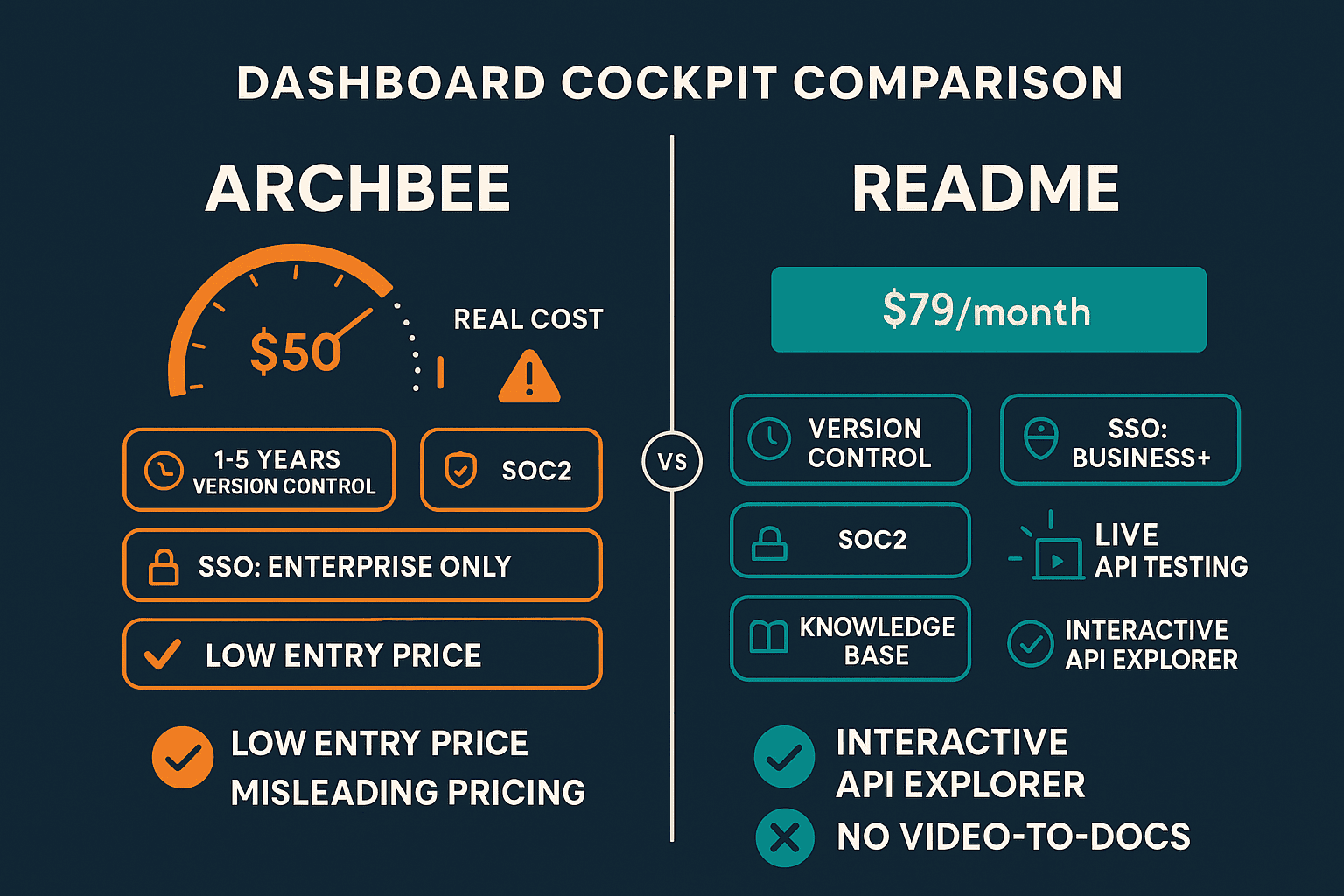
But here's the catch: that base price doesn't include AI writing assistance ($20/month extra), analytics ($80/month extra), embeddable widgets, or API access. What looks like a budget-friendly option becomes a $150-230/month commitment once you add the features most teams actually need. For small technical teams genuinely willing to work without these capabilities initially, Archbee offers a legitimate low entry point. For everyone else, the advertised pricing creates false expectations that evaporate during the purchasing process.
What Is ReadMe?
ReadMe is a premium API documentation platform built specifically for companies creating developer portals. Its signature feature is the interactive API explorer—allowing developers to test API calls directly within the documentation itself. ReadMe doesn't pretend to be budget software; it's positioned as best-in-class tooling for companies serious about their developer experience.
In October 2025, ReadMe launched Agent Owlbert AI, adding intelligent doc linting, style consistency enforcement, and Ask AI search capabilities. The platform excels at versioning for multi-version APIs, changelog management, and maintaining branded developer hubs. At the Enterprise tier, pricing climbs above $3,000/month, but you're getting transparent premium tooling without hidden add-on fees. ReadMe knows what it is and prices accordingly.
Feature Comparison: Where They Differ
Pricing Philosophy and Total Cost of Ownership
Archbee's advertised $50/month base price is technically accurate but functionally misleading. Teams evaluating Archbee should calculate their real cost based on necessary add-ons:
- Base price: $50/month
- AI Write Assist: +$20/month
- Analytics: +$80/month
- App Widget and API Access: Additional fees
Most teams land between $150-230/month once properly configured, which eliminates much of the apparent price advantage over competitors.
ReadMe takes the opposite approach: higher upfront pricing with premium features included. You're not paying separately for AI capabilities, analytics, or API explorers—they're part of the package. At Enterprise scale ($3,000+/month), ReadMe becomes expensive, but the pricing is transparent and predictable. You know what you're getting and what it costs.
Neither platform offers workspace-based pricing that scales gracefully. Both rely on traditional per-seat or tier-based models that create cost anxiety as teams grow.
API Documentation and Developer Experience
This is where both platforms shine—and why they've earned their reputations in the developer tools ecosystem.
ReadMe's interactive API explorer is genuinely best-in-class. Developers can test API endpoints directly in the documentation, see live responses, and troubleshoot integration issues without switching tools. For companies building public APIs or developer platforms, this creates a materially better onboarding experience. Agent Owlbert AI adds intelligent linting that catches inconsistencies, enforces style guidelines, and improves documentation quality automatically.
Archbee handles OpenAPI/Swagger documentation competently with good visual presentation and clear navigation. The documentation experience is clean and developer-friendly, but it lacks the interactive testing capabilities that make ReadMe stand out. For internal API documentation where developers already have access to testing environments, Archbee delivers sufficient functionality. For public-facing developer portals where first impressions matter, ReadMe has the edge.
Both platforms handle versioning and branching for documentation that needs to track multiple product versions, though ReadMe's implementation is more mature with better strategies for managing complex version relationships.
AI Capabilities and Content Intelligence
ReadMe's Agent Owlbert AI suite (launched October 2025) represents a more comprehensive approach to AI-assisted documentation:
- Doc linting catches inconsistencies and quality issues
- Style consistency enforcement maintains voice across contributors
- Ask AI search helps developers find answers conversationally
These capabilities are included in ReadMe's pricing, not sold as separate add-ons.
Archbee's AI Write Assist costs $20/month extra and focuses primarily on content generation rather than quality enforcement or search intelligence. If you're paying for the add-on, it's functional. But the fact that AI is an optional extra in 2026—when AI-assisted documentation has become table stakes—reveals Archbee's pricing strategy of maximizing per-feature revenue.
What Both Platforms Don't Do
Neither Archbee nor ReadMe addresses several critical enterprise documentation needs:
Video-to-documentation conversion: Neither platform helps you transform training videos, product demos, or recorded workshops into searchable, structured documentation. Teams with substantial video content libraries are left converting manually or using external tools.
Multi-tenant client portals: Both platforms assume you're documenting your own product. Neither offers architecture for consultancies, implementation partners, or agencies that need to deliver branded documentation portals to dozens or hundreds of different clients from a single system.
Knowledge orchestration at scale: Enterprise implementation partners (SAP consultancies, Workday specialists, Salesforce agencies) need to manage knowledge bases across multiple client engagements, coordinate updates across teams, and deliver customized documentation efficiently. Neither Archbee nor ReadMe is built for this use case.
Multilingual documentation at scale: While both platforms support some translation workflows, neither offers automated translation across 100+ languages—a requirement for global enterprises delivering documentation worldwide.
Who Should Choose What?
Choose Archbee if you need...
The absolute lowest entry price for basic API documentation with OpenAPI support, and you're genuinely comfortable starting without analytics, embeddable widgets, or AI assistance. Archbee works for small technical teams (under 5 people) on tight budgets who can live with the base feature set initially and add capabilities later.
Built-in review workflows are available without upgrading to Business tier, which creates workflow value that some competitors lock behind higher pricing.
Choose ReadMe if you need...
Best-in-class interactive API documentation where developers can test endpoints live within your docs. If you're building a public API or developer platform where the documentation experience directly impacts adoption, ReadMe's interactive explorer justifies the premium pricing.
Agent Owlbert AI delivers genuine value for teams maintaining large documentation sets where consistency and quality matter. The Ask AI search helps developers find answers conversationally rather than navigating hierarchical documentation structures.
Established brand credibility matters if you're in a competitive developer tools space where your documentation platform reflects your technical sophistication.
Choose Docsie if you need...
Video-to-documentation conversion from training videos, not just API docs. Many enterprise teams have substantial knowledge locked in recorded training sessions, product demos, and workshop recordings. Docsie transforms this content into searchable, structured documentation automatically.
Multi-tenant portals delivering branded knowledge bases to multiple clients from one system. Implementation partners, consultancies, and agencies need architecture that scales across dozens or hundreds of client engagements—not just single-product documentation.
Enterprise knowledge orchestration for teams managing documentation across multiple client implementations. Coordinate updates, maintain version control, and deliver customized documentation efficiently without maintaining separate systems per client.
100+ language auto-translation for global documentation delivery. Docsie handles multilingual documentation at enterprise scale, automatically translating content across languages without manual coordination.
Complete CONVERT → MANAGE → DELIVER workflow that goes beyond developer documentation to address the full documentation lifecycle including content conversion, knowledge management, and multi-client delivery.
Workspace-based pricing that scales without per-seat inflation: $170/month for 15 users with all features included. No add-on fees for AI, analytics, or essential capabilities.
The Verdict: Think Beyond API Documentation
Archbee and ReadMe are both competent developer-focused documentation platforms. ReadMe delivers premium interactive experiences with transparent pricing. Archbee offers a low entry point that becomes expensive with necessary add-ons. Both excel at technical API documentation.
But most enterprise documentation challenges extend beyond API reference pages. Implementation partners need to convert video training into documentation. Consultancies need multi-tenant portals for different clients. Global companies need automated translation. Growing teams need pricing that doesn't inflate per-seat.
For teams whose needs genuinely begin and end with API documentation, both Archbee and ReadMe deliver functional solutions. For everyone else—especially enterprise implementation partners, consulting firms, and companies managing knowledge orchestration at scale—Docsie addresses the broader documentation lifecycle that both Archbee and ReadMe ignore.
Ready to see what enterprise documentation management looks like beyond API reference pages? Start your free Docsie trial and experience video-to-docs conversion, multi-tenant delivery, and 100+ language translation in a single platform built for teams managing knowledge at scale.